Join the discussion

Write your take first — we'll ask for email only when you're ready to publish.

  • Hacker News
  • Real estate.

    That is what those "useless pieces of paper" are good for.

    They send us goods, tools, food; we give them pieces of paper; true. I guess they could invest in their own people, pay them well, give them better education. Nope, they're doing "business," they're doing the capitalist game, not the patriot one. What to do with that useless money, lots and lots of it? Buy the most stable stuff: land. Businesses. Just look around... Housing crisis? Where do you think that is coming from? One, ever-more-rich carpetbaggers benefiting from government programs that were supposed to benefit the workers, two, India, China, Vietnam, "poor" countries where the wealthy run the game worse than here and have even less respect for people than POTUS ever could. And of course the oil sheiks, about whom we hear when they get some fashionable property, like the top Europe soccer teams, but otherwise are just quietly parking those "useless dollars" to their best interest.

  • >You legs may have a comparative advantage at running

    that's not what comparative advantage means except in a degenerate sense.

    if country A is worse than country B in both making clothes and making paper, their comparative advantage is in the product which they are less worse at; they can maximize their GDP making that product.

  • I think a lesson is going to be taught, all right.

    Unfortunately the feedback loop in nations is much slower than in bodies.

  • That’s the whole trick: if the feedback cycle is long enough, the next person gets blamed for it, not the current.
  • Doesn't feel realistic. The comic version at least makes sense at some level; the real-world one doesn't.

    The real world version is "they're ripping us off by giving us cheap stuff that our producers can't compete with on price." Which is arguably a problem, yes, but the one thing it's not is a "ripping us off" problem.

  • The real world version is even funner because it's not about receiving cheap stuff, rather the complaint is about receiving free stuff (trade deficit).
  • If tariffs are so obviously and universally bad, then why do tariffed countries respond with retaliatory tariffs instead of letting the first country shoot themselves in the foot and getting on with their own business?
  • During Trump 1.0, retaliatory tariffs were targeted at swing states. E.g., on Harley-Davidsons manufactured in Wisconsin. The goal was to make it politically painful to the president and undermine his reelection chances.

    I imagine Carney is picking industries that are assymetricly painful to the USA or, since Trump isn’t up for re-election, congressional Republicans.

  • If punching random people on the street is so obviously bad, then why do people fight back when I do it?
  • Because the other non-isolationist countries have the rest of the world to trade with. Their tariffs on USA don't make all of their imports more expensive, only redirect trade to other countries.
  • Political pressure works? The immediate pain from tariffs is quite different from the long-term loss.
  • 1) (all) tariffs aren't obviously and universally bad, only when applied universally without any coherent long term goal/strategy.

    2) retaliatory tariffs are targeting the hostile actor, not widely against all (other) trading partners, thus redirecting trade towards less hostile country.

  • The broader tariffs are the worse they are. Targeted tariffs can have a function but if targeted at a country that function isn't an economic good for either country it's only good as a political tool. You could argue that industries that you are the second cheapest in compared to that country could reap some benefits from supplying local markets (but not if there are other countries cheaper than your own that aren't also tariffed that can supply more of the demand) and then a targeted tariff may make some (long term) economic sense.

    Targeted tariffs can have more nuanced effects. You'll notice that Canadian politicians are talking about targeting red states with their tariffs. These tariffs will also economically hurt Canada, but you won't see a retaliatory tariff on things that hurt Canada disproportionately which would be the case with universal tariffs. You can expect them to pick luxury industries (like they did with bourbon) where preferences can be changed or industrial/commercial ones where (preferably) local or other suppliers are near parity with the US rather than say gasoline.

  • Tariffs (and retaliatory tariffs) can be universally economically negative and still be rationally pursued by individual politicians.

    For example: if Donald Trump tariffs the country you are in charge of, you are likely willing to pay the economic cost of a retaliatory tariff to seem like you are standing up to America to your constituents. The politician’s goal is to be re-elected.

    The politician may aim to deter getting tariffed in the first place, and promising a retaliatory tariff if another country tariffs you first is also reasonable as a deterrent from a game-theoretical perspective.

    All it takes is for one world leader to not understand or care about the clear economic negatives to tariffs to start the chain: everyone else can be a rational actor.

  • Maybe reducing trade with a country that is taking bad/strange/stupid decisions might be worth it. If your industry can change some trade partners (and diversify) it might a plus.

    In Canada's case the reliance of one trade partner (see https://atlas.hks.harvard.edu/explore/overtime/?exporter=cou... ) is probably a weakness that retaliatory tariffs can influence.

  • i'm a little bit confused by the current news. I thought the supreme court said the tariffs are illegal without congressional approval and the government started refunding the money.

    now the news is full of all these tarriffs about canada?

    What's the factual non-partisan reasoning by which trump has been found not to have the power to create tarriffs, but is still doing it with canada?

  • Even if it's illegal, who's stopping him?

    Until anyone does, "crime is legal", as coffeezilla says.

  • > I thought the supreme court said the tariffs are illegal without congressional approval

    The ruling wasn't as generalised as that. What it said was that the president doesn't have the authority to impose tariffs under the provisions of the International Emergency Economic Powers Act, which Trump had cited as the basis for some tariffs. That made those tariffs effectively illegal, but the ruling said nothing about tariffs which had other legislative provisions as their legal basis. The tariffs that you see today cite some other rule as their basis rather than the IEEPA.

  • The Trump Administration first used the International Emergency Economic Powers Act to declare a national economic emergency and impose tariffs on countries under the pretence that they were economic threats to America.

    The Supreme Court ruled against the tariffs because while it allows the president to regulate foreign imports as a measure against economic threats; it does not specifically grant the president power to impose tariffs, duties or other taxes which is typically a power that belongs to Congress.

    The tariffs on Canada are now being imposed under Section 338 of 1930's Tariff Act which allows the president the authority to apply up to 50% tariffs on countries the president finds has "discriminated", directly or indirectly, against the United States.

  • Section 338 allows it. Anything Canada does that gives themselves any trade advantage allows retaliation. Essentially inevitable.

    whitehouse.gov/fact-sheets/2026/07/fact-sheet-president-donald-j-trump-imposes-additional-tariffs-on-canada

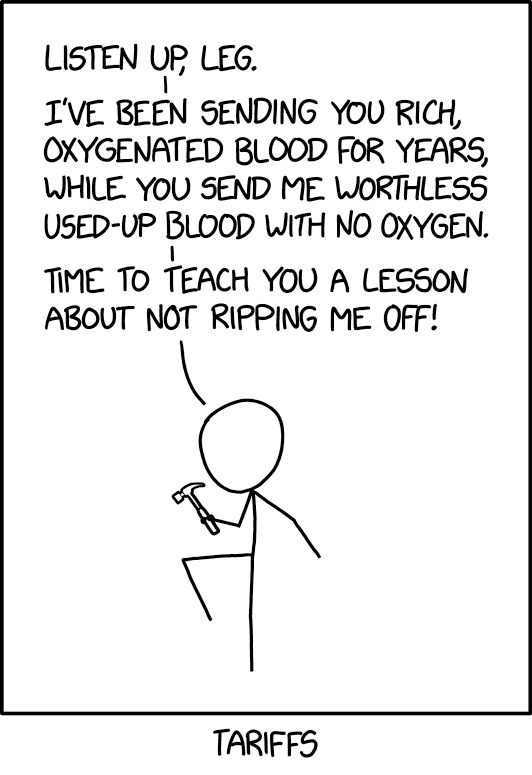
  • To make the analogy even more perfect, the character should be holding a saw rather than a hammer.
  • Or a gun, because America is famous for its gun culture, and it would be more clearly "shooting yourself in the foot".
  • The context here is that president Trump has an interesting view of trade deficits / surpluses. Specifically, he frequently cites cases where the US has a trade deficit with another country -- where the US is spending more in that country than that country is in the US -- as if that country is "taking money" from the US.

    This is a bit peculiar, because it ignores the whole "the money we are spending is being exchanged for goods that come back to the US" part of the trade. I.e. it's not a problem that I have a "trade deficit" with the grocery store, because I have my groceries.

    https://finance.yahoo.com/economy/policy/articles/trump-brag...

  • Actually you, like most of us, have a trade deficit with the grocery store and the movie theater, and a trade surplus with your employer. Which one is more enjoyable to have?
  • Also, Trumps argument always ignores the bulk of US economy and exports: services.

    Somehow we count shoes and timber but not gazzilions in financial and cloud services.

  • Economically, it's a problem long-term. Dollars only have value if you can buy things with them. Japan, China, Saudi Arabia - countries we've had trade deficits with - have been buying our business, infrastructure, and real estate.

    Not defending tariffs, but there's a reason people care about trade deficits.

  • He doesn't have a view on trade deficits. To imply he does is giving him far too much credit. The "most powerful person on earth" in charge of the United States fundamentally doesn't understand trade deficits or tariffs.

    We do a disservice when we act like he has a strategy or view about these things. He doesn't. He is ignorant of how they work, and to prove it you only have to listen to his own words.

  • It also excludes money spent on services, which in most cases favours the US.
  • A current account deficit is a capital account surplus. Persistent deficits shift the balance between Asset vs Export sectors, dumping the export sector and pumping the asset sector. Put differently, we can pay for imports with shit that we make or shit that we own -- and this has implications for people in our country who make shit vs own shit.

    A better analogy for the trade deficit would be sitting on the couch slamming potato chips and observing the shift in our body away from muscles and towards fatty tissue. Should we be excited to see this example of specialization in action? Is it wrong to want to fix our diet and push our body composition in the opposite direction?

    https://yalebooks.yale.edu/book/9780300261448/trade-wars-are...

  • An even better analogy for the US using trade deficit as an excuse for tariffs would be a billionaire hedge fund manager complaining about payments made to his janitor. Essentially the janitor just takes money from the hedge fund manager without ever buying any financial services in return. The solution, of course, is to fire the janitor and start cleaning toilets himself.