Join the discussion
Write your take first — we'll ask for email only when you're ready to publish.
- Hacker News
- They are, until a murder takes up residency in a tree outside your apartment in Emeryvile. Then they are cool roommates you have to get away from else you lose your sanity.by Avicebron
- A friend is someone you’ll spend time around given other options. If you’ve spent any time getting to know crows (or jays, or any other corvids), it’s quite obvious this is the case. I had a scrub jay who’d perch on my foot while I read in the morning. I considered him a friend, and by that standard, he me.by roughly
- Crows are fascinating creatures. My wife read that they will chase hawks and eagles away, so she started putting food out for the crows near the tree where they gather (we have chickens and ducks that we don't want the hawks near).
Now they bring trinkets as gifts and leave them near the tree. We also had a crow in the past that would make barking noises when it saw our dogs and freak them out. I'm convinced it was messing with them.
by sethev - We have quite a few birds around our house and it has been quite gratifying to see how much they accept your presence after a while. While making coffee yesterday morning, there were three tauhau hopping around in the tree outside the window, less than a meter away, unconcerned. If I go outside they'll keep to about 2 meters. When I'm working in the garage, a piwakawaka often comes in to watch me. If I'm digging in the garden there are a few (I'm going to guess starlings) that watch me digging in the garden close enough I'm surprised they don't land on me. As soon as I stop digging, they're in the dirt rummaging for what I might have turned up. Collectively they have all decided that I'm not out to get them so just go about their business. Except for the piwakawaka, which does seem to go out of its way to just watch me make things.
It possibly helps that I have a dog that will not tolerate a cat on the property and seems to believe that birds don't exist.
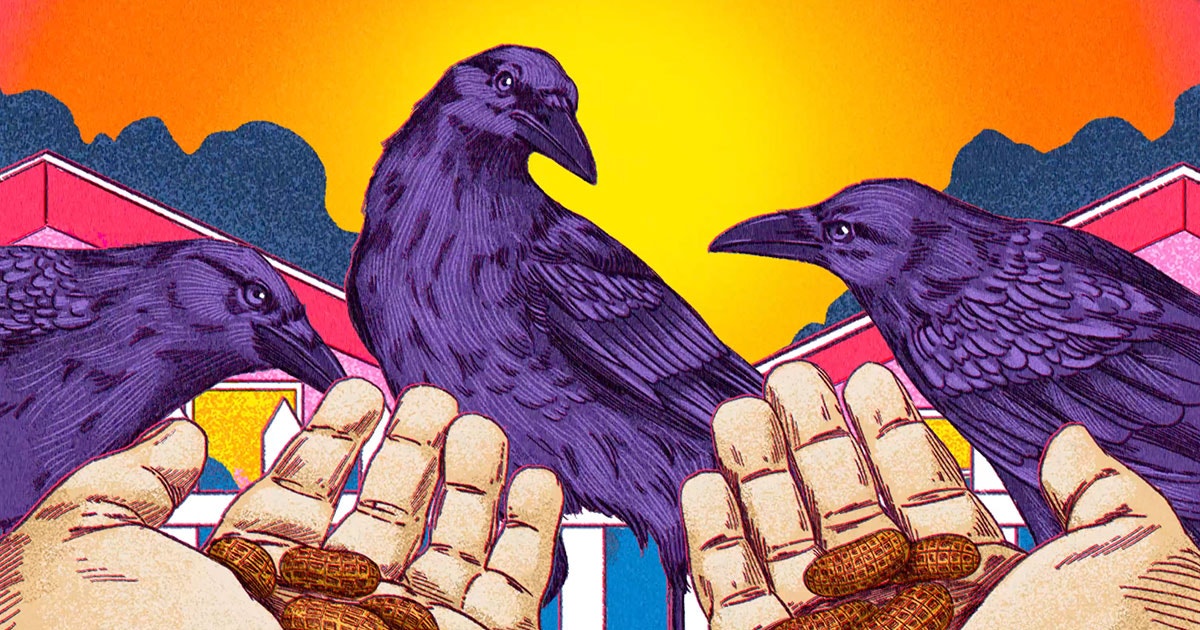
by Lerc - I don't know the answer, generally speaking, but we've got a pair that pop onto the back fence every morning waiting for their peanuts. I think they're multigenerational, as I have reasons to suspect that the "original" Mr. Peanut has passed on. Anyway, the bold one will come sit with me in the front yard. When I walk the dog, they'll follow me for a bit, flying a few feet off the ground right in front of me, I assume to make their presence known and get a piece of dog biscuit (which I oblige). They have never gotten obnoxious about it by crowing at me, just silently hanging around: "if you could spare a bit of dog food, kind sir..."
Friends? It's probably transactional from the crow's POV, but OTOH they hang out on the fence and just sit sometimes even if there are peanuts on the ground. I enjoy seeing them, though. I will say, though, that after many pounds of peanuts not a single one of the little bastards has ever brought me a present, as is advertised. :-)
by mikestew - > Even when humans have a friendship—or something that feels like it—with a crow, the relationship happens on the wild animal’s terms. They visit when they want to, and they may disappear from our life suddenly.
It goes also the other way around. I do not leave a note to my neighborhood crows when I move town.
I think that it has nothing to do in which terms it happens but the communication barrier. It is very possible that the crows signal that they are leaving for good but we are just missing the message. And my reason to not leave them a note is because they cant read, if they could I would.
by Frieren - Crows can remember a dangerous person and tell their friends about it. From "Social learning spreads knowledge about dangerous humans among American crows" (https://faculty.washington.edu/wirsinga/Cornell2011.pdf)
We exposed wild crows to a novel ‘dangerous face’ by wearing a unique mask as we trapped, banded and released 7 –15 birds at five study sites near Seattle, WA, USA. An immediate scolding response to the dangerous mask after trapping by previously captured crows demonstrates individual learning, while an immediate response by crows that were not captured probably represents conditioning to the trapping scene by the mob of birds that assembled during the capture. Later recognition of dangerous masks by lone crows that were never captured is consistent with horizontal social learning. Independent scolding by young crows, whose parents had conditioned them to scold the dangerous mask, demonstrates vertical social learning.
by smurda - I like the fact that they are so ... observant. A specific crow (I recognize him due to the missing feathers around his collar) will spend a while sitting on a tree outside my window, observing me for no reason. I do feed them generally by leaving peanuts in a specific area in the backyard early in the morning, and I'm sure this one partakes in the feast; but I have never rewarded his presence in any form, and yet there he is, in the middle of the day, just hanging out on the branch of the leafless tree, just sitting there, observing me. If I turn around and make eye contact, he often flies away. But I can see him in the reflection on my ipad's screen, and if I don't turn around and make eye contact, he will stay there for a while. It is fun interacting with "smart" creatures who have their own personalities and active social lives.by mlmonkey