Join the discussion
Write your take first — we'll ask for email only when you're ready to publish.
- Hacker News
- >an over engineered
It’s not, that’s called a duct tape solution, which is the opposite of engineering, that’s poor design and bad practice, there are so many failure points and moving parts that it’s eminent it will fail. The engineering design should be reliable, simple, and efficient. Instead of that cluster chaos you made, you could have had a relay wired inside the bell that simultaneously trigger a normal and simple electric-based bell, so it works for you and the other person.
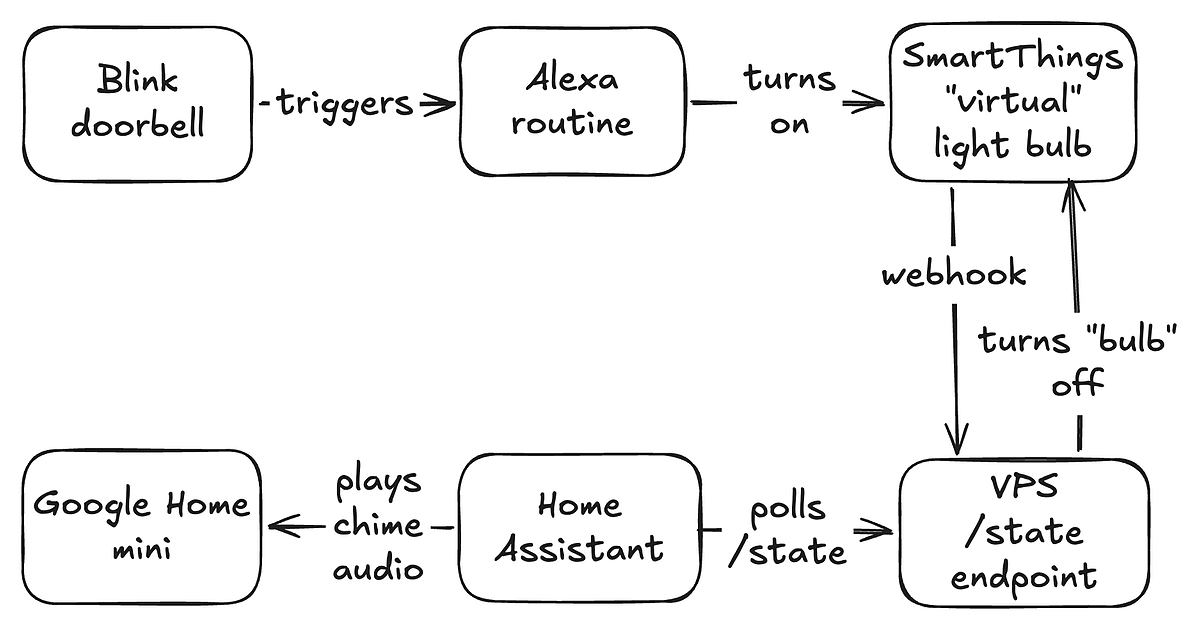
by tamimio - I thought it was finally time to write up the story of my absurd home doorbell implementation, especially because the upcoming Samsung SmartThings API pricing means things will have to change soon.
Suggestions welcome!
by vghaisas - Everyone here is looking for a simpler solution, but the real fun is in its Rube Goldberg-ness.
Let it bounce around the globe 3 times through Tor, Iroh, Blockchain, Tailscale, Meshtastic, Thread, Zigbee, Bluetooth, WiFi, IrDA, NFC, TransferJet, FireWire, UART, SPI, I2C, and OneWire, using the free tiers of AWS, Azure, GCP, OCI, IBM Cloud, and Baidu Cloud. And it's 2026, don’t forget a game of telephone powered by free LLMs on OpenRouter.
P.S. Speaking of chimes, I found this page with a bunch of sound samples from a Japanese company. Strangely satisfying: https://qq-bell.com/media/x-plus-64sound
by usagisushi - This seems way overkill. I understand that that the OP didn't want to pay a subscription, but a really quick google showed that Blink makes a $30 product that solves this exact problem (not being able to hear the doorbell inside), the Blink Chime, which plugs into an outlet and then connects to 2.4Ghz, not requiring a subscription.
I guess $30 for what is effectively a glorified chime for your door is a bit much, but considering the time it probably took to put together this (kind of over-engineered) and the (presumably) monthly cost of the VPS, it makes more sense.
Also, I feel like something like MQTT or another message broker could simplify this significantly, making the whole VPS /state endpoint unnecessary, without exposing your home mini pc to the internet, since the mini pc would connect to the MQTT (I think HA actually has a built in mqtt integration? although you'll still need to make something to process the message once the MQTT gets it) and the SmartThings API would also (assuming the processing after the SmartThings API is hit is customizable in some form)
- I’ve recently been looking into what older gen IoT devices I can buy used for cheap and are also hackable (some existing progress has been done before me is my bar). My first adventure was with an Amazon Echo Dot 2, I picked up two off Facebook marketplace for $5 each and managed to vibe code my way into a working implementation of LibreEcho (which does not currently support the echo dot). I’ve got that wired into my home local AI brain so it can do tasks like add grocery items to shared notes, or download movies or TV shows (jellyseer+flexget+jellyfin+etc).
My next plan is to do a doorbell. I want it fully local only and I know there are providers who offer this brand new for $$$ but I love the idea of picking up cheap IoT devices and hacking them instead. My current candidate is EZVIZ DB1C but I haven’t bought it yet and definitely open to suggestions!
- I am constantly amazed that people rely on anyone else's compute infrastructure for things like doorbells, cameras, locks, switches, or sensors (network infrastructure is, at the moment, a seemingly acceptable integration for isolated communication.) There is inevitable over-pricing and capture by these companies; it's in their nature.
Add to this the security and downtime risks, and the equation really doesn't look good. Equipment that is tied to someone else's cloud is an astonishingly bad idea, but everyone has their own immediate (or even long-term) reasons for ignoring advice. "You get what you deserve."
by johnhtodd - I fail to see the relation between a video doorbell and stopping a burglar. Burglars wear masks.
Also, a doorbell ringing on the outside of the door is not only silly but in case of an apartment complex highly annoying for your neighbors.
And make sure your neighbors like being monitored through your five services.
Personally I have a button outside my front door. It is connected with a copper wire to the other side of the door to a small device that sends out an audible notification. No cloud required.
by artisinal - I am super sensitive to over engineering. For my doorbell I wanted something that lets me play a custom bell sound. You would be surprised that 99% of the solutions out there are complete over engineered stacks that depend on wifi devices, Internet access, connecting to various cloud services... So I built my own: a basic wireless button sends a radio 433 MHz signal, and my receiver is plugged inside the house and triggers an off-the-shelf playback PCB module that reads an MP3 off an SD card and plays it on a speaker wired to the module. No Wifi, no Internet, no cloud, no apps. And the rare times I want to change the sound, I update the MP3 on the SD card.
Edit: there are very, very few products on the market designed as simply as this, just an R/F signal triggering local playback. I think the only commercial doorbells designed like this I found were an out-of-stock product, and a UK device designed for 230V that would have required a bulky adapter to work for me in the US.
by mrb