Join the discussion

Write your take first — we'll ask for email only when you're ready to publish.

  • Hacker News
  • I made a 2-minute animated explainer of this study for a small channel I run: https://youtu.be/pzMBygLewZI?si=YBkRi8nP47RfTVhR — feedback on accuracy welcome.
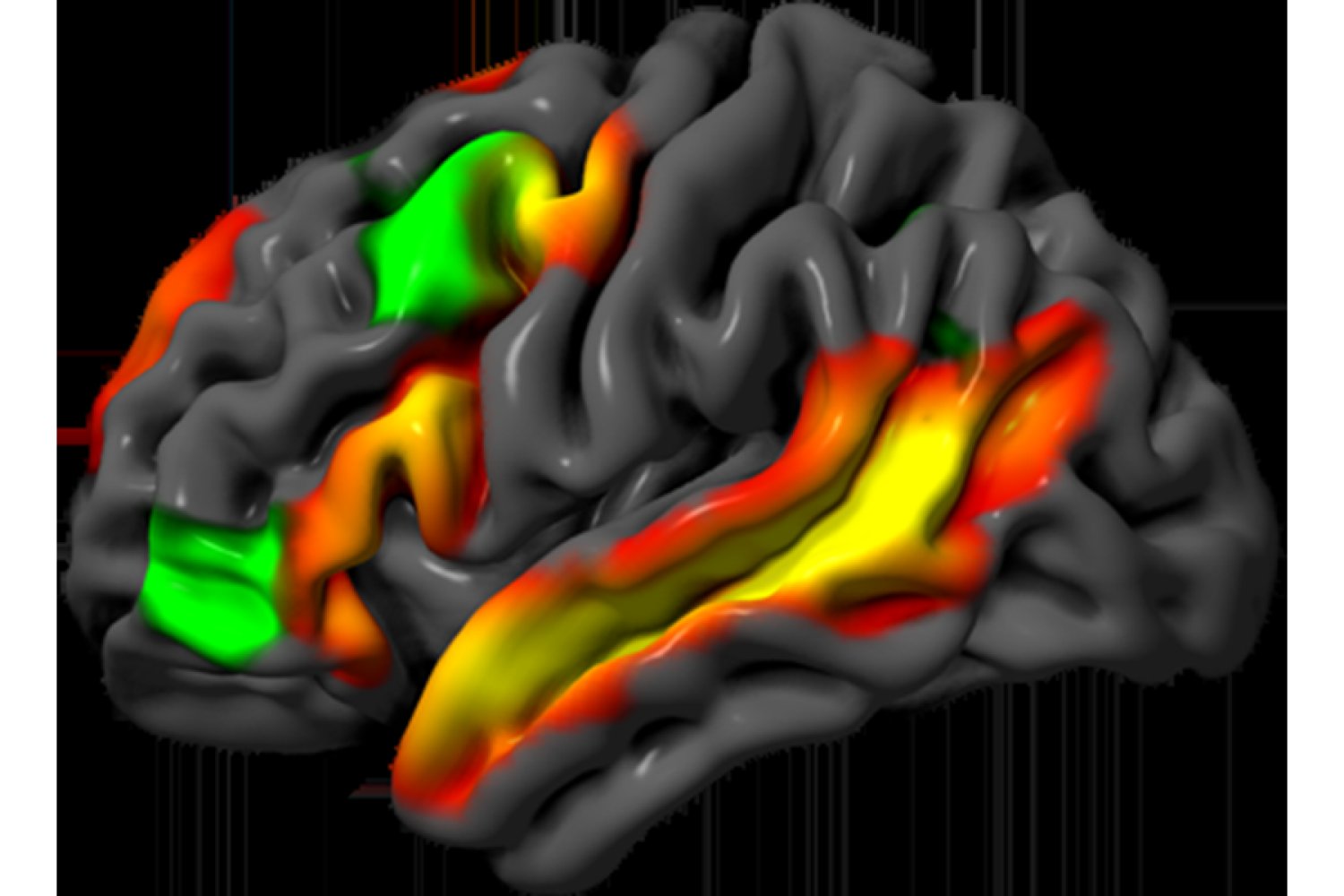
  • The study tested rule-induction puzzles (number sequences with hidden transformation rules) on two patients whose language networks were destroyed by stroke, plus fMRI on healthy volunteers solving the same puzzles silently. Both lines of evidence point the same way: the language network sits out during reasoning.
  • disclaimer: I really don't nearly enough about this stuff to be taken seriously, these are just my immediate thoughts.

    fMRI is one of the best tools we have, but that doesn't mean it's good. fMRI shit should always be taken with spoon of salt. source: a bunch of grad school friends in neuroscience and psychology a few years ago.

    "on two patients whose language networks were destroyed by stroke, plus fMRI on healthy volunteers solving the same puzzles silently. Both lines of evidence point the same way: the language network sits out during reasoning." that doesn't mean they didn't learn the meta-ability of how to solve such things without language. You can learn something with language, move it to a separate "database" in some abstracted form then pull from that "database" from a non-language component. In fact I would think the language-isn't-thinking people would favor an explanation where the thinking ability is stored independently of language. I guess my point is that no "language" component being lit up during a specific reasoning task doesn't exclude the possibility we learned that specific reasoning algorithm (for lack of a better word) via language + other things.

    TL;DR maybe this specific "logic" ability is a learned-via-language+ component of the brain. Language not being active during that puzzle could just mean language+ generated that component and stored it in a more abstract form than language.

  • > plus fMRI on healthy volunteers solving the same puzzles silently

    Are they looking at blood flow in areas to map "language network" and other stuff? I remember a few recent papers that found that a) blood flow doesn't necessarily mean "active area" and b) two brands of fmri found completely different "areas" activating for the same patient + same puzzle.

  • Nice explainer. One nuance I’d be careful with: “the brain doesn’t think in words” is broader than what the study seems to establish. The stronger result is that the natural-language network is not necessary for the kinds of inductive and deductive reasoning tested here.

    The AI implication is fascinating though. We tend to build systems where the language model is simultaneously the language interface, memory, planner, reasoner and controller. Human cognition may be pointing in the opposite architectural direction: separate persistent state, reasoning/control mechanisms and language, then let language be one tool among several.

    That distinction seems more interesting to me than simply asking whether LLMs “reason in language.”

  • what do you trying to say with your first para .

    can you give me example

  • One must be careful about what is meant by "language" here, which is actually language expression. LLMs don't possess conceptual content. They only operate on language expression.

    Language as an internal conceptualization is still (obviously) essential to logical reasoning. The question of how language and logic relate can, therefore, concern either the internal language of concepts or the expressed language and its grammar, the latter of which is related to logic in that it reflects to some degree the internal language, but it is not identical with it.

  • Am I off base to view this as a strong hint AGI won't arrive through mere LLMs?
  • There have been strong hints since the 60s.
  • LLMs have been found to have the same activations for the same concepts regardless of what language the question is asked in. So the answer is that they don’t do logic in a particular language either, they use their own internal symbolic representations.
  • Probably not.

    LLMs might be a step towards AGI (assuming that's possible) but the prevailing belief that LLMs and human brains (the latter being the most complex structures in the universe that we know of) are already functionally equivalent in every way that matters seems more like an article of faith to me than fact.

  • Who uses just LLM these days!?

    We use harnesses. Practically useful AI is a system of pieces already. It hasn't been pure LLM since ChatGPT 3.5 release.

  • First you'd have to come up with a commonly accepted definition. By some ~16 years old definitions from famous experts in the field, we've already achieved it. By today's definition (of the same expert) we haven't. There are people today that think we have it. There are people today that think we'll never have it. It's such a loaded term / topic.

    Also, regarding LLMs, 2 years ago another famous expert in the field was adamant that LLMs can't plan, can't do math and they can't work at long contexts. Obviously they can do all of that now. So, really, no one knows.

  • this must be symbolic of something, nebulous, like how statistics can mean anything that will get more grant funding, but nothing actualy specific or informative. we can see the lesser version of this in click title writing everywhere, so the whole thing is a war for attention, but of course people seem to form some kind of resistance or more often get sucked further and further in, but then become essentialy zero sum partisipants. thats why the quest is to get them young and lock them into lifetime spending routine
  • My ex-wife doesn't have internal dialogue. Instead, when she is thinking through something she has images in her head of shapes morphing. She told me that she felt having an internal monologue would be horribly annoying and horribly slow.
  • Did her brain get bricked every time she saw something of high enough quantity?
  • I remember having more visual thinking until preteen, but then it gradually turned into a monologue and I hate it, because I can tell I got slower at mundane thoughts even if it helps me think through complex stuff.
  • I’m really not trying to sound like an ass, but it never occurred to me that anyone would seriously believe that language is required for “logic”.

    Babbling toddlers can do logic. I sometimes can also do logic, even though I don’t have an inner voice and don’t formulate thoughts in words of any kind. As I’m relatively sure I’m not an ET alien, there are probably plenty of people like me.

  • I grew up speaking 3 languages, and picked up a few more since then. To me it seems innately obvious that language is just a layer on top of the (much more complex) mental activity that goes on underneath all the time.

    I do find myself thinking in one language or the other at times, but none is exclusive, often they get mixed together (the "next-token prediction" in my mind allows picking words in other languages that may more accurately describe an idea) and most frequently I do not have any internal dialogue at all.

    I am pretty sure this is true for everybody, that the internal dialogue is not something natural but rather something people are so used to that we identify with it. Meditation and flow-state inducing activities (physical excercise, playing music, etc) make me think that this is the default for people, as these allow to access that lower layer of mental activity where internal dialogue disappears, even if briefly.

  • This maps with experience taking the anti-seizure medication Topamax in college.

    I trialed for a month it as an off-label migraine preventative on recommendation from my neurologist.

    Topamax can dampen neuronal activity in the language area of the brain for some people.

    It was a terrifying experience, but it was also a valuable one as it changed the way I view intelligence.

    About 10 days in, my writing and speech skills had devolved to that of a primary school aged child. I tried to type a text message and struggled to come up with simple words like “and”. My speech slowed down considerably.

    The terrifying thing was that my internal world was still as complex and meaningful as it was before. All of the emotions I felt were real and legitimate. My cognition outside of language was intact, I could do math just fine and conceptualize and abstract problems.

    In spite of this, I was unable to convey what I was feeling and thinking to the outside world. It felt like I was trapped inside my own body.

    After recovering, my intuitive understanding of the link between language and intelligence was changed forever.

    See the following for more info on Topamax/Topiramate language impairment: https://link.springer.com/article/10.1007/s10072-008-0906-5

  • Did you write more about that experience somewhere?

    This seems to corroborate my feeling that aptitude with language is a very poor proxy for intelligence, although it's often used as one. My own experience is that I'm less struggling to find the right words and sounds more clever at the times when my brain is actually empty and I'm "not there", and at the contrary the more "self-aware" I am and the more I struggle to articulate my thoughts, as if my brain (or ego?) was stepping in the way and slowing me down by trying to supervise what I'm saying too closely, making me sounds dumb.

  • Was your understanding of language also impaired?
  • You are very important research subject, pls share more about your experience to the world , or try to be part of some research/project.
  • Scary, but cool!

    To clarify "cognition outside of language" and "unable to convey"... did it purely affect external communication? Were you able to think "in language"? Do you tend to rely on thinking "in language" (whether inner monologue, describing problems like drafting prose, or otherwise)?

    by jdub