
Join the discussion
Write your take first — we'll ask for email only when you're ready to publish.
- Hacker News
- This video linked from the site is quite good at adding a sense of scale to the undertaking. I also love that Roman will be supported by Hubble and Webb.by stuart78
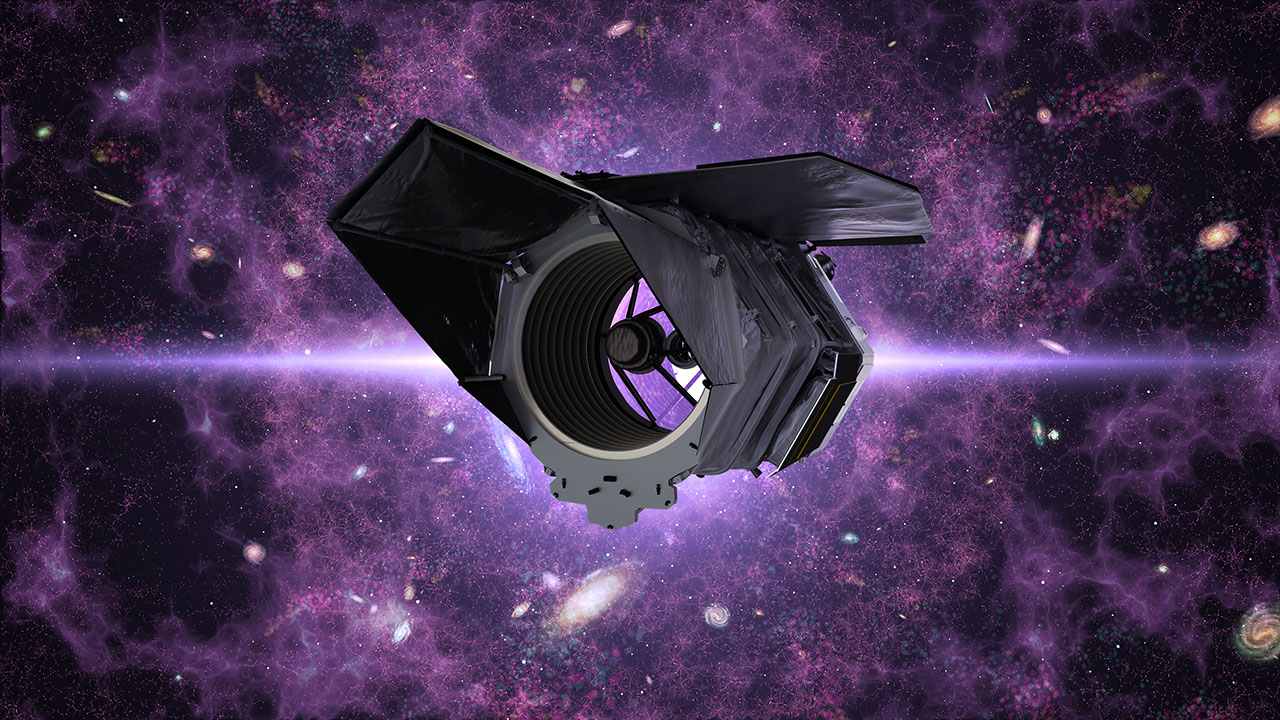
- I watched a documentary on how this telescope is going to be used with JWST. Basically the Nancy Grace telescope is a wide field high resolution telescope where they would photograph the same location in space over multiple days.
Since it’s high resolution and wide space it would still capture a huge area in detail and then they would basically use the photos taken over days/weeks to cancel out the stars/galaxies that appeared on every photo and only take the diff. That would give the anomalies like supernova, etc. and then they would focus JWST on that anomaly to zoom in and observe it closely.
- Meanwhile it did launch and separated from launch vehicle.
Most recent status update can be found at https://science.nasa.gov/blogs/roman/
by guenthert - https://en.wikipedia.org/wiki/Nancy_Grace_Roman
P.S. I didn't post this at top level ... it was in response to a silly joke about the Romans which has since been flagged by dang ... apparently my comment was relocated to the top level but it's redundant here as this link was already given in the post (which I didn't see when I made this comment.)
by jibal - Oh, thank goodness. I greatly appreciate the link. I was confused and annoyed and now I’m happy.by alsetmusic
- I'm really excited about observations we're about to see over the next decade. Bringing NGR online and combining with Rubin, Hubble, and JWST will give us imagery and hopefully new discoveries and understanding.
I had the fortune of letting some of my neighbors through a telescope for the first time for the partial lunar eclipse. I say fortune, because it is amazing to be a part of someone having that experience that never disappoints. Even if they've seen images from NASA/ESA, putting your eyeball directly to the 'scope is much more meaningful.
by dylan604 - I will never understand why NASA doesn't build at least two copies of expensive space telescopes like this. One single launch failure and boom (literally), the entire project is a failure?
It wouldn't double the cost assuming they do it with even a modicum of efficiency and intelligence. And hey - assuming that the launch goes smoothly, you can get double the benefit
by nightsd01 - what if both of them blow up?by gosub100
- Whatever the reason, it seems specific to the intersection of space and telescope. Space probes, landers, and crewed vehicles all get made in multiples, as well as ground based telescopes like Keck or the gravitational wave observatories.
- I guess for one thing, these launches don't tend to fail and second, they actually do make duplicate missions sometimes. See Voyagers 1 and 2, Spirit and Opportunity and Curiosity and Perseverance.by spuz
- why build one when you can build two for twice the price?by pwarner
- Because the incentives are not properly aligned. The US has historically wagered big money on singular missions, which given the cost per launch makes perfect sense. Now that costs per launch are decreasing rapidly, and critically launch availability is also increasing, the opportunity for scale is presenting itself.by Aboutplants
- They have often indeed made “flight spare” copies of the main instruments.
When I worked for Mars Global Surveyor, one of the museum-pieces in the lobby was a glass case with the Viking spectrometer flight spare.
The flight spares were exceedingly useful when the spacecraft had some kind of trouble during its mission, because you could mock-up the flight spare in a lab and replicate many situations very closely, and propose solutions based on the mockups.
- I worked briefly in a satellite lab, and we did indeed have duplicate parts for most things.
Any space telescope with a mirror, is a different story, e.g.
https://science.nasa.gov/mission/webb/webbs-mirrors/
The RST has an 8ft mirror. The mirrors have to be ground and polished in a clean room to tolerances that are the highest in the world. I vaguely recall it's a square law or worse - for radius-to-time-to-polish. So you're paying for time, and you're paying for the expertise of one or two custom built places that can manufacture them.
by DrBazza - Part of the story is everyone being shocked at being under budget and ahead of schedule. I don't know everything, but I think this is reasonably attributable to the fact that this is a retrofit of an obsolete spy satellite. The leftovers of the security sector will be the most advanced scientific space surveyor. I have to wonder what things would look like with different priorities.by willis936
- People shouldn't be shocked that employees of the US government can deliver things ahead of schedule and under budget.
The problems are that anyone gave Musk/doge the time of day and that we're too used to the president giving no bid contacts to incompetent donors.
by dfxm12 - Isn't that also how Hubble started? I'd assume there's a lot of lessons learned to avoid costly research on conversion of the platform.by dylan604
- If we’re playing what-if, consider the contributions those spy satellites made to keep the Cold War cold and provide for decades of Pax Americana and a security umbrella over Europe that they didn’t have to pay for.by alex43578
- > I have to wonder what things would look like with different priorities.
Things aren't as simple as more money = more good.
Rapid progress requires adversity, the kind you'll find when nations compete for military power, for example.
by Mawr - IIRC the mirror is from a spy satellite, but the chassis and electronics are all NASA.by ChocolateGod
- Roman is scheduled to launch tomorrow (Aug 30) on a Falcon Heavy rocket:
https://www.space.com/news/live/nancy-grace-roman-telescope-...
by Reason077 - For some tasks, surveys in particular, field of view is critical. You would need many Hubble telescopes to do what Roman can do mapping everything out there.
"What really makes Roman stand out is that it is designed for wide-field imaging. The cameras on telescopes can often only detect objects in a very small patch of sky. If we use the size that the full moon appears in the sky as our guide, Hubble’s field of view is often smaller than that —meaning each picture it takes is of a patch of sky smaller than the full moon. Webb’s instruments often are even smaller than Hubble’s. Each picture taken by Roman, however, will be larger than the full moon, allowing it to survey more of the sky much faster than Hubble or Webb."
https://science.psu.edu/news/ask-expert-will-roman-help-reve...
by marze - And yet the narrow-field Hubble produced this famous image
https://science.nasa.gov/mission/hubble/science/universe-unc...
Those are galaxies. In a field of view "about 1/13th the diameter of the full Moon."
by SoftTalker - The Rubble and NGR have the same size mirror but they are constructed differently. The former is not sharp over the entire field of view, the latter is - that coupled with a much, much larger camera (nearly 300MP) lets it record images at least equal to to HST but over a very wide field of view.
As to speed, it is not just the camera view that makes NGR faster but also physical factors such as not having to wait for earth to get out of the way.
by beezle - The data, up to 1.4TB/day raw compressed, is planned to be fully open, every observation is public as soon as it is processed with no embargo. You can just download it and start looking for Rama or Oumuamua or plan your exoplanetary real estate empire or make a really big sandbox game. I at least want somebody to make me a cool screen saver.
You could easily be the first person to see a galaxy.
I wonder how much space exploration could be financed by auctioning off naming rights.
by delichon - > I wonder how much space exploration could be financed by auctioning off naming rights.
My favorite part about this is that since names are largely a social construct, given the right situation, we could just nullify all the paid names and start again.
Sure, whoever does this will lose a lot of credibility. But say a disliked president signs an order forcing his country to stop accepting names that were paid, it only takes nobody reinstating it. And the rest of the world also giving up on the names, of course.
So you can totally fund space exploration this way, and then society can decide that it sucked and nullify it after the buyer is dead and unable to protest. I guess the family could, but...
by petterroea - > When deep space exploration ramps up, it'll be the corporations that name everything, the IBM Stellar Sphere, the Microsoft Galaxy, Planet Starbucks.by Carrok
- > every observation is public as soon as it is processed with no embargo
That's a big deal. Do you have any source for that? (I couldn't find it in the ones you linked). This is great for humanity as a whole, but... poor grad students who now need to rush to publish their papers even sooner.
by ghgr