
Join the discussion
Write your take first — we'll ask for email only when you're ready to publish.
- Hacker News
- A bit weird writing style, and I don’t know if this is Substack or the lack of proofreading.
It quotes a problematic statement and then after one or two paragraphs, it says this:
> But here is an important thing that many people forget:
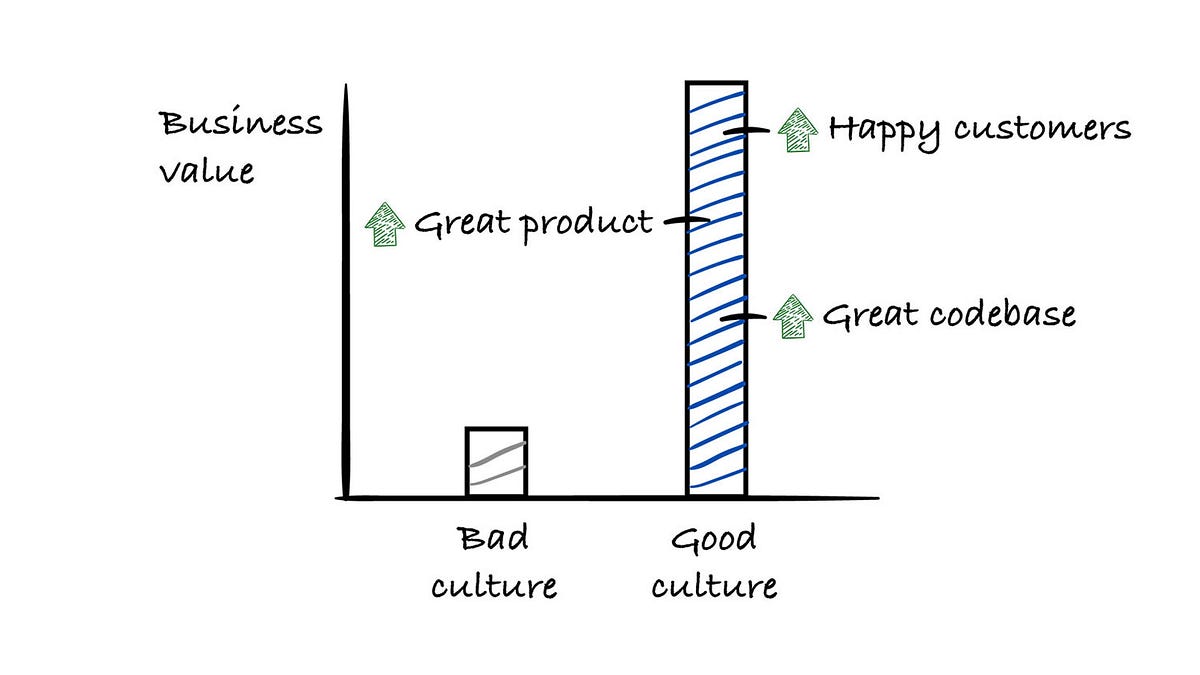
> There is no better productivity hack than a great culture. No AI tools will provide bigger productivity gains.
> I’ve unfortunately seen and heard this sentence quite a few times, either directly or from an engineer or engineering leader who has reported that to me.
So the problematic sentence is the one that talks about a great culture being the biggest productivity hack? I had to scroll up again and see what it was referring to.
by AnonHP - After 35 years in the industry in various capacities (from architect, engineer, VP, and different products, small and large companies, ...) I can heartily confirm this.
A company with a good culture is like a good football or soccer team. They work with each other to win, they know each other (enough for the job at least).
I am working at a bigger place now and the AI mandates handed down have been quite unproductive... As if we wouldn't have been able ourselves to figure out how to use the new tools - like we have since the beginning of software.
If management trusts you do to your job and has your back, then you trust the management and will naturally do a better job. Now there are always a few people who are exceptions to this, and part of good culture to identify those and remove them.
by linuxhansl - > I am working at a bigger place now and the AI mandates handed down have been quite unproductive... As if we wouldn't have been able ourselves to figure out how to use the new tools - like we have since the beginning of software.
This is so true. We have figured out how to use an endless list of software tools. Hardly anyone is as prepared to use the new tools as software engineers.
- In my experience, every company is great until things start going wrong. And when things start going wrong, no amount of culture is going to save you.by iamflimflam1
- > Without good culture, everything else won’t work well
Except the market is full of proof this isn't true. You can still do very well with a broken culture if you have an oligopoly, through tactics like vendor lock-in, by buying up upstart competition early, using VC funding to capture the market by selling below cost, etc.
And now that you have hundreds of thousands of people who have been laid off from high-paying jobs, it's an employer's market.
by ElProlactin - You're listing examples where there is no marketby Kinrany
- Those examples all had good culture at some point. It's just that once you're too big to fail (and/or have captured regulatory bodies) you get to tear apart the culture and extract the short term rewards. Literally killing the golden goose.
It's short sighted yes... And that's the point once your means of making money is not tied to societal productivity.
by johnnyanmac - The devops ppl talked about culture too. Seemed not too helpful.
Afaict toxic managers and C-level managers make for bad culture.
Now what?
by newsomix9xl - I remember the devops guys preaching about this "better culture". They talked about a no-blame culture for one. It resulted in a bunch of virtue signaling where I worked. At the end of the day, the people repeatedly causing ops related problems were canned anyway. They were still blamed of course, just behind closed doors. This "culture" went so far that there was even a company named after it called "Blameless", which fell into the depths of oblivion.
- Reading your post, I just realized that "bad culture" perfectly explains what bothered me about my last workplace. So thank you for that concise tag to put on what I was seeing.
As for your "now what", companies with a bad culture will be at a competitive disadvantage. Their efforts to wring more productivity out of their broken culture usually make the culture worse. My advice would be to leave ships once you realize that they're sinking. (That doesn't make you a rat!)
by AnimalMuppet - Argue the need to implement workplace democracy:
https://en.wikipedia.org/wiki/Workplace_democracy
The idea that we shouldn't be able to vote for our bosses is completely ridiculous. If we had truly collaborative workplaces it would probably unlikely another $50 trillion worth of value once you give workers the ability to exercise their voice (passionate workers want stable working environments, if executives are never held accountable by their subordinates how can we argue such an unfree system is worth preserving?).
by shimman - It's easier to deploy AI than it is to create good culture.by joshheitzman
- > It's easier to deploy AI than it is to create good culture.
Very agreed.
by kevinprk - The biggest stock-price hack for a CEO is:
* announce that effective immediately, the company will begin its transformation to an "AI-first" organization, with AI driving most development workflows by end of year
* percolate the message through upper management down to line managers that they are to assure their reports that the aim of the transformation is to augment current employees, not reduce headcount
* stealthily start lopping off heads anyway
by bitwize - It always felt like AI adoption should come from the bottom up, driven by people who are actually in a position to assess whether it makes any positive impact. Granted, that only works if your culture encourages agency in the first place.by andrii
- Welcome to a day in the life. The company I work for prides themselves on a culture of agency and letting developers be developers. I am pushing the AI revolution but the compliance requirements and modern Luddite zeitgeist are a daily source of frustration. If the AI isn’t perfect then it’s slop. But we’ll gladly excuse the existing 2 million lines of spaghetti code because of past deadlines and lack of resources to pay down the tech debt today. Fingers crossed though. Every failure brings you one step closer to an inevitable success.by sph87
- AI accelerates dysfunction. It will help you get to the wrong place faster if you're already heading there.
I do believe the opposite is true too. If you have a strong culture, a product or idea with promise, and a team of smart and capable people, it can move you faster in the right direction too.
The problem is that every person or company in group 1 thinks they are in group 2.
by aesthetics1 - I think that every person or company in group 1 thinks they are in group 2 because they see ‘speed’ in ‘completing work’ as a signal in better performance. Especially since VCs are pushing for speed (https://x.com/Alfred_Lin/article/2084636778791858256), a lot of misguided person and company who is moving fast thinks they are in group 2, when the speed they have only doubles them down group 1by claw-el
- I worked on a 20-ish team of good-but-not-brilliant engineers. Our secret weapon was liking each other and having very low turnover over the course of 10 years.
As a principal engineer at Meta and LinkedIn, it’s still the most productive team I’ve ever been on
by sghiassy - Given that you work for Meta/LinkedIn, I don't think 'productive' is the correct adjective. It would be like saying that Ted Bundy was more 'productive' than Jeffrey Dahmer.by dosisking
- Studies have been performed and they come to the conclusion the highest performing teams are the ones with greatest psychological safety:by riffic
- I was very unproductive at Meta because there was so much tribal knowledge context gatekept by others who were too busy to continuously offer any meaningful support despite giving lip service. In other words the flow of information sucked ass compared to when I worked at a startup, even though I didn’t feel much politics at my level (senior).by nexus2045
- Yep, same experience. We were a company of largely bootcamp grads with past experience in the product area. Most people had tenures of 5+ years and everyone had great rapport. Made it to unicorn status and then some. Then, for whatever reason, the C-suite decided to let go of most of the senior engineering team (rumor was cost-cutting measures at the behest of investor(s)).
Went from IPO hopeful to struggling to position to sell the company now that it was obviously down-trending. Everyone else worth their salt left within a year. Biggest takeaway was how effective everyone was despite not having a traditionally strong engineering background, just because everything traveled so fast because everyone knew everything about the product and everyone was happy and eager to talk to one another, and how quickly that disappeared.
by remixff2400 - No matter how much I try to explain to some executives that you don't want the most productive individuals, you want the most productive team, they just don't get it.by CSMastermind
- I think the points being made here are mostly good-ish. The last place I worked created a team of principles whose whole goal was to create a system to turn jira tickets into PRs and it was incredibly demotivating and bore no fruit before I left.
But, and maybe I'm just a curmudgeon, but I kind of wonder why we write articles like this. Like if a culture is bad, is it likely a CEO is going to be looking for random blog posts for constructive criticism?
Or even managers? I look at the market forces at play, and I just don't think many (any?) organization successfully create an incentive structure where performance on intangibles (specifically management) can be assessed well enough to make a bad culture into a better culture. I've worked at zero places where managers where seriously held to account for how "motivated" their employees were; when there were surveys of engagement engineers almost never truly believed they were anonymous (and why would they?) and were hesitant to give honest feedback.
In short, being a CEO is a skill of crafting and debugging a machine of people, a skill that I think life gives almost no training for, and a skill that most people with that title have no awareness or aptitude for. </rant>
by zug_zug - >> but I kind of wonder why we write articles like this
I think its a way to speak out and get it out there, than stay unspoken. Author as well others who share same opinion get some validation that they are not only ones.
by truncate - > But, and maybe I'm just a curmudgeon, but I kind of wonder why we write articles like this.
Good question.
Personally, it feels good to read these when stuck in a bad situation/culture. Feels good (relieving) to write too. I don't really believe these reach and/or change the relevant category of people.
by chanux - It might be a pipe dream but I'd like to see some sort of checklist for dev companies using hard-to-bullshit objective criteria to highlight that they either have a good culture or that their culture is toxic.
I remember many years ago companies used to advertise their "joel score" (not quite the same thing but related) to attract employees.
This is something which I think investors could also use as an indicator of company quality.
A lot of cultural problems also have quite easy fixes they just require shining a light on specific abuses of executive power which simultaneously hurt employees and destroys shareholder value. There is a lot more of this than I think people realize.
by pydry - Part of the value is to help the people stuck in bad cultures realize that it's the culture that's broken, not them. It's easy to lose sight of that! If you can recognize it, it's easier to do something about it whether that's changing your behavior and expectations, trying to change the culture bottom up or leaving altogether.by tikhonj
- > Like if a culture is bad, is it likely a CEO is going to be looking for random blog posts for constructive criticism?
The CEO (or at least the founder) created and cultivated the culture of the company thus far. If the culture is bad, they are the single largest reason why.
You are right in that execs won't seek out the blog article which criticizes their strategy... unless they actually want to steelman against their own position (which is a very useful activity but few people do it).
But the CEO doesn't need to find it on their own. They surround their self with a Board, investors, sales people, managers / leadership team, people from their MBA program, etc. the article just has to plant a seed which grows somewhere in that ecosystem.
That said, the article may not be right. The largest and most successful companies in the world aren't the ones with the best company culture. They simply work in industries where the money is so prolific that the people who want to work in the industry are already highly motivated. The CEO doesn't need access to this information because it isn't true; it simply tickles your cognitive biases.
by thephyber