Join the discussion
Write your take first — we'll ask for email only when you're ready to publish.
- Hacker News
- I made it to a third round interview at anthropic in 2024 and they had me build a web crawler as their programming test. Part way through I started on making it respect robots.txt and I could immediately tell they were no longer interested in me.by kdowns
- I also run a public cgit instance and get over 1M hits every day, although my pet projects are nowhere near the size or impact of kernel. I had to block (via nginx conf) cgit endpoints for diffs, blame, snapshots and historical commits, because nothing else works. Now they return 402 (payment required). I consider this my total defeat and it's killing me inside, but it is what it is.by virgoerns
- I really enjoyed the writing style in this article.
And the bot progression from "alter user agent" to "change IP addresses" to providers having to ban whole subnets, whole ASNs, and realizing "proxy SDK monetization" is a thing mirrors threat actor progression from the time before LLMs.
by jdnier - Tavis Ormandy called this, about Anubis, almost exactly a year ago:
https://news.ycombinator.com/item?id=44962529
It never really cohered as a solution. High-powered scrapers are better equipped to handle proof-of-work challenges than end users. Proof of work makes sense for a password hash, where any one guess at a password provides zero marginal utility. But every request from a scraper is productive to the scraper.
by tptacek - I maintain a formerly popular gaming website, and it used to have hundreds of legitimate requests per second. The load would be especially high during popular event times. So, it’s always been running on a dedicated server.
It also has an “online users” counter, which attempted to count real user sessions of unauthenticated user which still maintained a session, which lets them comment, or modify certain filter and display options. It never counted the Google bot.
Over the last few years this counter went from 100-200 users online to thousands. I have been very hands-off with it for many years, doing minor upgrades and backups. However, the site also has gotten quite slow, these sessions were obviously impacting it. So, I finally investigated these crawlers, and yes, it turns out it’s an insane amount of traffic that is entirely artificial, the site has just a handful of real users, and thousands of these crawling sessions that actually try to do everything they can, click every button. It doesn’t help that sort and search were implemented using GET links.
I fixed the counter to exclude the crawlers, but I have a bit of a dilemma. I don’t want to stop the bots from updating their knowledge based on all the content.
The best solution I could find is the new CloudFlare feature where they might charge the crawlers for every request, or otherwise block them. I think that’s a fantastic idea for the internet, at large. I signed up for the beta access, but haven’t heard from them again. I do think it’s unfortunate that this requires CloudFlare and the middleman.
Overall, it seems like the LLM are really straining the internet economy, the openness of it. Email spam used to be the worst, but the organized trillionaire labs sucking up the entire internet is going to break something if we don’t preempt them better.
It’s too bad the copyright and public internet systems are not acting quick enough. And I think there is no reason to act like this race really has to be at such a breakneck speed.
by Demiurge
This statement holds the core misapprehension behind Anubis. It’s not a ton of cycles. There is no difficulty setting that would be inconvenient for bots but usable for humans on mobile devices.> because apparently what we have to offer is worth spending a ton of cycles to calculate the Anubis challenge.I noticed the other day that lists.ffmpeg.org had moved to Anubis difficulty level 6, which takes ~180sec for my iPhone 17 to solve at ~100KH/s, making the site unusable. So I spent ~10 minutes vibe coding a safari extension with a native bridge to an optimized C kernel using ARM SHA256H* instructions that can do 200+ MH/s on the same device. This solves Anubis difficulty level 6 in a handful of milliseconds.
Given the numbers and capabilities involved (a single $5K ASIC miner yields 200TH/s, a million times more hash rate than my optimized kernel running on an iPhone), I don’t see how proof of work could possibly be a sustainable strategy to keep bots out without ruining human user experience. It’s an arms race that can’t be won.
Edit: I encourage you to try this yourself. Here's a sample prompt that ought to one-shot the task:
> Build an iOS Safari Web Extension that accelerates Anubis proof-of-work using a native C ARM64 SHA-256 kernel. Precompute the invariant 128-byte challenge prefix, search fixed-width decimal nonces with ARM SHA-2 intrinsics and two worker threads, and target difficulty-6 solves under one second. Relay challenges from a Safari content script through the background service worker to native code, then submit the valid nonce/hash through Anubis’s normal pass-challenge endpoint. Include a deterministic benchmark app, correctness tests against CryptoKit, bounded execution, and fallback to Anubis’s stock solver.by semiquaver- > Why is git.kernel.org “interesting” to crawlers
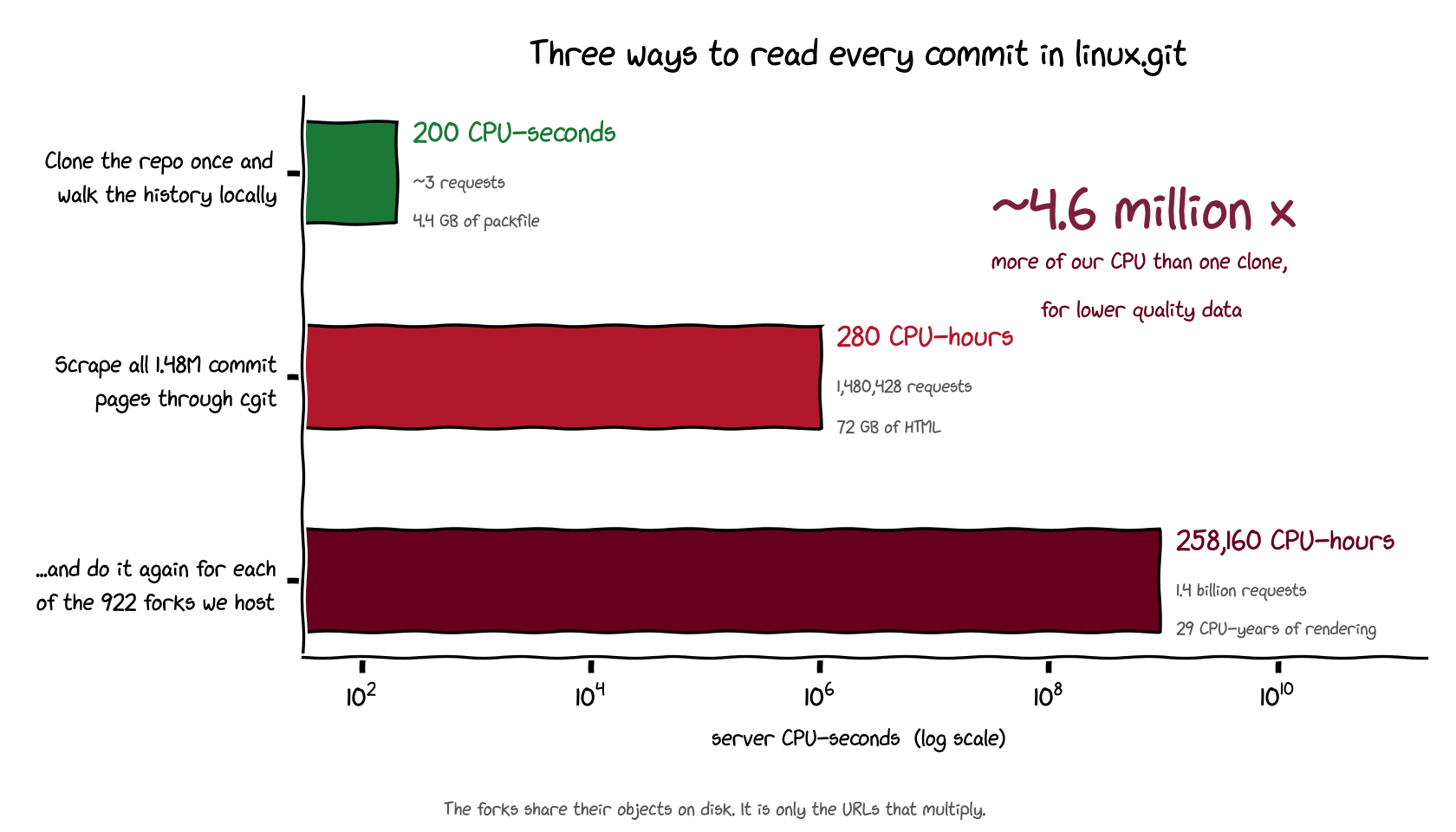
I think the post underestimates just how little thought and effort is put into these bots. I also run a cgit instance with far less interesting projects, and am not spared from the deluge of HTTP requests.
The explanation I could come up with is that they try to crawl all links regardless of how much sense it makes or how much load it causes. cgit being cgit, this means billions of links for all combinations of parameters and hashes. That, or it's a deliberate DDoS attack.
by mzajc - I've spent the last few days adding traps to one of my websites, ironically using LLMs of course, and I've been having quite a lot of fun doing it.
Instead of the proof-of-work system of Anubis, I've gone down the iocaine route but implemented it in my application itself, as it's built in Elixir and causing problems for scrapers is really fun when it takes almost no server resources.
Currently I trick bad scrapers into a fake infinite black hole path with the promise of tasty data, then serve images to them one byte at a time over 15 minutes (after sending the header quickly), bloat the responses to cost them tokens, and randomly return AI generated images of sexy toasters. I have an admin dashboard with a little leaderboard for which ones get the most stuffed, and it keeps my heart warm on these wet autumn evenings.
by robotmay