Join the discussion

Write your take first — we'll ask for email only when you're ready to publish.

  • Hacker News
  • "Vopt is a well-known, safe, and fast defragger for Windows. Previously shareware the author has provided a free serial number for everyone before he passed away." https://www.majorgeeks.com/files/details/vopt.html
  • I love this. However, Amiga’s Reorg program had a vastly better display, with a larger, resizable window and individual pixels instead of large boxes. You could see much more of the disk at once and get a feel for what the entire operation was doing. Large holes would appear in the middle of a hunk of data, then large files would get moved into the hole, leaving new holes where their incontiguous blocks use to be. Defrag was nice. Reorg was captivating. I miss it.
  • Love the warning for using on a mobile device.
  • Norton Speed Disk [1] for DOS was more satisfying to watch because it would visualize reads and writes. So you'd see it grab blocks and then smush them together into contiguous areas. The Windows version was not, as I recall, as satisfying.

    [1] https://youtu.be/-T712Wbc6a0

  • You should see Norton Speed Disk for Windows defrag a DriveSpace volume! It's two step process.
    by M95D
  • Speed Disk for Mac was even better because it used fun colors and _really_ showed things moving around. https://www.youtube.com/watch?v=FUKvTe1q7CE
  • Will need to degauss after this
    by pjot
  • What, you don't need the data any more? Or are you conflating screen degaussing?
  • My computer's definitely gonna be faster after this.
  • I do laugh in that in all the times I ever did this for real (even back to my massive 170MB drive), it never felt much faster.
  • I recall there being some techno-mysticism surrounding defragging regarding how often and when it was necessary, what it did and didn’t help, etc. I also remember the claim “Macs don’t need defragging” but I don’t know if HFS(+) was actually any less prone to fragmentation than FAT32 was. Companies like Symantec were happy to sell defragging tools to Mac users regardless.
  • People used to say the same about Linux ext4, it didn't need defragmenting.

    afaics all that meant was file allocations make a little extra space at the end, so if the file expands it doesn't need to allocate a new block.

    If one keeps files around for a long time and constantly adds to them, then the files get fragmented on any filesystem.

    The only way to avoid this is pre-allocate all files to their maximum possible size and never exceed that size.

  • Wikipedia claims [1]:

    > The HFS Plus file system transparently defragments files that are less than 20 MiB in size and are broken into 8 or more fragments when the file is being opened.

    Which I expect would have significantly reduced the need to defrag and thus reduced the joy of computing. :p

    [1] https://en.wikipedia.org/wiki/File_system_fragmentation

  • I love it. A couple notes: - This is about 10x a real defrag speed - WAAAY too fast - IIRC the "Data that will not be moved" was typically lumped at the beginning of the drive, not spread out all over.
  • It could be spread out too
  • author commenting on such things:

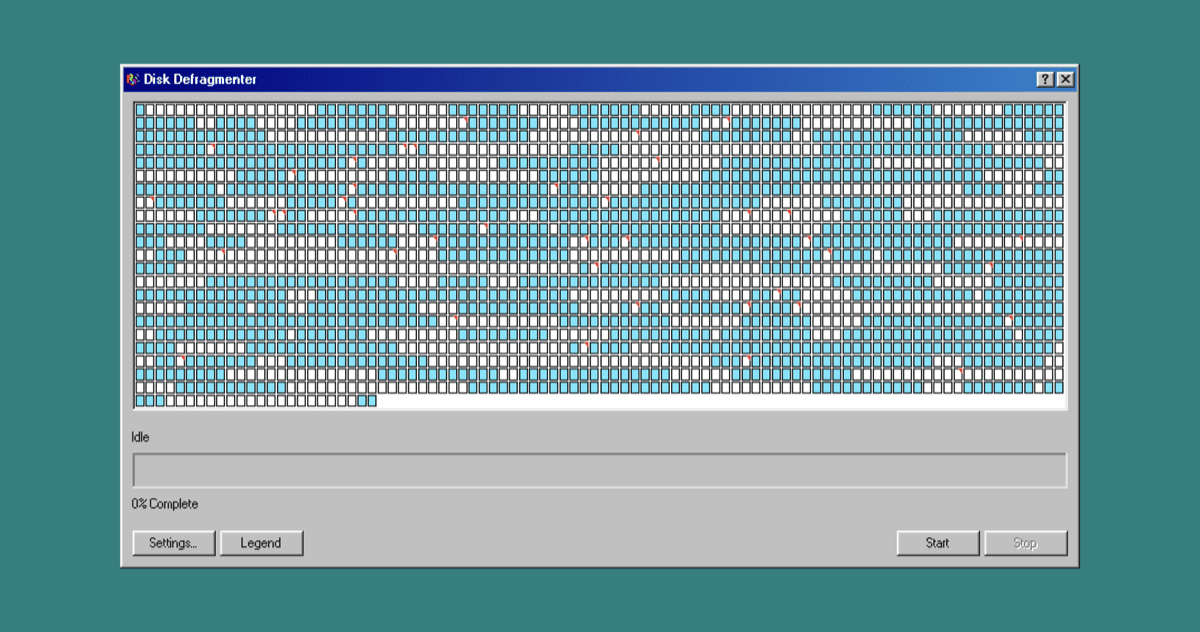
    https://morello.dev/blog/defrag98-rebuild

    what it looked like before

    https://morello.dev/blog/windows-98-defrag-simulator

    a previous discussion:

    https://news.ycombinator.com/item?id=40962195

    here is another version i found when googling these things that seems somewhat similar, but with a few more "accurate" features. also, has the source available in a single file.

    https://horatioconkerhead.github.io/win98-defrag/

    if you want the real deal, you can run windows 95 in the browser quick. it took running it a few times to get it to actually defrag:

    https://archive.org/details/win95_in_dosbox

  • I am guessing the developer took into account the fact that the younger generations these days don't have the patience for real time defragging.
  • I'm a stickler for accuracy too. The defragged blocks in the original Win9x program weren't solid blue - they had a hatch pattern texture to them. I remember it way too vividly.

    Source: Watching a disk defrag was every millenial kids equivalent of going to the laundromat and watching laundry tumble.

    https://youtu.be/dc_SDyLYq3U?t=347

  • I love this. I wanted the disk noise, and I got it. I will say that’s a lot faster than my drives were in the late 1990s though.
  • The speed is determined by a simple 1000 / <iops> per disk (there's different disks if you click "Settings").

    If you inspect and go to sources and look for "1e3 /" you'll find the line responsible, you can set a breakpoint and change e.disk.iops to 1000 which will make the timeout per row 1s instead of 2-4s, so the whole thing goes faster.

  • There's something satisfying about defragging that has been lost to time. Like oiling a squeaky engine
  • That and many desktop PCs making a kind of grinding noise from the floppy drive on start up, along with the bios "BEEP", as the default boot order option was to seek booting from A: (and possibly B:) floppy drives before the hard drive.
  • Degaussing too.
    by slig
  • I agree. It may sound elitist but back then you need to understand a few concepts to use a computer. From simple things like a filesystem (folders, file, different file types, things my 19 years old nephew don't know), to how to install software, how to download software (!) and then things even a bit more technical: an operative system, how it works, booting, drivers, etc.

    Now everything is just easier (which is better for most people!) but I miss the old days.

  • Perhaps it's appropriate for me to link to the free game I made where you play a taxi driving through Disk Defragmenter and delivering stray blocks of data to their final locations: https://safetystoatstudios.itch.io/ddr. It was pretty fun to watch Defragmenter as a kid, but it would have been better if it was interactive, kind of like the 3D maze screensaver.
  • Brilliant. Now we need a crazy taxi and GTA version where you cause mayhem trying to steal or return blocks.
  • AND you made it for Sega Genesis! That's so good.
  • When I was younger, my friends and I joked about making a "Disk Fragmenter" which would enumerate through every file on the disk and split them into non-contiguous clusters to make sure that the actuator arm on your platter-drive gets a PROPER WORKOUT TO FEEL THE BURN.
  • LOL
  • Such tools really exist and they're used for testing file systems, so that you have a more realistic "aged" layout on a freshly created test file systems.

    We also have memory fragmenters to do the same for memory for the same reasons.