Join the discussion

Write your take first — we'll ask for email only when you're ready to publish.

  • Hacker News
  • Wow this is a deep dive, most people focus on the PC era. The Ultima/Impression were some of the very first commercial PCI cards, behind maybe NCR SCSI. Another interesting vendor in that era was Number Nine.
  • I haven't thought of Number Nine in years, but the mention reminded me that the BIOS on some of their cards displayed a Beatles lyric quote during boot.
  • Number Nine was amazing. But even more amazing was the computer integrator / producer that shipped their computers with Number Nines. The company Intergraph.

    I think the remnants are here now[0]:

    0, https://www.octave.com/about/about

  • My first association when someone mentions Matrox is MPlayer and mga_vid kernel module. I had G200, and hardware YUV acceleration worked perfectly. Direct access to hardware from MPlayer, it worked very nice, in console with `-vo mga` and in X11 with `-vo xmga`, there was no difference at all.
  • Je me souviens de passer régulièrement près du siège social dans le west island lorsque je travaillais à Montréal.

    Matrox était connu pour faire d’excellentes cartes pour le médical. Malheureusement, 3dfx était trop en avance pour les jeux.

  • In 2004 I was working in digital signage for museums and for one of them we needed to drive 16 displays from one computer. The article mentions this card:

    > On the 17th of December in 2004, the company announced the QIP LP PCIe where the QIP meant Quad Information Display. This was the industry’s first PCIe x16 graphics card, and it was a derivative of the Parhelia. [...] The card could drive four displays with a maximum resolution of 1600 by 1200 per display,

    I think we had 4 of these in one system and it was the only card on the market that allowed for this. We ran this on Linux and getting the bios set up correctly to support this was a nightmare. My memory is fuzzy though

  • That was an interesting read. Unfortunately I never has the pleasure of owning a Matrox. I got really close to buying a Millennium G200 back in the late 90s, but decided to go for the RIVA TNT instead. Was in the nVidia camp (with brief stints in Intel and ATi) until I swithed to ATi/AMD for good around 15 years ago.
  • I’m not quite sure what their functionality is nowadays, but I remember Matrox parts being popular as minimal VGA controllers on servers.
  • Had the Millennium. Wanted the Riva TNT. I had also file-deleted both of those from my brain.
  • I have a friend whose wife has strong sight challenges. He once swapped a much newer and more powerful card with me for my last matrox card, iirc it was a millennium ii. The matrox utilities included with the drivers had one of the best desktop zoom systems ever delivered on windows and this was worth more to them than anything else.
  • Memories! Back at university I got a G400 and, with the open documentation they released, was able to make a driver for BeOS. It worked but looking back it’s stark how much I have learned since then. One feature I particularly love is a dual head setup app using combo boxes instead of menus!

    Th code is still online, in full early 2000s web styling. https://64kib.com/old_foft_site/

    by foft
  • I had, briefly, some Matrox card with 3D acceleration on a DOS PC. It drove a PGA (Professional Graphics Adapter) monitor, a standard that predated VGA and went nowhere. The monitor was quite good but useless with anything else.

    For a time in the 1980s, I was writing drivers for graphics boards, and later doing 3D animation software. I tried a lot of graphics boards from now-forgotten vendors. Texas Instruments had the first PC RGB monitor and display that could display white text without color smear. The Wang Professional Image Computer was incompatible with everything else in PCs, with a different card form factor, a different monitor interface, and a different memory/device address layout that allowed 720KB of memory instead of 640KB. Plus their own version of DOS. Fujitsu lent me a prototype Fujitsu Sapphire, which never worked right. When I went to return it to their location in Sunnyvale, they'd moved out, shutting down their 3D graphics business. Dynamic Pictures had a decent 3D board, the Oxygen 202, that worked with NT 3.51. It took a while to get that working, but eventually it worked and I got 3D work done.

  • Founded in 1976 by Trottier and Matić, and according to the article and Wikipedia, since 2019 has been owned 100% by Trottier. There's no indication that the founders lost majority ownership at any time, and although they sold off one division in 2019, it appears that Trottier still owns 100% of the remaining two divisions today.

    That's pretty remarkable, isn't it? How many tech companies that had a period of being a household name have lasted 50 years and are still majority-owned by all or some of the founders?

  • SAS Institute is another. 50 years this year. And the founder still owns it fully.
  • When I was working on early 3D video games in the 1990s, all these companies would give you prototype 3D cards to make sure what you made was compatible. This was pre-direct X. On Battlezone, many of us had different video cards to maintain compatibility. I had a G200. It wasn't the fastest card, but I always thought it looked great.

    Later we got to demo early builds on pre-release TNT2 cards and it caused a panic for us because our game had always been graphics limited, and the graphics pipeline was built to be very steady. Incredibly smart programmers wrote our renderer from scratch in those days. Suddenly the frame rate was really fast, and choppy, because the hit from physics and AI between frames caused stutters. After that NVIDIA dominated.

  • Wow, I loved that game when I was a kid. Thank you!
    by rtra
  • I remember the same. My whole game dev company went to one game developer show and everyone came back with a couple of GPUs each. Two out of the three games we were writing were 2D only.
  • I was just a teenager and enthusiastic LAN party participant back then, but also was learning the basics of 3d modeling, animation, and gamedev.

    The pre 3DFX era was kinda interesting. The first hardware accellerated game I saw was VQuake on the Rendition Verite 1000 or whatever the branding was. It blew me away. When the Voodoo1 came out I was shocked by the framerate, but thought it looked ugly compared to the Rendition version. Technically the Verite had worse texture filtering, but I was used to the aliasing and thought the Voodoo looked overly smoothed.

    Back when 2d acceleration mattered Matrox was king. And you could always trust it'd drive even the most picky CRT at whatever refresh rate.

    You also could get the capture card with the Matrox Millenium and turn a Win95 pc into a legit video editing station, all be it hilariously limited vs today. I worked with a non profit briefly that did stop motion animation production with this setup.

    I was the first with a TNT2 at the big LAN party group in my area. The Voodoo2 SLI setups were still faster, but with the TNT2 you could do 16 bit color with a tweaked color map for id engine games, and it looked absolutely killer.

  • When I was building a linux PC in the late 90's, I bought a Matrox Millenium with the memory expansion to 8MB which could do 1600x1200 with 24 bit color.

    That was an awesome card for the time, and an incredibly stable analog signal, which Matrox was known for - other cards at the time would get fuzzy, shimmer, or have ringing / ghosting.

    At the time, for good support you needed to *buy* an X11 server for accelerated graphics support. I forget which one I paid money for, but within a few years it wasn't necessary as open source had caught up.

    by zdw
  • You mean the one from Xi graphics?
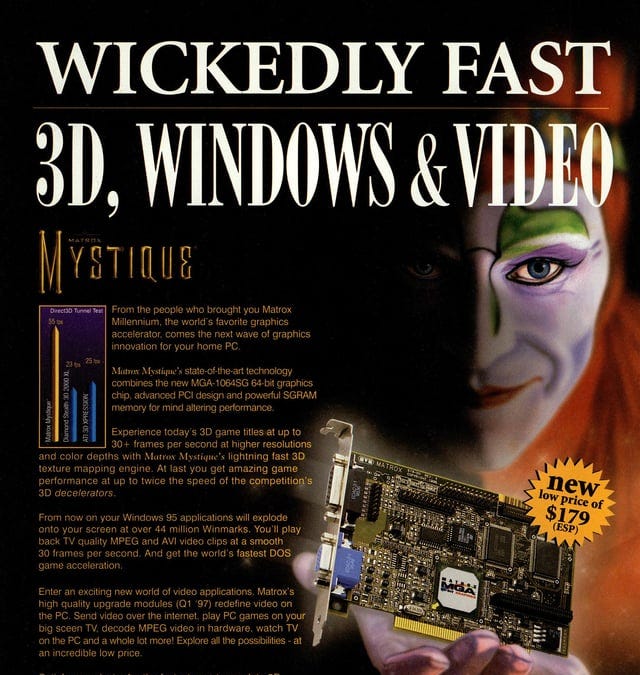
  • I think I had a Mystique which may have been a PCI model as well. I remember the signal quality being very visible switching a display from that box into some other one which had some S3 or something. The image looked noticeably blurry or fuzzy with the exact same display and cables on the worse card.
    by a96
  • Yeah, I wanted a Matrox so bad at that time because you could also do dual monitor on some of those cards. I had a sick NEC with a degauss button and trinitron style horizontal lines and a shit packard bell monitor. I wanted to do dual monitors so bad with both, despite the resolution asymmetry. Some matrox also had connection points for antennas and video capture. They were truly workhorse cards. But they sucked at 3D and were lapped in the Boot mag benchmarks for Quake 3D et al. I ended up with a 3D Labs Permidia 3D card anyway because I couldn't afford a Diamond or Voodoo and ended up turning textures off fully on Quake 3d in the end. Fun times, shout out Hard OCP.
  • Lesser known feature was that the Matrox MGA/G200 chips were capable of delivering "sync on green" via regular VGA cable. This was a specialized format were VSync/HSync weren't transmitted over dedicated pins, but encoded into the green signal. This was required by some (then) older workstation monitors. In the early 2000s, I managed to get a 20" SGI workstation monitor for 20€ at ebay (at times where 20" monitors were above 1000€) - because no one could use them with regular PC hardware. Using a single "sync_on_green" flag in my XFree86.conf file, and it would work flawlessly on my linux box.
  • PS2Linux required monitors able to do sync on green, which caught many that managed to get it, in for a surprise.
  • Sync on green could be done with the ATI Mach 64 as well. I picked up a 20" SGI monitor (if memory serves, it was made by Hitachi) on the "free" table around 1999 on my university campus.

    I got it working, but the one I had was pretty limited - it did a specific resolution at 60 Hz (I may have the details wrong - it was a long time ago). I never ended up using it, as I had a newer 17" DEC Trinitron from an old Alpha 3000/300LX that I also got super cheap, and it was a much better screen.

  • Back then some friends and I got hold of some lovely 20" Sun monitors that were sync-on-green only but none of our cards supported it.

    No matter! A transistor, a couple of diodes, and half a dozen or so resistors soldered into a DE15 plug shell made the "sync plunger" that cured all your woes.

    I probably still have a couple lying around. I could still just about draw the circuit from memory, not much good in these HDMI days.