Join the discussion

Write your take first — we'll ask for email only when you're ready to publish.

  • Hacker News
  • I wish to be named Emperor of One Thousand Galaxies.
  • It’s something of a pity NASA doesn’t offer that chance to crush 1,000 independent peace loving democratic galaxies in my brutal rise to power as my soldier fanatics sweep the universe.

    I’d pay for that. More exciting than owning a pixel.

    Imagine the headlines NASA To Sell the Universe.

  • I'm happily surprised they didn't ask for money.
  • They do this reachout all the time. I've got my (and family members) names on a usb stick held inside it and Mars lander (the non-mobile seismograph, whose name escapes me)
  • It’d be nice if we could see the pixel in an image preview. We have images for every pixel assignable, some even as sharp as the ones the telescope will get.
  • Fair correction: this is a pixel in Roman’s detector and its corresponding image data, not a permanently owned 3D location in the universe.
  • Is lake Michigan taken?
  • Not any more. The governor of Wisconsin just renamed it.
  • Joke's on them, I already own a star from the International Star Registry 8)
  • Good try, federal agency, good try.
  • If I adopt a coordinate, does that make me a Space Lord or Space Baron?
  • I got to say that while i had heard about jwst every week or so on how it was getting delayed and being overrun with costs, I didnt hear anything about Nancy grace. They were similar in price too.
  • My exclusive coordinates are whatever space I currently occupy.
  • Maybe we could map a discrete GUID to some amount of cubic volume of the universe and say that you 'own' that GUID and cubic volume of space.

    Referencing how many possible GUID can exist:

    The total number of theoretically possible GUIDs (Globally Unique Identifiers) is 2¹²⁸, which equals exactly 340,282,366,920,938,463,463,374,607,431,768,211,456. This is approximately 3.4 × 10³⁸ (340 undecillion) unique values

    a really quick calculation says that if you assigned every cubic area of the universe (ignoring that it's spherical?!) to a single GUID, each GUID would 'own' a cube of space about 680 AU on each side. So there's not really that many GUID.

  • This reminds me of xkcd/865.
  • This is a complete tangent, but how would you identify which cubic volume you own?

    Would it:

    1. Somehow remain static as stars and planets moved through it?

    2. Be relative to some coordinate system that we define?

    3. Follow some object like an asteroid or planet?

    Option (1) is literally impossible. We tend to think of space on Earth as something you can reliably divide up statically, e.g. you can divide the space inside a box up into cubic segments, and that works fine. But in that case, you've defined a coordinate system relative to the box, which is of course moving through space relative to everything else. You eliminate the motion issue by making everything relative to the box.

    We can't meaningfully do anything similar for the space between astronomical objects. Everything is moving relative to everything else, and there's no way to "stick a pin" in space. In a very real sense, there is no such thing as a fixed, static volume of space - space is relational, it's what exists between separated objects, it's not an object that can be divided up statically. All the relevant physical theories - special and general relativity, and quantum physics - confirm this.

    For option (2), we can try to define a box - a coordinate system relative to Earth, or the Sun, or the Milky Way galaxy, or the Local Group of galaxies, or the Laniekea supercluster, etc. But those are all moving relative to everything else, so any location we identify with coordinates based on that will similarly be moving. One day you might own a piece of space on one side of the Andromeda galaxy, the next day it would be out in intergalactic space (because at those distances, radial coordinates move fast!)

    You might think that perhaps we can define coordinates relative to the cosmic microwave background (CMB) rest frame - the reference frame in which the CMB radiation looks uniform and identical in every direction, i.e. not redshifted or blueshifted. In a certain cosmological sense, this is a good candidate for the rest frame of the universe. But the problem is, how do you assign coordinate values to that? You're left with the same basic problem - any point you pick either can't be reliably identified, or is moving along with some chosen object.

    Option (3) ends up being the most sensible, for the relational reason I mentioned: we can, in many cases, reliably identify a particular object in space. Now we're back to the "star registry" kinds of scenarios, where you "own" a star. Owning a piece of space can't really work.

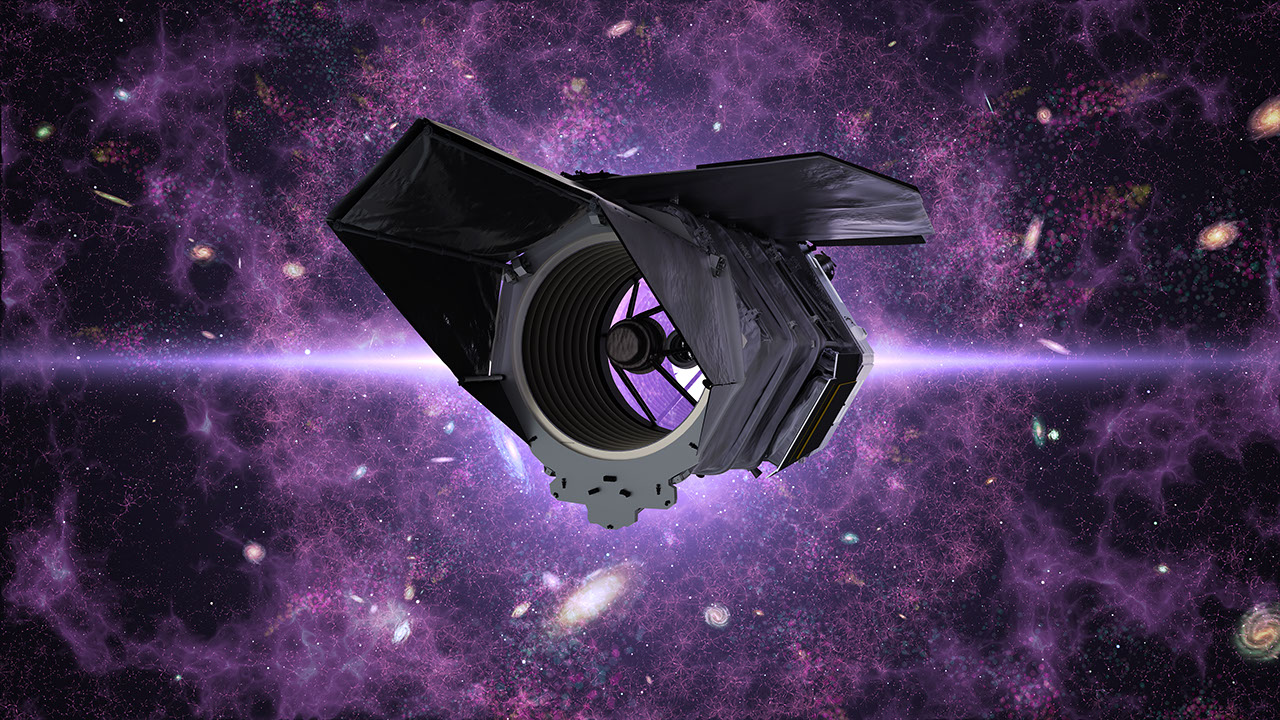
  • Title doesn't match submission: it's not really a "coordinate" in 3D space, you "adopt" a pixel from the early imagery taken by the Nancy Grace Roman Space Telescope.

    Maybe that can be reverse-projected back to something like a coordinate (if you know the distance), but it's not the same thing.

  • NasaFTs are back in style!
  • It's a solid angle basically, right ? That's a coordinate
  • Thank you for the clarification. My brain read the headline and imagined a combination of what3words and the stargate address system!
  • It's a coordinate on the celestial sphere, which is just as good a coordinate as anything else. Now, if the title had said something like "place" you might have a case that the expectation is that a specific spacetime point is being defined.