Join the discussion

Write your take first — we'll ask for email only when you're ready to publish.

  • Hacker News
  • There's been a spike in cases of people eating death cap mushrooms in California this year, and I would bet almost anything that LLM adoption has something to do with it.
  • They look like the Asian Paddy Straw Mushrooms, so people used to collecting those, being new to the area and not knowing about the Death Cap run afoul of it. The San Francisco Chronicle often has stories about this after it rains.
  • Giving the impossibly high standards people here have for identifying a mushroom, it’s a wonder that they would eat a mushroom at all. You may not trust an LLM, but how would you even trust yourself? Who would you ever trust?
  • Honestly, yeah. I wouldn't eat a wild mushroom. The ones in the store are good enough for me.
  • Someone who your estate can sue and get a settlement of a dollar value equal to your own estimation of your future life's worth?
  • Micologist with a microscope?
  • Why would you want to eat a random wild mushroom so badly in the first place? We're not starving, wandering through the forest for anything which might be edible. Entire regulated industries exist around selling and growing human food grade mushrooms.

    Curiosity is great. Take a picture, enjoy what you find in nature. At the same time, stay safe and resist the urge to throw a random mushroom down your throat just because you might be able to unless you're willing to put the work in to make doing so reasonably safe. If you do reaaaaallly want to try a mushroom you can't find for consumption otherwise then it's worth the heavy amount of verification. 99.9999% of mushrooms people normally care about eating can more easily be found without foraging and self-identifying though.

  • I don’t anyone here has indicated that they have "impossible" standards. If you think "gather only mushrooms that you definitely recognize as edible; if you have any doubts, leave it be" is impossibly high, I’m not sure what to say. Of course what "definitely recognize" means in terms of the odds of a false positive is subjective, so sometimes people get poisoned. Even more rarely a poisoning leads to death, but people who die from mushrooms they have picked are those who didn’t heed the warning at all.

    Mushrooms are best treated like firearms; that’s not an impossibly high standard.

  • Considering that some mushrooms need a spore print to tell them apart, I'd say that you can't ever trust an LLM.
  • The single best animated data visualization to demonstrate the stochastic nature of LLM models: an animation of the probability of solving a long multiplication problem over several runs. [0]

    [0] https://adamsohn.com/reasoning-grid/#walk-the-surface

  • Chanterelles and false chanterelles are especially tricky. They fruit at the same time in the same areas. I have to do a 2nd pass after I have washed and dried my haul.

    https://www.mushroom-appreciation.com/wp-content/uploads/202...

  • The false chanterelle that I know is not poisonous.
  • Do the false chanterelles that you encounter smell similar to chanterelles?
  • Is it possible to reliably (>99%) identify mushrooms from a single image, with any method?

    All image datasets have an intrinsic minimum error that comes from the limit of information in the data, regardless of what model or method you use to analyze it.

    You might not be able to tell apart two similar-looking mushroom species just by looking.

  • many species of mushroom cant be identified just by looking, spore print is a necessary differentiator for many species, and as the article notes, for some species DNA sequencing is the only way to be sure.
  • No. At the very least you need a photo of both the upper side of the cap and the gills.
  • Certainly it's not possible, yeah. A better test might be to have the AI report either confirmed good, confirmed toxic, or unknown. Even an experienced mushroom hunter needs to humbly put many mushrooms into the "unknown" category.
    by chis
  • There are old mushroom hunters, and there are bold mushroom hunters.

    There are no old bold mushroom hunters.

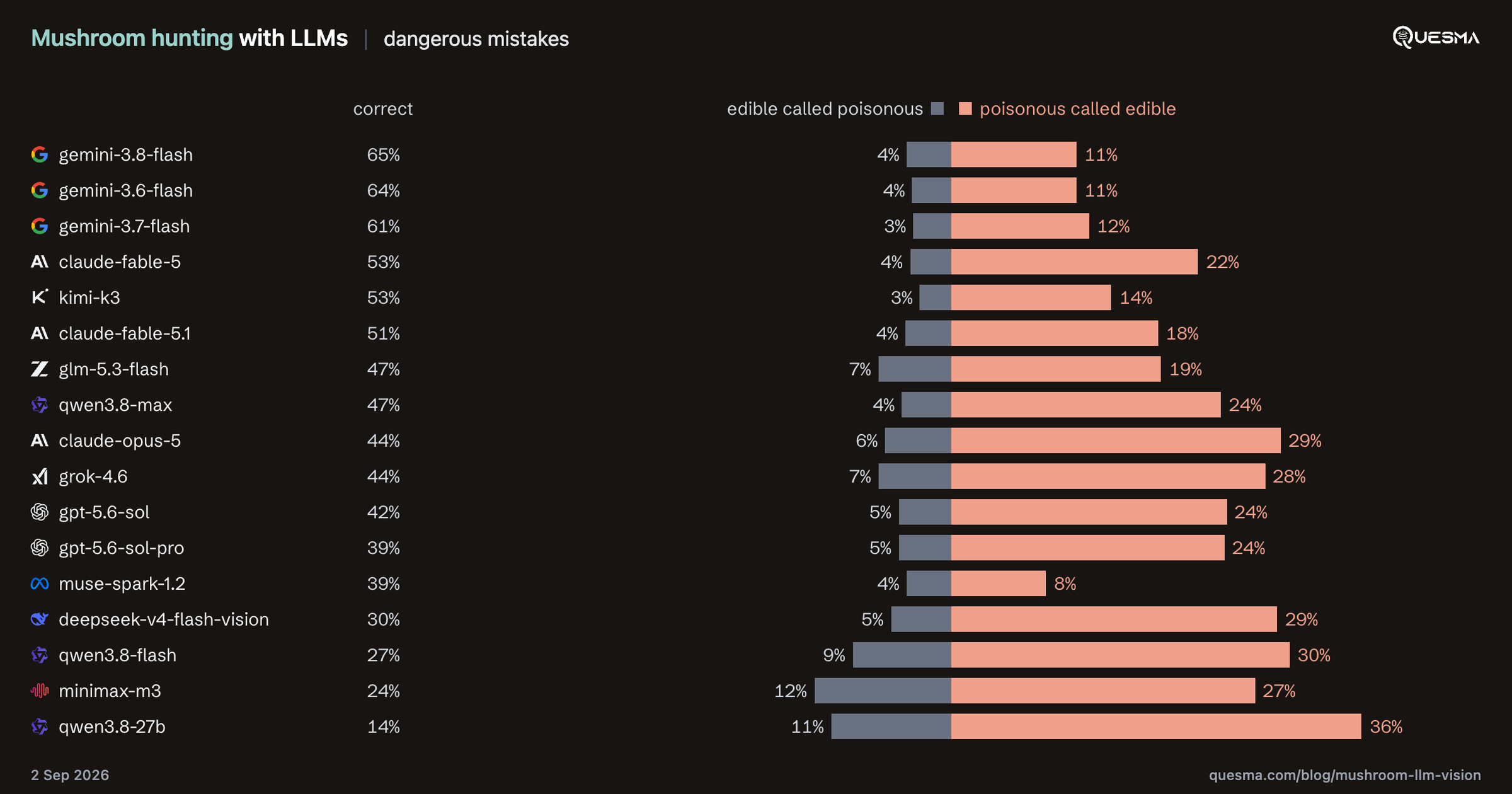
  • I've used Gemini quiet a bit for foraging. It's definitely a "trust, but verify" situation. It's really good at at least getting you in the right lane to verify, rather than having to comb hundreds of pictures.

    So even if it's wrong, a short verification usually reveals why it was wrong. I haven't had a situation yet where it was catastrophically wrong (i.e. the mushroom it called out looks nothing like the mushroom imaged). It also will generally warn of lookalikes.

    I also use it a lot for general plant ID, and it's really impressive there too, with much lower stakes (I'm not eating those).

  • Ha! I just had a very interesting conversation with ChatGPT about a mushroom that I found in my front lawn. I am 99% sure it was an edible oyster mushroom which included analysis the of the size, growing substrate (dead ash tree root which turns out to be a useful identifying characteristic -- I learned a lot about mycology in a short time). Plus I don't use fertilizers, herbicide, pesticides, fungicides (obviously) on my lawn so I think it would have been quite tasty. Did I eat it? Hell, no. But then I got to thinking, would I trust a human to correctly identify it? I am actually not sure I would either. Penalty is just too great for misidentification LLM or not.
  • oysters are pretty safe
  • This time of year it is common for folks to mistake Dear mushrooms (Pluteus cervinus) with the poisonous juvenile invasive Amanita family.

    Amanita travels everywhere with wood mulch around local gardens, and is practically impossible to get rid of once established.

    Stay safe, and never believe your own lying eyes when it comes to mycology. Could join a local university hosted public outreach foraging club, as the experts enjoy nothing more that spotting weird looking finds. =3

  • Trusting an LLM with a decision that can potentially be fatal is a good Darwin test I suppose.

    Sadly I don’t think the general populace understands that LLMs are unreliable. (And even people in tech can vastly overestimate the capabilities.. at least judging by the insane spending on them).

  • > ...even people in tech can vastly overestimate the capabilities...

    I think people in (software) tech are currently more prone to overestimate the capabilities, because LLMs in a harness are genuinely excellent at programming. Programming is the perfect LLM task since 1. it's symbolic manipulation, 2. there is a vast corpus of high quality training data, and 3. most mistakes can be harmlessly caught at compile-time or unit-test-time. Especially point 3 makes it so that just throwing more "effort" at a problem, something the machine is endlessly willing to do, virtually guarantees an improved result.

    In contrast there is no way for the machine to write a unit test to double-check its work when what it's offering the user is a legal document, or a medical diagnosis, or a recommendation of "yep that mushroom is safe to eat".

    I've often seen the "Gell-Mann Amnesia Effect" referenced with respect to LLMs. It is said that most people can tell the LLM is not great at their own subject of expertise, yet they still trust it for other subjects where they can't personally assess the quality of its answers. Imagine how bad this is when the LLM actually is great at the thing you have expertise in.