
Join the discussion
Write your take first — we'll ask for email only when you're ready to publish.
- Hacker News
- Good in theory, bad in practiceby AbuAssar
- The delicate discussion of why this project failed does not obscure its actual shape. The failure to embrace has cost decades of progress in most critical dimension of society.
I hope that's recognized and progress occurs.
by aaroninsf - You’re up against a tall order trying to modernize Arabic. Arabic is half a language and half a religious practice in itself. Arabic speakers, who are absolute majority Muslims, have explicit statement from God that Arabic is a holy language sent by God as the most perfect language PERIOD. It’s why he chose it for the Quran, and why it should remain unchanged. All attempts to “improve” it would be an admission of some problem or some deficiency which is heresy in itself. How can you improve on what God has already declared perfect? The solution is often to go back to the older style of Arabic instead of your local dialect if you really want the perfect Arabic, not to invent new concepts.
Even though Arabic script itself isn’t necessarily mentioned in the Quran and Muslims will generally accept that the script itself was “standardized” after the Quran, they would also argue the concept of “Authority of Al-Salaf” which is the belief that the closer the generation is to the prophet, the more authority that generation had on whatever topics they ruled on. There is an important hierarchy of authority in Islam where the Quran is at the top, followed by any saying or a judgement by the prophet, then followed by those of his direct followers, then their followers, then scholars of their followers, then their followers, all the way down to today. Since according to the most accepted story, Arabic and its script were “standardized” in the few decades following the Muslim prophet by his direct followers, you can’t really improve it. Or rather, you have to have a really enormous social influence and respect to be able to even make the slight modifications. There has been few influential Caliphates or scholars in history that have been able to do so, but it’s hard to imagine anyone today with that level of importance or influence.
- This seems wrong. There's a lot of diversity in Arabic, there has been modernization in Arabic, and the Quran does not declare Arabic a perfected language. Arabic has changed already.
I'm not saying this project will be successful and I'm sure the cultural importance of Classical Arabic is one of its obstacles but I don't believe this is a language group that is religiously forbidden to modernize its typography.
by tptacek - >Arabic speakers [...] have explicit statement from God that Arabic is a holy language sent by God as the most perfect language PERIOD
This is wrong and I couldn't find a serious source stating anything like it. There's nothing in the Muslim faith that suggests the Arabic language itself is holy or sent by God.
The whole post reads a bit like a rant against Arabs suggesting their background precludes adaptation or something of the sorts.
by nervai - I don't think Arabic script is that hard. It's nearly phonetic, unlike English. It's not super broad and hard to memorized like kanji. I don't know, maybe I'm just removed from the struggles of people learning it for the first time.
- By saying it “isn't that hard” you're admitting that it could definitely be easier.by Timwi
- It's interesting since a lot of language simplification attempts of that era did succeed, off the top of my head, Chinese (in the PRC) and Malayalamby InfiniteRand
- And English :) to LOL Fook this. Fook that. Bro.
Younger generation of simplified brains will come up with even more simplified languages.
by shuwix - Turkish as well. They moved from Arabic to Latin script.by mohsen1
- I once was curious about possibly learning Arabic. I left more confused after my initial research than I went in.
What's a good Arabic dialect to learn such that you're as intelligible as possible?
by mettamage - Fus-ha Arabic (High Arabic) is intelligible as it is used in official communication, academia, news papers, documentaries, etc. But obviously it is not spoken day to day.by za3faran
- When I was studying it, we were told Syro-lebanese was the cleanest and most easily understandable, with Egyptian a distant second despite being quite peculiar due to widespread popularity of their media production.by neitsab
- For all the boneheaded/bad decisions that Mao Zedong made, simplifying the Chinese script turned out to be an excellent one, greatly increasing literacy and having a good side effect of making Chinese writing much accessible and legible at smaller sizes (found in modern print and on screen).
When it comes to typing on computer/phones, nowadays Chinese type Latin letters (pinyin) that approximate a Chinese sound, which then reveals Chinese characters that relate to that sound, which they can then select. it's much faster than using root strokes to "build" the character. I was wondering if any similar technique is used in Arabic?
- There's an Arabic version of pinyin called Arabizi which consists of the Roman alphabet plus the numbers 3,5,7 and 9. It's written left to right and was created for texting on feature phones. Everyone can read it in any Arabic-speaking country. Given that so little is published in Arabic, a change to this grassroots script is long overdue.by pseingatl
- Mao did not simplify Chinese. The First Chinese Character Simplification Scheme simply adopted simplified characters in common use.
But if it was such a great idea, why is it not an issue in Hong Kong which does not use it?
by xdennis - It’s not needed. There are strict rules on how a letter is rendered based on where in the word it is.. and there are 28 letters (plus some variants).by zawaideh
- Arabic doesn't need it because it's based on a finite number of letters and each letter is a sound, pretty much like latin. It does also contain a 4x2 nunation[1] system that acts as short vowels and/or stress but it's apart from the stress, it's optional and can be mostly* derived from context.by senadir
- Simplified Chinese don't make much sense. The idea is that humans write everything manually forever, so simplifying saves time. But that's moot with computers that system coupled with high resolution monitors, and IMO it just leaves less clues for learners and less literate to infer meanings. They're also less visually balanced than the traditional.by numpad0
- But doesn’t Taiwan use the traditional script? And over in Taiwan they don’t seem to have issues with literacy or using smaller screens?by ViktorRay
- > it's much faster than using root strokes to "build" the character.
In fact, input methods like this not only exist—https://en.wikipedia.org/wiki/Cangjie_input_method—but are in more common use than you might expect! I've met more than one (regular-person, non-technical) office worker who could barely hunt & peck on a coworker's Chewing but could fly with Cangjie. e.g., https://youtu.be/sVAQSBU5OOo?t=98
Coïncidentally (or not,) they also had very high written character recall and speed… (a skill that is notably very weak among syllabic-IME users…)
by jamesdutc - It's easy to see how it could simplify typesetting, I would think computers though have that mostly covered now. Making Arabic easier to read is interesting, it would help new learners potentially, but I am not surprised that existing readers and writers might not warm to the idea. I wonder if Simplified Mandarin isn't a little similar, mostly accepted, but with a little pushback.
- One of the hardest thing for me when reading Arabic is to identify the start and end of letters. I have started using monospace Arabic font with little gaps. Works great. https://github.com/eliheuer/hasubi-mono
- I had a similar issue yesterday with classical Greek. Some website used a typeface that renders one of the diacritics in a totally unfamiliar way.
I had to copy and paste the text into another doc and change the typeface to understand.
by CoastalCoder - This made the rounds on HN a few ... weeks? months? ago, and it's also about Arabic typesetting, and it's a very interesting read: https://lr0.org/blog/p/arabic/
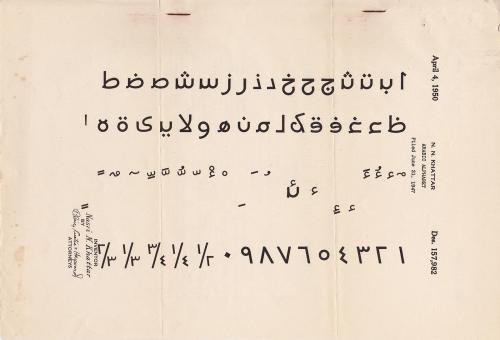
I'm a little surprised that Nasri Khattar wasn't mentioned in it.
by pavel_lishin - My biggest problem letter is mim. It essentially disappears in a lot of styles. If I was more fluent I’m sure I’d recognize the words more readily and know when to look for it. I don’t find the rest of the letters too difficult even at my basic level.
I was struck by the lack of books in the homes of even educated people in Yemen. I once went to a book fair in Sana’a that was well attended. Think it was on a college campus. I don’t remember seeing many novels in Arabic, they were mostly in English and French. I had been told that if someone sent me any books in the mail they would have to be cleared by the censor before I would get them. That pretty much equated to never getting them. The book fair was a relief. I picked up David Copperfield and Women in Love and that was enough to last me until I made a trip out of the country.
by musictubes - The lack of books and therefore lack of reading leads to reduce vocabulary. I read somewhere the average of known words by an Arabic speaker was substantially lower than English speakers.
When I switch to speaking Arabic (poorly) I struggle to find words because my vocab level is so bad. Imagine for an every day person, not being able to effectively express themselves. It would lead to a ton of frustration, miscommunication and misunderstanding.
I really need to improve my Arabic!
by greazy - Efforts to reform Arabic script made more sense decades ago when illiteracy was high. But once the internet came along, the young people across the Arabic-speaking world who might have once been illiterate, took to literacy very keenly: you had to be at least at little literate to SMS with friends, access internet porn, and get sweet dopamine hits on social media. Suddenly Arabic script turned out not to be that big of a problem after all.by TFNA
- Those same teens came up with Arabizi so they could text. It consists of the Roman alphabet plus the numbers 3,5,7 and 9. It's written left to right and was created for texting on feature phones. Everyone can read it in any Arabic-speaking country. Given that so little is published in Arabic, a change to this grassroots script is long overdue.by pseingatl