Join the discussion

Write your take first — we'll ask for email only when you're ready to publish.

  • Hacker News
  • > AI progress is racing along, but virtually all of the visible progress is in the realm of knowledge work, i.e. activities that can take place inside a computer.

    The most visible "progress" of so-called AI is in activities that take place at the interface between computers and gullible humans.

    The reason so much less progress has been made in robots is that real-world physics isn't gullible.

  • > I am confused at how Waymo engineering can be so robust as to yield an astonishingly good safety record, and yet so slapdash as to happily drive into deep water.

    I feel this is actually somewhat straightforward. I assume deep water on roadways is not commonly in the training set, because frankly it isn't common in real life, and when it is common people do not drive and do not gather that training data. As a result the proper response has not adequately been beaten into the models. There are probably also challenges of world-sensing, since water can act as a mirror, and maybe other complications. So waymos are bad at handling deep water on roadways. However, deep water on roadways is also not common in the areas where waymos are deployed. As a result, waymo's have a great safety record, and at the same time they make mistakes that are obvious to a human.

    A common criticism of AI discourse is that people act as if LLM's "think". I don't want to be a vocabulary purist, but I suspect that's related to the astonishment here -- the Waymo doesn't know what flooding is, it doesn't fear drowning, it doesn't think. So unless it's been repeatedly trained, or a special case has been hard coded by manual effort, it doesn't know that flooded roadways are dangerous.

    I have made a lot of assumptions here, and I don't truthfully know what the training data looks like. Feel free to push back if you think my assumptions are wrong. I'd especially be interested if somebody can show that water on roadways _is_ in the training data

  • (I'm the author of the blog post)

    My thinking here is that Waymo has logged hundreds of millions of miles at this point (and even more in sim), and there are a lot of nines in their safety record. So even the rare edge cases should have come up. You make a good point that the deep water scenario may be not only rare, but also under-represented in the training data. On the other hand, you'd think they would have thought to explicitly train for it; it's not that obscure of a possibility.

  • People drive into deep water all the time - some states specifically have laws making them financially liable for the cost of rescue because it’s such a stupid thing to do. But still, they do it.
  • Main problem of humnoid is price. Price starts from 20,000$ and we need jetson thor(On-device) or 5090 for learning capabilities. Their ability per cost is not greater than human. The other problem is hard to predict/simulate real world contact physics. Thus, most of company use VLA for task with contact. Even if VLA is advancing rapidly, it's still immature to be deployed in practical.
  • “I may not care if my household robot takes all night to tidy up and fold the laundry.”

    I do. I don’t want robot vacuuming or making noise at night or doing something potentially dangerous unmonitored while people are asleep.

  • Small cleaning robots have existed for long enough. For floor sweeping they are more efficient than any 2-legged form.

    Not folding the laundry, though.

    by xxs
  • people very soon as going to look back at all of us and just think "they didn't even have robots yet! how did they even eat?" Well, future readers, it isn't easy! We either go to the store and bring back groceries ourselves or pay a helper to do it. No robot in the loop there. Then when it comes time to cook something we either have to cut it up and otherwise prepare it and then cook it ourselves, or another human can do it, or we can buy fully prepared foods that don't require cooking. And then when we're done we have to put our own dishes away into a dishwasher. We can't just say a few words and have a robot do it for us!
  • As if people of the future will be able to read. Maybe some future AI anthropologists will read it though.
  • > We either go to the store and bring back groceries ourselves or pay a helper to do it.

    Or order it from Amazon, in which case there was likely a robot in the pipeline.

    Robots are very widely deployed, but almost entirely invisibly to the customer yet.

    Roomba is the main exception.

  • Eat? You must be living under a rock. We've been evaporating our sustenance and storing it in the cloud for years.

    Perhaps nanobots will be able to carry the chemical makeup of a cheeseburger and rebuild a bite directly in our mouths, no cooking necessary!

  • “If a self-driving car finds itself in a situation it can’t handle or suffers a glitch, it can pull over or, in the worst case, just hit the brakes.”

    Wrong. Try hitting the brakes of your self driving car on highway at 65mph or during unprotected left turn with oncoming vehicles.

    Or have a glitched self-driving car hit its brakes and block the road, for emergency vehicles, and endangering other people.

    Self-driving cars can also suffer a glitch without knowing they suffered a glitch, like Waymo cars driving into flooded roads.

  • This is why im not worried about "AI" taking over the world. Robotics still has a LONG way to go. A human can balance a plate on their arm with food while holding a glass of milk in that hand and a donut in the other and still manage to open a door, step over potential floor obstacles, maneuver tight spaces, get bumped by a child or dog, and still set it all down without spilling it 99% of the time. Just the hardware with the dexterity and responsiveness to perform the same task would cost unimaginable amounts of money to produce, not to mention the control systems needed to do it smooth and gracefully enough.

    Maybe in another 2 decades I could see it possibly starting to change, but even then I wouldn't bet the horse on it until I saw it. Cars only have three degrees of freedom and even that we are barely able to get working well enough to put it into limited practice. And yet one single human finger has atleast 3 degrees of freedom, and is covered in what is the equivalent of a million tiny ultra sensitive tactile sensors.

  • This is true, but it’s also assuming the robot has to be human shaped. A robot with 4 extendable arms and a gyroscopically balanced cabinet in its chest wouldn’t have too much trouble with that task.
  • I've yet to see anyone address the more immediate problem for (humaniform) robotics, which is that it runs counter to the economic benefits of specialization at industrial scales.

    A robotic warehouse that's just like a human warehouse but with robots walking the aisles will always be more expensive (and likely far less efficient) than a warehouse purpose built for automated picking using standard containers and graspers, conveyer belts or path constrained wheeled platforms--something I've seen in operation 20 years ago.

    A factory of general purpose robots sewing t-shirts will always be more expensive than a factory a low wage humans sitting there doing the same.

    The Fourdrinier process for making flat-sheet goods (i.e., paper, thin plastic, in massive rolls) is more than two centuries old. The idea that robots, returning to dipping a mould into the furnish to create individual sheets, could even come close to the economics of modern papermaking is insane.

    [0] https://en.wikipedia.org/wiki/Paper_machine

  • People think robots in terms of humanoid or number-5 style robots.

    I think it'll be more capable appliances at first.

    Like a lawn mowing device that also spots weeds and can spray them.

    Next iteration has arms to rip weeds out of the garden.

    Next has attachments so you can direct it to do pruning.

    Next it can figure out the pruning itself and move the outcome into the woodchipper.

    And so on and so on.

    It's not going to be one day a humanoid robot comes into the house and does everything.

  • The Jetsons' Rosey was never seen cleaning the bathroom, was she/it ? Some things are too implausible even for childrens' science fiction.
  • Ooh. I see. so that's how it aaall got started: https://m.youtube.com/watch?v=YVMoLvMrC8E
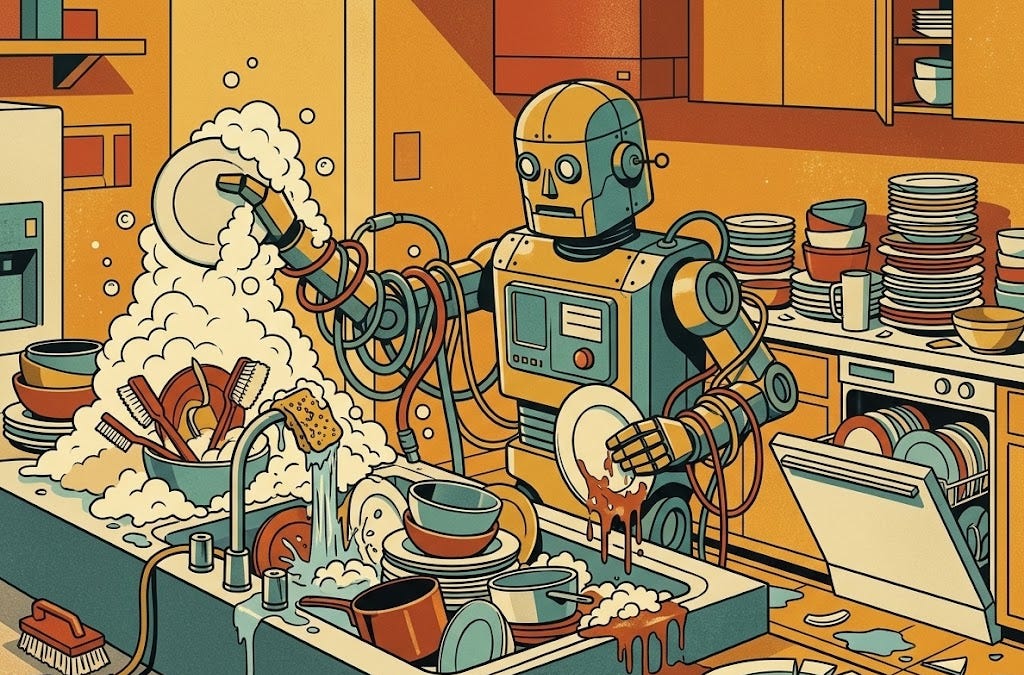
  • Sometimes, I wonder why we even need humanoid robots for some tasks. For example, we had that robot over the past year that would wash the dishes...would be more efficient if it had 8 arms for that job. Or if I wanted it to clean my room, an arm that can extend up to the ceiling.
  • While I agree this is a technical path that makes sense, I'm not sure it's a financial path that does. Or at least not outside of very upscale, niche products for wealthy consumers or businesses.

    Which doesn't mean I disagree with you. I also think that this progression is the most likely. But it implies we're decades away from broad adoption rates.

    Think fifty years to hit mass adoption, not five. (Because that much more closely aligns with other structurally disruptive tech like automobiles or computers) Which is definitely not the story being pitched to investors at the moment.

  • > Like a lawn mowing device that also spots weeds and can spray them.

    That's available as a tractor-pulled implement for farms. Deere and some others make such things.

  • Yes the problem is very hard. Mainly because high DOF generalization is very difficult.

    We have self driving cars because what are the control inputs? Pedal, brake, steering wheel. This already took many many years.

    Now for a humanoid robot: An action space that is metaphorically Hilbert. (Physically, yes, obviously)

    Also, IMO, LLM's can aid the development of robots, but do little beyond a planning, human control interface. Below that it's the domain of control and the solution will be the correct combination of classical, neural, and real time optimization based control.

    All the bad-ass biped robots that actually look natural? It's PID controls wrapped with control barrier functions constraining the QPs that are being solved in real time.

    But that's annoying to derive per-application. So we'll need neural methods which can be learned (while being constrained by a priori knowledge of dynamics). My hunch is that the Yann LeCunn type of jepa models will be how tasks can be learned.

    by kooi
  • > So we'll need neural methods which can be learned

    Data is a problem. LLMs had the advantage of the whole internet to train on. Robots don’t have that corpus of information. And real time learning seems to be something that everyone in AI is studiously ignoring.

  • I don’t think the complexity scales with every additional degree of freedom like you are painting here. I think it’s just a matter of getting the right training data in sufficient quantities for an LLM to output across all degrees of freedom simultaneously without it being some exponential leap.
  • >Yes the problem is very hard. Mainly because high DOF generalization is very difficult.

    >We have self driving cars because what are the control inputs? Pedal, brake, steering wheel. This already took many many years.

    Its actually amazing to me that this hasn't been solved yet. Its really not that hard of a problem.

    Modern robotics, including self driving, are famously all about end-to-end training. We are trying to replicate what humans do through muscle memory. But muscle memory is not what makes us good at operating in the physical world. The thing that matters the most is our ability to simulate the world around us in a compressed form into the future, which lets us predict how our inputs will affect the world.

    A similar system in a self driving car should be able to drive perfectly without self inflicted accidents 100% of the time, especially with basic lidar to serve as an error correction mechanism to the camera 3d scene reconstruction.

  • > All the bad-ass biped robots that actually look natural? It's PID controls wrapped with control barrier functions constraining the QPs that are being solved in real time.

    That's not entirely true. Locomotion is well addressed by RL in sim. It's true that there is still a PD layer, and the RL policy produces setpoints for it.

  • Roboticist here. All of this, and he didn’t mention compliance or online adaptation to otherwise un-sensable dynamics. Or massively complex miniature mechanisms.

    Current generation tactile sensors cost a couple thousand $ PER FINGER, and have a real world MTBF of hours. The cost can be solved with economy of scale. The fragility is harder.

  • I don't think that's true. AI could work around all the physical imperfections.

    Just imagine yourself controlling an imperfect robot with some joysticks or maybe a sensor suit. You'd certainly do much better than current robots. The limit is the robot's brain, not the physical actuators/sensors.

  • yep. and with the western funding model, how many hardware iterations can you do before you run out of runway?
  • I'm picturing humanoid robots having to operate in pairs so they can constantly fix each other.