Join the discussion

Write your take first — we'll ask for email only when you're ready to publish.

  • Hacker News
  • It annoys the heck out of much of the rest of the world but the truth is that Americans are staggeringly wealthy compared to nearly every other place on the planet. The US GDP per capita figures do translate into significant wealth for a large portion of the population.

    Most don’t live like it and frankly the ones that show off typically are nowhere are wealthy as they’d like you to believe. Meanwhile the person driving an older model car and mowing their own grass has millions in the bank and doesn’t think twice about it.

    Many are simply very wealthy but not materialistic.

  • It annoys the heck out of many Americans as well.

    Once you realize that 10% of households are getting $200k+/yr of unearned income and 1% of households are getting 1.3M+/yr of unearned income by virtue of owning lots of assets in an economic system geared to pump assets at the expense of literally everything else, it becomes very clear why the social contract experienced by the rest is undergoing rapid deterioration yet still has legions of influential staunch defenders that come out of the woodwork any time someone proposes even modestly pushing back on the worst of it.

    Oops, did I say "unearned income"? Forgive me, I meant unrealized gains -- I didn't mean to imply that any taxes were due on those massive passive flows of money. Perish the thought!

  • And based on this comment section we get seriously offended when you point it out.
    by rcpt
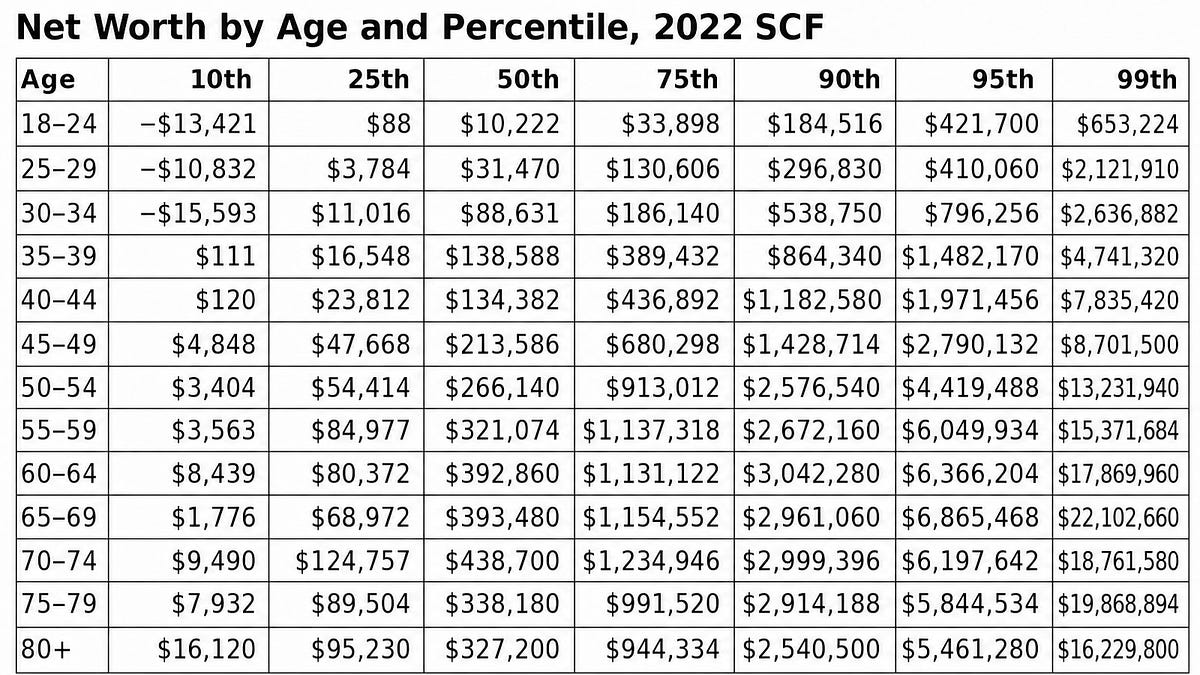
  • 25th percentile never goes above 125k at any age, and 50th percentile doesn't go much about 400k at any age.

    Sounds like a lot compared to annual income, but that's trivial if you're trying to retire and live off these assets until you die. Especially since public support, pensions, etc have been eviscerated.

    Assuming you can get income of 5%/year from your assets (obviously depends on interest rates, investment mix, etc), 50 percent of people would need to survive on 20k/year or less to retire.

    That's not being wealthy. That's choosing between abject piece, and working until you die. Dystopian.

  • The numbers are broken, a more accurate measure would have been median rather than average.

    People work because they dont have or need more money to survive.

    Reality will tell you if people need to work as many hours and as many jobs, they must be struggling. This is also true of many western and other so called rich countries.

  • Wow, there's so much wrong with this "statistical analysis" to the point of absurdity. Goes to show that even a 30-year economics professor can be duped by AI.
  • Source: Chat GPTs calculations.
  • I was going to say something similar: invoking one’s credentials as a professor only counts for legitimacy if that 30-year legacy of thinking on the topic is applied to the problem under discussion.

    In my opinion, if the analysis is offloaded to the plagiarism machine, it loses all epistemological value.

  • It looks like his results are taken from the Federal Reserve 2022 Survey of Consumer Sentiments. https://www.federalreserve.gov/econres/scfindex.htm The data is publicly available. I don't think that this was hallucinated.
  • Given the inequality in the USA, it would be more relevant to the rest of the world if he used the mode instead of the median. The mode is what most of the population gets to experience. In most OECD countries, the mode and median are a closer than the USA, so the median is a better approximation of the mode. Comparing the USA's median to their daily experience is a little misleading, the mode would be less so.
  • Looking at a generation that benefited from both an epic housing price run up and same for stock market and observing that the old people seem to be very rich is A) stating the obvious and B) not a sign of the system being healthy and sustainable
  • The chart there is deceptive—to be fair, we should be showing 1 and 5 percentile as well. Saying “walking around a mall you might encounter a few decamillionaires” is shifting focus from the fact that 1 in 10 people are experiencing near zero net worth and the bottom 1 percentile likely are suffering way more than the top 1 percent are enjoying their riches.
  • Seems fringe and out of touch with my reality and everyone I know. Does anyone have any info on who the author is and what sorta school of though he's involved with?
  • Really? Given you're on this site I imagine you know at least some technical people. And for the most part we're all very well off.
    by rcpt
  • The data is from the federal reserve.
  • He is the living, breathing stereotype of what I would expect from an "economics professor for almost 30 years":

    "I got in early to the ponzi and life is good can't see what the ungrateful young'uns are whining about!"

  • > who the author is

    The article has the author listed at the top. If you click on it, you'll see which university he works for. With his name and university, you can Google to find his wikipedia page.

    https://en.wikipedia.org/wiki/Bryan_Caplan

  • The numbers aren't fake but the analysis glosses over a lot.

    The author's data says the median net worth for 65–74 year-old households is about $410,000, but 56% of it is home equity. Exclude the house and the median net worth drops to $171,000 and the median financial assets (the part that could actually be converted to cash easily) are only about $115,000. At the 25th percentile, wealth excluding home equity is under $30,000 for every age bracket from 55 up. So basically the net worth number looks best for the people whose wealth is least spendable.

    That calls into question the author's claim that "given their current net wealth, a solid majority of Americans can comfortably retire without Social Security." Back of the envelope math: safely drawing 4% on $115,000–$170,000 provides just $5,000–$7,000 a year versus a median SS retirement benefit in the low $20,000s.

    For a typical retiree, SS is worth more than every financial asset they own combined. The author says that downsizing or reverse mortgages count as "doing fine" but that's just his opinion. Reverse mortgages are expensive and you lose your equity quickly, and downsizing in the current market basically means that you pay way more for way less.

    From what I can tell, it's basically the top third who could do without SS comfortably. Not at all a "solid majority."

  • This whole article is giving off "PragerU"

    Is this chart based off personal or household net worth?

  • From the Fed's own description of the dataset "The Survey of Consumer Finances (SCF) is normally a triennial cross-sectional survey of U.S. families. The survey data include information on families' balance sheets, pensions, income, and demographic characteristics."

    Families would suggest household, not personal.

  • Of course people in US are very wealthy if you are looking at dollar amounts. It would be impossible for cost of living to be this high, without a lot of people having decent amount of wealth.

    But people's perception of their own wealth depends way more on relative value of their wealth compared to cost of living. If you live in a city where some shitty 2 bedroom apartments cost 1m$+, you aren't going to feel all that rich even if you have 10 million dollar net worth.

  • The mean and the median wealth differences is the most striking. USA is second on mean wealth and 27th in median (just ahead of Greece). A few trillionaires pulling it up with nothing trickling back down.

    Still wealthy either way but I always find it a bit jarring how skewed the US self perception is since people generally experience something closer to the median.

  • $10M at 10% returns is $1M/yr passive. That'll pay for an expensive apartment before you consider working.

    In fact, that's sort of the problem: the massive "rich people get paid for being rich in proportion to how rich they are" cash flows run away exponentially from the "poor people get paid for working" cash flows, inflating the price of any inelastic good beyond their reach. The economy stops being about work and starts being about wealth. Which might be fine if most people were wealthy enough to not work, but that's overwhelmingly not the case so it's overwhelmingly not fine.

  • I was born and grew up in the states and am living outside the country (near Europe) and the smallest things made me realize how truly rich Americans are compared to the rest of the world, in real terms. Even things like fast food or Walmart are a testament to the abundance the US has (not saying it is right or wrong). And these systems are supported by the simple fact you just have a lot of rich people walking around relative to the global population.

    To put it more succinctly, I know engineers/lawyers/doctors in this country I’ve been living in that make 2k a month and it’s good. They work hard, it’s stressful. A fast food worker in the US can make $15/hr and bring in 2.4k a month.

  •     Even things like fast food or Walmart are a testament to the abundance the US has
    
    You can get similarly fatty foods in most corners of the world. Doesn't matter if you're deep in central Asia or Africa, any urban settlement will have a restaurant that sells them and most of the roadside stations too.

    Supermarkets are pretty American, but that's not true for the same reason it might have been in Yeltsin's day. I think you'd have trouble making a serious argument that communities with Tesco are fundamentally poorer or worse off than those with Walmart.

    American megastores with 60,000+ SKUs are just a cultural preference in North America, and not even a universal one at that. Costco is very successful both domestically and internationally by rejecting that model. Trader joes (Aldi) is extremely competitive in the US despite a blatantly European business model. Americans are far more excited for either one of those to move in than a Walmart.

  • Are you also comparing benefits and cost of living? That fast food worker cannot afford an apartment, groceries, or healthcare after taxes. God help them if they have children. Further, what little safety nets that exist in the United States are being gutted by the current administration and the likes of DOGE, which was run by a billionaire who paid a massive sum of money to the current administration to be put in a position to cut government benefits.
  • The issue for Americans is that living a pretty "normal" lifestyle is way more expensive compared to living very similar "normal" lifestyle in most other developed cities.

    Easiest example would be groceries. If you live in a crazy expensive place like Manhattan, you could easily spend 4-5x more on groceries compared to a city like Warsaw. But it's not like you are getting better produce or products in Manhattan, you are getting same stuff, just paying way more.

    And this is true for other day to day stuff too like Housing, Healthcare, Schools, etc.

  • The US does not lead in broad markers of "social good" like life expectancy, happiness index or social mobility, so what exactly is this KPI useful for?
  • And for that 2k/mo they barely make rent, can't save and are one health issue away from $100k debt. Not really a shining example of either wealth or freedom.