Join the discussion
Write your take first — we'll ask for email only when you're ready to publish.
- Hacker News
- Whatever they eat, did that go down to an all time low. Im m curious about the chain reaction vs an isolated result.by krm01
- That was my thought too. Nothing in an ecosystem exists in isolation. Change a single variable, especially a dramatic change like going from 8% to 60% on a single variable, and there will be ripple effects throughout the local ecosystem. The Law of Unintended Consequences is one of those unchangeable, eternal laws that when you forget them, the Gods of the Copybook Headings limp up to explain it once more*.
* https://www.kiplingsociety.co.uk/poem/poems_copybook.htm for anyone who doesn't recognize the reference in that last sentence. Most people will, I hope, but there's always the lucky 10,000. (https://xkcd.com/1053/)
by rmunn - Cattail tubers and bark from smallish hardwood trees that they embed underwater for winter food. Hidden affect of that is the cattail is not particularly good habitat or food source for waterfowl so then you have one more item pushing down on waterfowl populations.by destitude
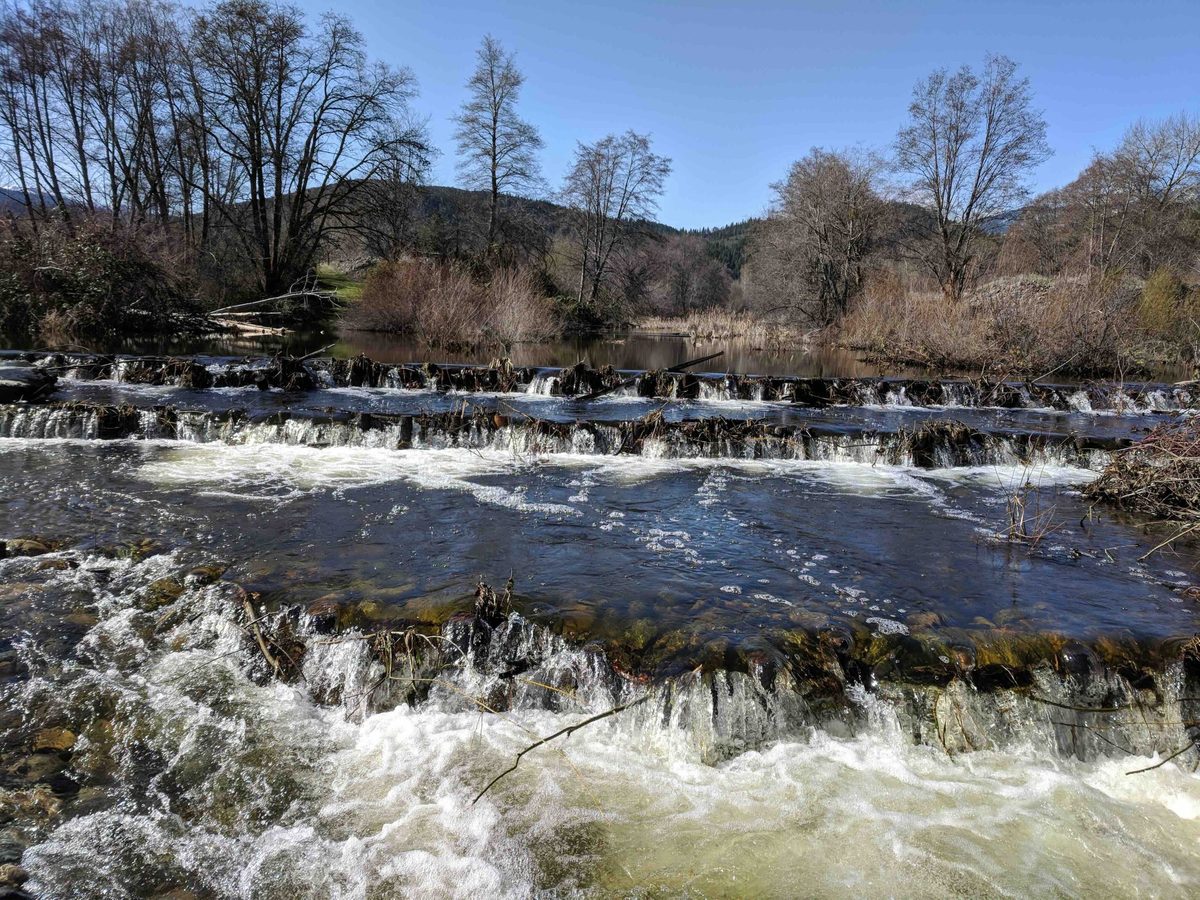
- There's a wetland near where I live where beavers have reached saturation, with a web of dams that has turned a valley into prime beaver habitat. (1:45 short video)by pfdietz
- The temperature is cooler? That can't possibly be the only reason to explain such a dramatic change in survival rates. We definitely need more research on this topic.
- There's more food, less energy wasted fighting excessively strong current, and more places to hide from predators. Water quality goes up downstream of a beaver(-ish) dam.by oatmeal1
- If you do even a moment of reading about salmon, you will find that they are extremely sensitive to warm temperatures. Even a couple degrees F above their "normal" will allow disease to run rampant.
- Maybe I missed it, why didn't they just reintroduce beavers?by josefresco
- We need a professional approach there, able to see the whole picture. Amateurism can be really expensive.
Sometimes beavers are a big mistake. Hazelnuts and willows can be chopped to the ground and just will return stronger and more dense. Poplars will regrow from the roots at some distance. Argentinian trees they will vanish instead. This happens because temperate South American forests never evolved with beavers. On this places they may done more harm than good.
by pvaldes - > Maybe I missed it, why didn't they just reintroduce beavers?
My guess is that trees are not there in numbers enough to support beavers. Or maybe they don't want beavers chopping the trees.
by pvaldes - TFA implies the issue is land owners won’t allow it:
> But beavers can only thrive if landowners allow them to.
by cornstalks - The beavers are still there, just not in high numbers like they used to be. Right now the ecosystem can only support the population that is already there. Maybe eventually it will support more and then the number will increase naturally.by petcat
- They are doing that in a few places in the UK. It's working really well and they can rapidly transform the landscapes they are in. The flip side of course is that a lot of residential areas and farmland is in what used to be wetlands that are now drained on purpose. If you introduce beavers there, it tends to be a bit disruptive as they would cause issues with flooding areas that people would prefer to keep dry.
But done right, they help restore wetlands that absorb and retain water rather than causing lots of issues with flooding downstream when it rains. Wetlands have a lot of bio diversity, insects, birds, plants, predators, and all the rest. They also capture a lot of carbon All good stuff. Mostly the beavers take care of all of the heavy lifting of building dams and maintaining them. It's a lot cheaper than trying to emulate what they do with a lot of human labor. But of course keeping beavers confined to where you want them is maybe a bit hard. So, artificial dams are a good alternative.
- Nice.
But beaver dams also capture sediment, one of the problems is that rain on loose soil forms deepening gullies.
Another big part is the wetlands, which helps water refill aquifers if the soil is permeable. And a charged aquifer provides springs.
I have no idea why I am so obsessed by aquifer recharge.
There’s a fair number of greening the desert YouTube channels using Beaver Dam analogues funded by the state.
by zeristor - >I have no idea why I am so obsessed by aquifer recharge.
Maybe humans have an instinct for water management like beavers do.
>There’s a fair number of greening the desert YouTube channels using Beaver Dam analogues funded by the state.
I enjoy some of these too. There's also water management focused regenerative agriculture projects that are cool like food garden pond systems in Hawaii[0]
by goda90 - With freshwater increasingly being a problem, being able to slow down tributaries and allow the water to percolate and help rebuild aquifers is something that should be happening everywhere possible.
Lost cost, high reward. Not sexy enough to get the attention it deserves.
by pstuart - You will be amazed at how much local governments don't care about this. They actively try to remove water was fast as possible from an area.by destitude
- Loads of projects being done for that (at least in Europe) after droughts have become more and more common. Netherlands especially, worldwide experts in water management because for hundreds of years they tried to actually get rid of the water; the whole country is full of infrastructure for managing the water table.
This year was bad in terms of drought, yet it seems it wasn't as bad as the one we had a few years ago (2018 or 19? I don't remember exactly) because they allowed the water table to go higher a bit, used the ijsselmeer as a giant fresh water reservoir, closed / limited locks, etc. After this year and the rapidly accellerating / worsening effects of climate change, like the drying out (ok, low water levels) of the Rhine, I'm sure they're working hard to do more. They can for example choose to allow the flood plains to flood even when there's no flooding, to (locally) add to the ground water. Granted, it takes (iirc) decades or hundreds of years for that to end up in the aquifers but better now than never.
Other projects I've heard of involve allowing rivers and streams to meander again, undoing the work of straightening them to get rid of water faster and / or optimize shipping traffic.
by Cthulhu_ - I’m rather partial to beavers myself and was sad to learn about their demise in North America. At one point their pelts were referred to as “the coin of the realm” https://youtu.be/8XToPq9lsOM?si=DJKedkQXuzJhSmf7by reilly3000
- Here's your link without the surveillance: https://www.youtube.com/watch?v=8XToPq9lsOM
I'd recommend Leila Philip's Beaverland: How One Weird Rodent Made America. It's a great work of narrative science writing.
I think we deeply underestimate the profound impact beavers had on the landscape in North America. We truly live in a post-beaver geography. The beaver hat fad in Europe was the primary driver of their population going from hundreds of millions to less than 100,000.
by culi - It was an interesting, but counterintuitive result that water temperatures went down after artificial beaver damming. Their theory is that the water is able to permeate more into the ground and exchange heat with the ambient underground temperature [1]
1. https://www.science.org/content/article/beaver-dams-without-...
by richiebful1 - Armchair theory: larger water surface from beaver lakes means larger evaporative surface means things cool down. Depends on the ambient temperature and amount of sunlight as well, of course.by Cthulhu_
- Imho wetlands and beaver dams increase median water flow in the creeks. Without them you get a spikes of flash floods in extreme cases and a dry/just trickling stream for the dry periods. The other benefit of a higher water table and less violent water flow is the riparian vegetation shading the water.by elmolino89
- I wrote a while back about some coho fry populations I found which would have benefitted tremendously from dams. Each day I returned I would find more and more empty pools along the river, picked clean of fish where I’d previously seen dozens or hundreds of fry. Beavers used to live here in great numbers, but these days it’s fairly uncommon to see them. I bet they saved a lot of coho back in their day.
- Thank you for posting this.
And also for your simple, matter-of-fact tone.
by bell-cot - Practical Engineering recently did an episode comparing human dams to beaver dams. Not really an apples to apples comparison because we build dams for very different purposes, but beaver dams are not only less disruptive to the environment - they are often a net positive. Although they do sometimes create a nuisance for human infrastructure.
https://practical.engineering/blog/2026/8/18/are-beavers-act...
by freetime2 - My youtube feed gets a decent amount of recommendation from channels such as Mossy Earth, Plant Wild, etc. that showcase some nature restauration project. While I cannot help myself to be a bit skeptical of those efforts (how really sustainable is all of this; isn't that just a tiny drop in the ocean, etc.), I really like to have positive and hopeful news like the one of this article amidst all the ambient negativity and pessimism.by PetitPrince
- At the very least they give us real-world experiments for what works, and honestly I will take the occasional bit of ecological good news over another article explaining how doomed everything isby BrtByte
- With how low many wildlife populations are, surprisingly small areas can be ecologically importantby tdb7893
- The way I see it, yeah it's a drop in the ocean, but these individual sites will act as "seeds", safe havens for wildlife that, from there, can spread out far and wide. Like these fish, they don't stay there, they go far and wide and become part of a much bigger ecosystem. Part of the reason why these restoration projects are important is because at the time, people weren't aware (or didn't care) of the scale or impact their efforts in hunting beavers had. I'm sure the individual hunters also figured their hunting was a drop in the ocean.by Cthulhu_