Join the discussion

Write your take first — we'll ask for email only when you're ready to publish.

  • Hacker News
  • If you want an expensive model to reason on your files, you need to give them your files.

    If you think a cheap model is smart enough to filter information to give to your expensive model, you can save some money. If you think your cheap model is smart enough to format your expensive output, you can save some money.

    In practice, this didn't work well until Qwen 3.8.

    Qwen 3.6 and (abliterated) Gemma 4 were almost there but still making mistakes.

  • Oh dear, why does this website override scrolling behavior?
  • My first thought too! I couldn't put up with it. Left quickly.
  • glad im not the only one that enabled screen reader mode to scan the article for some goodies
  • There are a bunch of approaches that do this kind of thing to reduce token usage ("semble" came to mind, technically different but functionally similar) but their performance is usually mixed because the models haven't been RL tuned to use them as they have the default tool suite. Combine that with the incentive by Anthropic et al. to make you actually burn through as many tokens as possible and I don't see these kind of things becoming mainstream yet. Maybe once we reach a point where consumers actually care about cost (because LLMs have become commoditized) these cost-reduction approaches become relevant enough to actually finetune the model with them.
  • It doesn't work well in practice.

    Try it yourself, use a big model like Opus or Sol to implement everything by first making a plan using plan mode.

    Then try distributing the task to a cheaper models like Luna Max or Gemini Flash 3.8.

    During planning, the big model already reads the relevant files in context, while giving a smaller model a slice of work itself requires the big model to reason about the task distribution, review, etc.

    So do you really save on tokens?

  • Maybe not, but I like to review the plan anyway so that I'm less surprised by what it actually did.
  • > Try it yourself, use a big model like Opus or Sol to implement everything by first making a plan using plan mode.

    When I do this, I can have it use cheap subagents with models like Luna to read the relevant files.

  • When I've tried it using API-rate billing I've saved on $$ on the tasks where I split planning+execution into Sol+Terra or Terra+Luna even. I wasn't paying attention to the token count, I was paying attention to the spend.
  • Side note: PLEASE DONT hijack scroll. Its just a bad bad thing to do. Please dont.
  • Does anyone even review these blog posts before they get published? If nobody in the company can be bothered to review it, I don't know why they expect anyone to persevere with the AIphorisms
  • It cuts token usage because they are using a different service with a different token budget for the reader/code writer tasks.

    You can also just delegate this to subagents with Claude Code (though you have a more limited choice of models unless you swap the cheaper models via OpenRouter).

    I'm OK using a dumb model as a smart grep, but the whole point of using the frontier models is using their intelligence for the hard stuff like coding.

  • You can also use hooks to force the use of subagents for this. The stack here is entirely unnecessary
  • I wish websites would stop messing with the scrolling behavior.
    by pmdr
  • thank_you_the_office.gif
    by _rwo
  • If I said what I really think should happen to designers and "devs" who fuck with scrolling, dang would have to delete it and ban me.

    Ublock on Firefox mobile seems to keep scrolling unfucked on this page for me. (Designer/"dev" of this page still sucks wet hobo socks.)

  • +1, this bothers me more than it should.
  • After seeing a few comments about scrolling on that page, curiosity got the better of me and I dared open TFA.

    I found no problem scrolling. Either Firefox on Android doesn't support whatever trickery they are doing, or they reverted it.

  • I used to date a girl who was a designer and had to plead with her that breaking behaviors I'm used to is not a positive UX.

    "But it adds motion" was the classic reply.

  • What great productivity gains are Spotify achieving in making their product worse?
  • Enshittification optimization. Fully automated now.
  • They released some AI related product for the desktop that was probably vibe coded and will not be installing
  • The spotify desktop app is one of the worst pieces of software by a major company I have ever used.
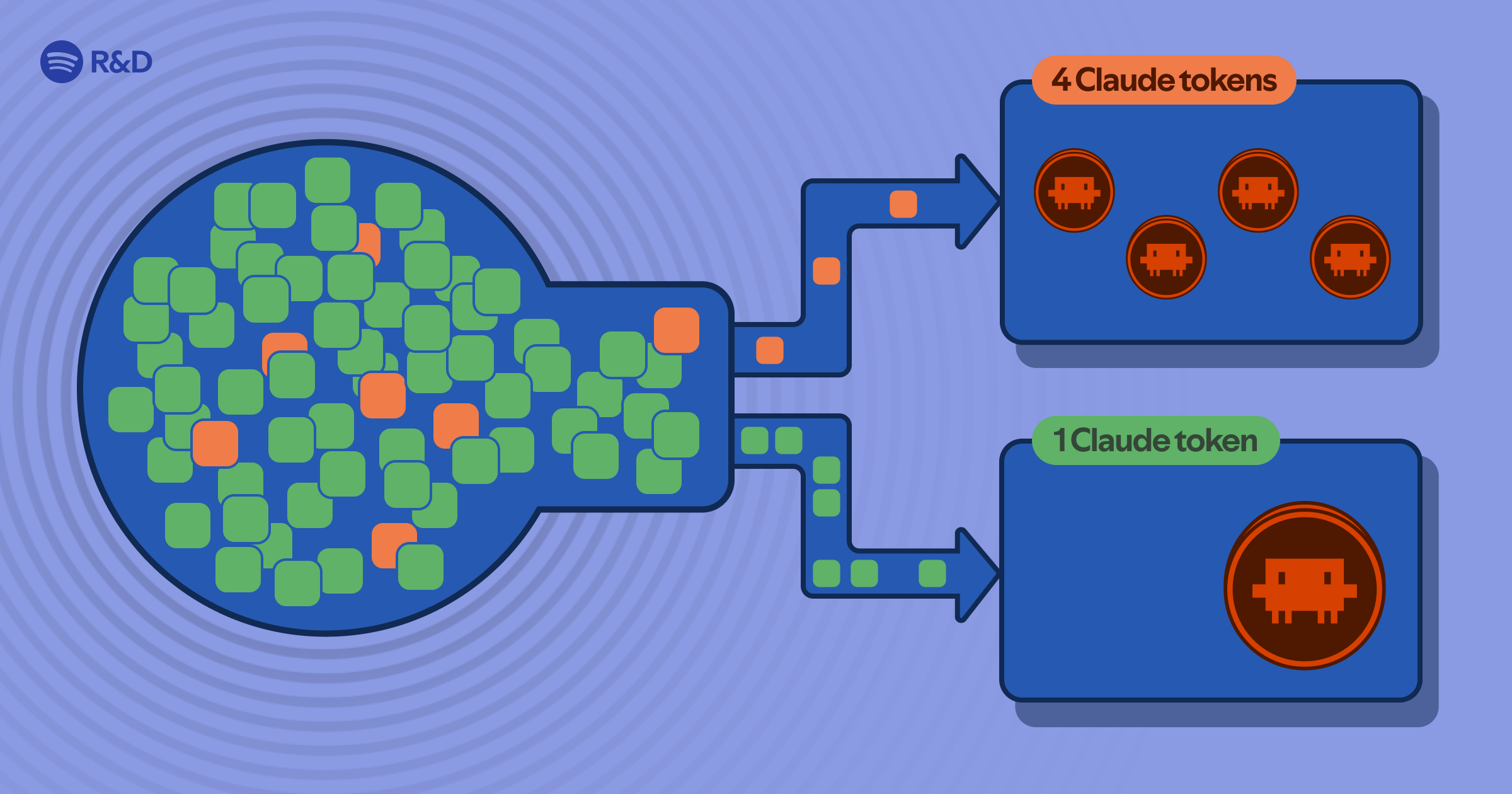
  • No mention of correctness or task success rate. This only works if the subagent model is much cheaper than the one running your session, which means it will probably be mistaken a lot more often [1] about what the code does. Routing purely on size tells you nothing about code complexity.

    On top of that, saving 90% of input tokens != saving 90% "of tokens", output is wildly more expensive.

    [1] especially if it's a really old model like Gemini 2.5!

  • Yeah this article is quite shallow after having read it; delegating to a remote sub-agent sounds novel but how does it _actually_ perform?

    I'm personally skeptical of optimizing for minimal token consumption, the closer to a vanilla setup I am the more confident I feel I'm always getting the best performance out of my models.

    Just look at how JetBrains measured rtk and found that while an individual call saves tokens, agents on average perform *more* turns and use *more* tokens to accomplish one task[1]

    [1] https://blog.jetbrains.com/ai/2026/07/rtk-claude-code-token-...

  • So this is just delegating certain work to dumber models? I certainly wouldn't use Gemini 2.5 Flash (!!?) for code writing as suggested.

    I've never had an issue with Codex or Claude reading massive files, they're really good at precise greps.

  • This does seem to just be a subagents implementation.
  • This is basically exaclty what Cursor started doing when Composer was first released.

    The app would start using it for exploration tasks, and then as it improved it became the default for writing code and tests too. You can change it of course, but I find it does a pretty decent job if you have a large model directing it.

    The parent model of course checks the work, but most of the time the handoff is good enough that no edits are needed.

    It's also pretty fast and cheap, firing off a bunch of sub-agents to explore different parts of the codebase is a regular occurrence for the way I work.

    by fy20
  • Am I missing something? Unless you have infinity money, would it not be very stupid to pay for "precise greps?"
    by jrm4
  • I wish I could say this explains a lot about the state of Spotify's apps, but they have been that way since long before AI.
    by lxgr