
Join the discussion
Write your take first — we'll ask for email only when you're ready to publish.
- Hacker News
- *Privatized profit. The ~210mil € of public funding wasn't private. It is now I guess, lol.
EDIT: Title has been updated so my comment seems out of context.
by nick_ - > "The findings identified an unintended opening of the vent valve
How do they figure things like this out, after a rocket goes "boom"?
by ____tom____ - Telemetry?by noisy_boy
- Something they might have is a lot of strain gauges around the rocket. They can tell if the rocket is bending and compressing (and how) -- but they are also essentially high-speed microphones. Valves make sounds (cause vibrations) and they are easy to spot if you have high-speed samples of your strain gauges. You can also triangulate distances if you have multiple strain gauges with synchronized high-speed samples.
It's good practice to dump data into several flash memories + transmit live. The live transmit is likely only a small summary of all the data that they capture -- distributed flash memory locations is a cheap way to increase the chances of getting useful data after a boom/crash (put them in orange water tight containers that can float + give them a beep-beep radio transmitter).
by peterfirefly - I'd rather see something owned by the people, not private.by sbseitz
- I'd rather Germany had been first on the Moon, instead of the US.
Disclosing a preference isn't necessarily insightful commentary on achievements.
by s_dev - Congrats to my country! After a lot bad news around car industry, a good hope for another heavy industrial branch.by eMpHaSe
- If Isar will get a large scale commitment from the government(s) to launch the OneWeb 2.0 constellation, as the European alternative to US, Chinese and Russian systems, they may well become a major launch provider. And of course they are already working on a much larger reusable rocket.
Although the original OneWeb satellites were assembled in the USA, they were developed in Europe and the components were always sourced predominantly from Europe, Canada, and Africa, with only some parts produced by the European companies in the USA, and even fewer parts sourced from the US companies. It is a very European satellite.
by generuso - Congrats! How come European companies still haven't managed to match SpaceX's capabilities? Europe has an incredible talent pool, especially in aerospace, and some of the world’s best expertise in precision engineering, instrumentation, sensors, avionics, and other hard-tech subsystems. A huge amount of the expertise and supply chain for these components is concentrated in Europe.
So what are we missing? Is it mainly systems integration, manufacturing scale, risk tolerance, organizational structure, or the willingness to iterate as aggressively as SpaceX? It feels like Europe has many of the pieces needed to build world-class launch systems, but hasn't yet put them together at the same scale and speed.
by num42 - Probably the biggest thing is that capital in the EU is far more conservative.by consumer451
- > So what are we missing?
There are some (many?) European companies which are considered as least as much as a jobs program as anything else.
In 2018, Alain Charmeau (in)famously expressed frustration with SpaceX in an interview with Der Spiegel and rejected reusability with these words:
“Let us say we had ten guaranteed launches per year in Europe and we had a rocket which we can use ten times—we would build exactly one rocket per year,” he said. “That makes no sense. I cannot tell my teams: ‘Goodbye, see you next year!’”
https://arstechnica.com/science/2018/05/ariane-chief-seems-f...
from the original
https://www.spiegel.de/wissenschaft/technik/alain-charmeau-d...
A more recent example would be the Future Combat Air System (FCAS) project which was officially cancelled in June 2026, due to (?) industrial rivalry and leadership disputes, with a side order of politics.
by logifail - Most of the US space launch startups have failed. And in Europe it is harder to even try.
There was a confluence of several factors which helped SpaceX to succeed, and not the least of these was the employee number one. For many years, Tom Mueller has been working in his free time on rather large liquid fuel amateur rockets, which he was building in his garage and which he was launching from some amateur rocketry facilities in the desert. In terms of regulation it was a relatively accessible hobby in the US. At the time Musk found him, he was working on the original "BFR" -- a very large liquid fuel amateur rocket. So the deal was to invest serious money into the project and scale the same no nonsense approach to a small orbital launch vehicle. They were in LA, the center of US aerospace manufacturing, so through Tom's professional connections and knowledge of who was who in the industry, they were able to source the necessary materials, components, and to find the key personnel for their company. Significantly, NASA has already spent probably a decade or more trying to get somebody to produce a cheap small launch vehicle. This did not directly affect SpaceX, but it did fund the R&D for example at Barber-Nichols, which enabled them to offer a turbopump for SpaceX engine at a much lower cost than it would have been possible otherwise.
At first, Musk and Co thought that they would be able to develop the rocket for a few million dollars. But even in the US regulatory environment it turned out that doing everything in compliance with regulations raised the costs to well over a hundred million dollars.
So, Tom's hobby + Musk's activism + industrial ecosystem in the area + NASA's prior support of component vendors + being at the right time to snag the International Space Station delivery contract were all important for SpaceX thriving where so many others have failed.
by generuso - Plesetsk is also european soil.by blini-kot
- Kourou as well, although maybe a different definition of European.by seszett
- Yeah, just like Toronto is American soilby ShinyLeftPad
- They're using "Europe" as political shorthand for Western Europeby kylecazar
- Europe is a vibe based concept, a place can be European or not depending on the vibes. Even the east west central etc. are completely vibe based. Portugal for example is Eastern European country, meanwhile Romania is central according to some textbooks.by mrtksn
- This is an article title that needs a ton of caveats (the ESA launch site in French Guiana is indeed part of the European Union, and Russia's Plesetsk Cosmodrome is within continental Europe). Nonetheless the underlying achievement is impressive, and it's very good to see more private operators competing in space flightby swiftcoder
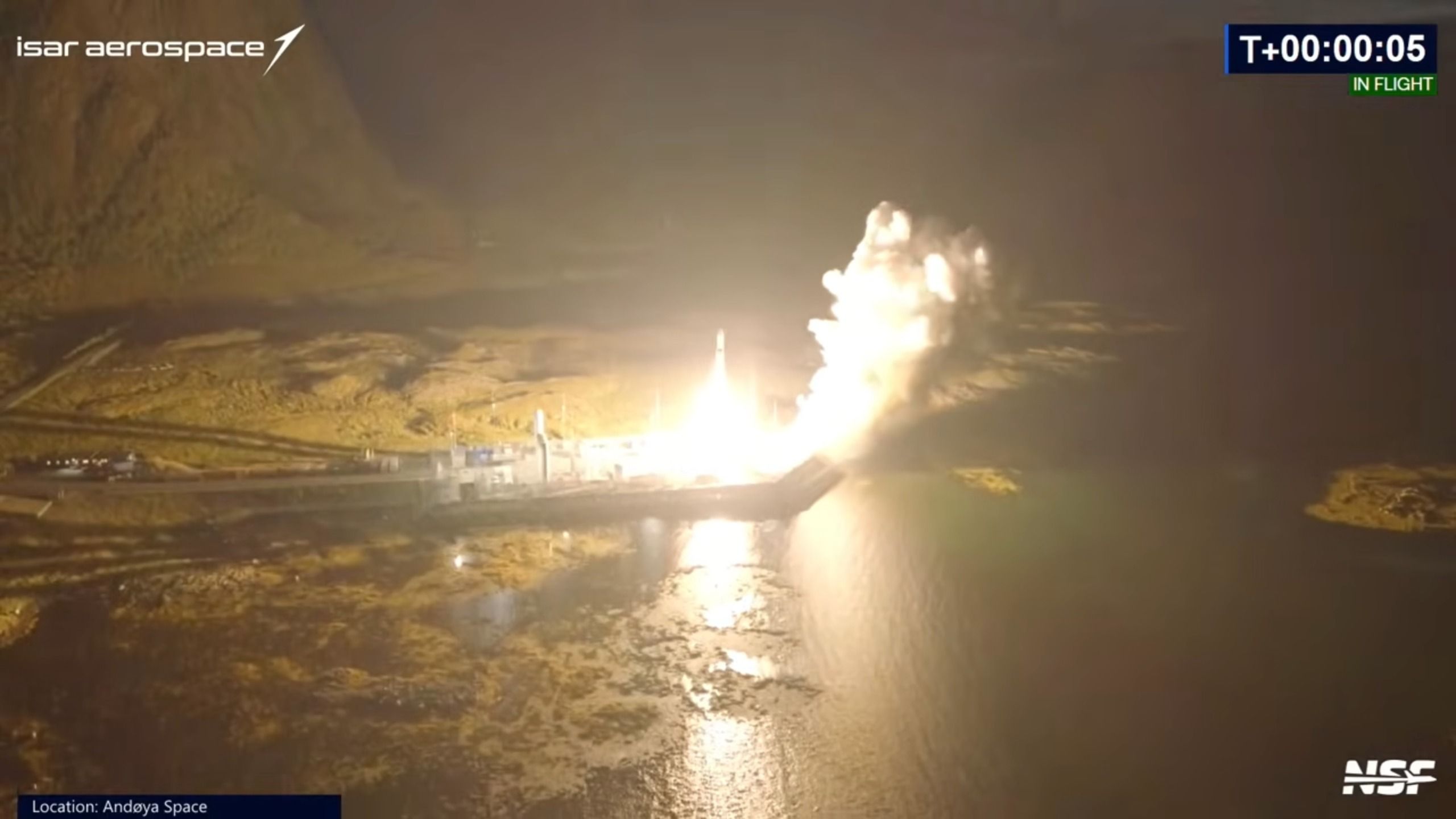
- Isar Aerospace launch into orbit [video] https://www.youtube.com/watch?v=Ss1DUqLjecc (https://news.ycombinator.com/item?id=49580325)
- Really beautiful with the rocket shining brightly upon the mountains as it lifts offby Aboutplants
- Thanks for that video. Super cool that they got pro streamers NSF involved.
Really interesting that they will be launching from Canada as well.
by consumer451 - Just for context, when Boeing completed the 747 Airbus wasn't even a thing. 5 decades later they have caught up in most categories and even surpassed in some. Who knows, maybe something similar will happen again?by pbkompasz
- Airbus did not come into existence out of nowhere. It is the result of merging some companies that had some ancestry going back to the time of aviation pioneers.by cookiewill
- A good historical nugget is that the Americans got a huge leg up in the space race by importing the Germans who worked on the V-2 program.
Germans killed Soviets by the millions. If you were a German of value (like a rocket scientist) you were eager to surrender to the Americans before the Soviets could get their hands on you.
If you were the Americans, you distrusted the Soviets already, so it was a win-win.
- For any unfamiliar with the history, Russia was a mass murdering machine in this era, vaporizing tens of millions of people, including Russians, in very short spans of time without even a second thought.
We all know Germans was. And some people would fling fecal allegations that “so was the US!”. No. German and Russian actions were categorically different than wartime casualties (even brutal, possibly criminal, wartime casualties like fire bombing heavily civilian enemy areas like Dresden)
by talon8635 - They got a leg up and still the Russians with Sputnik got into space first, on top of splitting Korea and winning in Vietnam and having the nuclear bomb fall into their lap and to top it off they appear to have the Manchurian candidate in the White House.by Danox
- > If you were a German of value (like a rocket scientist) you were eager to surrender to the Americans before the Soviets could...
Misleading. Pretty much all Germans were eager to surrender to the Western Allies - US/UK/France. That became the German government's official top priority in the closing days of the war, and Eisenhower threatened to seal the Western Front (to German soldiers and civilians fleeing the Soviets) when the Germans dragged their heels on his terms of surrender.
A relatively brief treatment can be found here - https://history.army.mil/portals/143/Images/Publications/cat...
by bell-cot - This went both ways https://en.wikipedia.org/wiki/Operation_Osoaviakhimby jgtrosh
- This is a huge success, but it I think also tells us that the EU is further decoupling itself from the US. Slowly but steadily.
Which is obviously the right thing to do, but it's interesting that it's not just a hypothetical anymore.
by hypfer - Are we forgetting about Ariane?by mlmonkey