
Join the discussion
Write your take first — we'll ask for email only when you're ready to publish.
- Hacker News
- wasn’t there a moral panic in the 18th and 19th that kids were reading too much? that books would rot the minds of the newest generation. i’d like to see that history addressed a little better. Part of me is sympathetic to this, I do agree that movies, media has gotten painfully simple. But at the same time, young people are working incredibly hard, richer than older generations were at their age, and technology and culture is definitely moving incredibly fast from my POV.by kart23
- This is why I still browse 4chan and of course HN - because the feed is entirely time based with zero recommendations and no infinite content.
I've also added userscripts to remove shorts and recs from YouTube as well as uninstalling absolutely all social apps and only using web
Ironically 4chan /pol/ now has higher quality debates and more diverse opinions than Reddit, and a faster website that doesn't constantly push nag screens or hang rendering.
What I'm getting at is the internet is too common and we need to retreat to extremely niche and selective platforms with limited content that you can't just binge for 2 hours.
by jiaosdjf - There is an algorithm to the HM feed and there are definitely recommendations. We are both posting in this thread because it has made it to the main page because people upvoted it. That’s the algorithm/recommendation system.by iammjm
- "It is notable that the era of peak democracy in the Anglophone world, the mid-20th century when the working class had the most political power, was also the peak of literacy."
That's the most significant line in the article. That was the peak of union power, and unions routinely had meetings and votes which mattered. What organization do you belong to today where the members can fire the leadership by a vote? When did you last go to a meeting run under Roberts Rules of Order, as almost all union meetings are?
by Animats - Reposting something I put in another doom scrolling thread
quite a while now. And have had periods where I've done it almost religiously. It is addictive. And the effects linger a lot longer than the period of scrolling. There is a thing I generally believe about neural pathways. That the road we most travel is the one we'll keep going back too. And doom scrolling makes me walk down those paths. To the point that it impairs and guides my thinking even after I stop.
And I have stopped. I have had periods where I have blocked Reddit, HN, LinkedIn. I will find myself walking those paths regardless. And then, after a time, I start seeking out the doom again because it's comforting in it's discomfort.
It's probably the worst moment in recent history for this. The constant barrage of information whether it comes from AI, climate disasters, politics or any of the other myriad things that are occurring right now. It feels impossible to break from that cycle. I'm trying.
I want to be present and live in the moment. But it's hard to feel powerless. And Doomscrolling, while it absolutely doesn't bring power, brings a comforting illusion of it. I am aware of it, so I am at least a little in control.
by podgietaru - > it's comforting in it's discomfort
What a strange phrase! But so true.
The only thing I would have to say is that you must keep doing the little and noble things that will bring no renown. It's small, but we all add up at the end of every week.
by Balgair - I think its deeper than "reading books" vs "doomscrolling social media's". Books can be fast food too. And, probably, in our time more and more books will become fast food.
There are a lot of good staff in format of short essay or in blog posts and even in videos. So, its a bit incorrect to say that reading is better than watching. Or that people was more intelligent due to reading.
Question here is not how, but what to consume.
But I think even consuming high quality/professional content, with deep research and etc etc, can be addictive and lead to problems described in this post.
I don't really know how to classify this problem, but maybe - "producing ideas by yourself" vs "consuming someone other ideas"?
With reading we consume ideas. But because reading is boring (rating by speed of receiving information), we also have lot of time to think, to produce new ideas.
And what with watching videos? especially short - you have almost no time to think about 15sec video content, because it already gone up and you need to forget it and see next...
So, reading and watching, doomscrolling is all about one, but on different stage.
And all this about competing two's: create it by yourself or listen it from someone other.
P.S. this is even make sense.. look: the more you do something, the more you skilled in this. And vice versa. So, when you stop thinking by yourself and start listening, your intelligence go down just because intelligence is about thinking, about analyzing and about your own sight, not someone other.
by feelamee - Here's my n of 2 story, but my young kids read all the time and it's likely for two reasons. My wife and I read, and still read to them every night, and second, they both have Kobo Clara Colour e-readers. They love graphic novels and the colour screen keeps them engaged (we had black and white e-readers before and it just wasn't the same). We get 100% of our books from the public library and they probably read 5-20 graphic novels a week. Best $120 investment we've made.by giarc
- How old are they?by talon8635
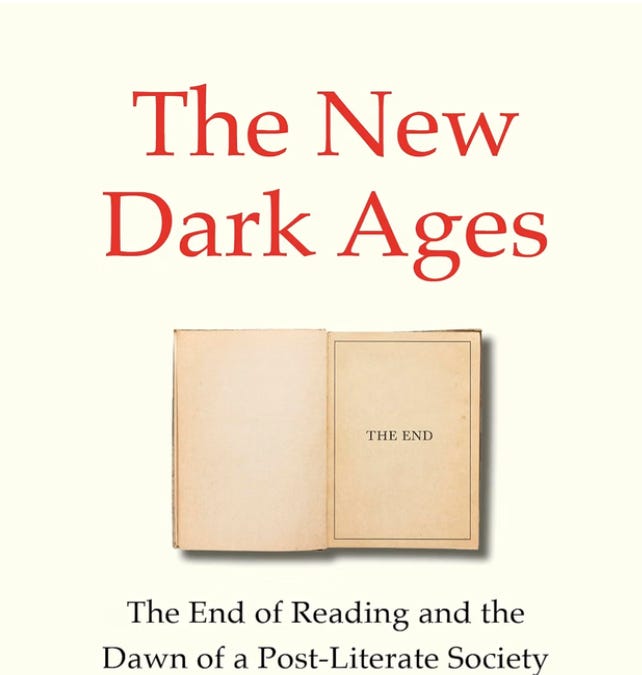
- Killer line: "Having written extensively about how no one reads books anymore, he decided to turn the subject into a book"by Tarsul
- Yeah, I think the elitist part of the book being reviewed is that it elevates books per se. I have a degree in literature and a home full of books, so I’m as sad as the next guy about no one reading anymore, but I think the argument (such as it is reconstructed by the reviewer) is better when focused on the types on things one could be doing, and the self-reflection and self-improvement that comes from doing them, rather than bemoaning the specific works not read.
“No one reads Shakespeare anymore” is probably true, but it’s just as sad that families talk at dinner less, kids spend less time outside, watercolors and paint brushes gifted by grandparents are tossed aside, and kids don’t ride bikes, go camping, explore the woods behind school, bake brownies (that aren’t viral recipes), and so on. Instead of measuring IQ in correlation to technology, you could probably measure VO2 Max.
I would be willing to bet that it turns out that the algorithmic feed, and especially TikTok, are specifically correlated to some of these deleterious things, and have outsized effects on kids, teens, and the neurodiverse. Not everyone possesses the self-control to put the phone away after a 15-minute scroll break the way grandpa would shut off the tv as soon as the 6 o’clock news was over, and the algorithm is designed to prevent that and ultimately probably wears down native willpower over time.
“Let’s ban TikTok” sounds stupid and reactionary, but what to do about it is a discussion we ought to be having.
by gregcohn - Hm, comparing developments spanning from the 12th century up to now with stuff that is happening in the last decade. Just give social media about 5 or 6 centuries to develop, and then check back to see if the arguments of this article are sound.
Edit: sorry for being so dismissive, but I just can't stand rhetoric that says something about "us" and "we". There were seriously stupid people back when we supposedly had larger attention spans. There are still stupid people now.
by smokel - Like I said in another comment, this famous article by the Atlantic [1] has pretty convincing testimony that kids studying the humanities at elite universities can't read either.
I agree with the sentiment that we tend to misrepresent the culture of mass societies, as if at one point in time there were droves of people reading Aristotle. But the ability to read and our transition to an oral or post-literate culture is very much affecting elites too. There is pretty good evidence when you compare contemporary histories. Or if you live in a bourgeois milieu, you just need to ask around.
I don't think that reading necessarily makes you a better person. I've met a good amount of people of the highest moral dignity who do not read. But on the whole, reading helps build competence - moral and technical - and create a sense of shared culture. Going back to an "oral culture" is nothing but a regression.
[1] https://www.theatlantic.com/magazine/archive/2024/11/the-eli...
by aerhardt - The history of Opium is likely more relevant.by api
- It is slightly dismissive, since we see degradation of literacy within the past 20 years.
https://literacytrust.org.uk/research-services/research-repo...
We also know from colleges and schools that students coming in are having difficulty doing the reading needed for classes, even in literature classes.
AI is making this worse, since it’s unleashed an epidemic of cheating and the tool itself is inimical to learning. (Learning is friction. The tool to remove friction also removes learning)
The issue isn’t that we have stupid people then and now. The issue is that trends of literacy and development now are changing direction.
by intended - It will be kind of surprising if neither global warming nor AI nor nuclear weapons knocks us back to a pre-industrial society in the next 200 years.by GPerson
- If there were stupid people back then and there are still stupid people now, wouldn't the interesting thing be to look at what's different?by estearum
- > Hm, comparing developments spanning from the 12th century up to now with stuff that is happening in the last decade. Just give social media about 5 or 6 centuries to develop, and then check back to see if the arguments of this article are sound.
For most of time, until the industrial revolution, technology didn't really advance that quickly. The world you were born into would be technologically near identical to the one you died in.
Technology is now advancing at such a rate that most if not all of humanity is in a permanent state of future shock, and it's only going to get worse. Nobody really seems to have a clue how to deal with that.
by RobotToaster - I used to think the same way, that people have always overreacted to new technology.
But over time I’ve started to feel there’s at least a bit of truth to some of those moral panics, and it's not correct to dismiss all. I remember laughing at an old article about “calcu-holism,” basically the idea of becoming too dependent on calculators. At the time it sounded ridiculous, but looking back, the point wasn’t that bad. Reaching for a calculator to do basic math is a silly habit, a sign of extreme mental laziness. And it's inefficient too.
I’ve noticed something similar in myself with attention. I remember reading The Power Broker, a 1,000+ pages tome, in under a month. Now I struggle to finish books that are a fraction of that length. And if it feels this way for me, I can only imagine what it’s like for teenagers who’ve grown up with smartphones their entire lives. Possibly, being completely engrossed in a book would be an alien experience to them.
by shubhamjain - I can tell, usually within a few minutes of meeting them, who’s really into social media.
There’s a little bit of frenetic emotional dysregulation, and then they say the weirdest stuff to me.
I don’t think you could have made a similar argument about heavy trash tv watchers. They may have had less to talk about, you may have found them less interesting, but it didn’t literally alter their personalities.
We have a big problem.
by coffeefirst - > I can tell, usually within a few minutes of meeting them, who’s really into social media.
Same for me, except it's people who don't read books.
by sporadicism - Do you have examples? Asking for a friend.
- The easiest way to tell in Europe is that a woman who has never visited USA speaks in phrases or uses slang words that an African-American woman from Atlanta would use. African-American men and women probably have the largest global cultural effect based on the relative size of the community to the population of the world.
- I would also add that having this kind of detection superpower probably requires the observer to be a social media addict too (low-key).
- Do you have examples of what weird stuff they would say? Im having a hard time imagining what you mean exactly.
- My 30 year old sister in law throws disregulated tantrums somewhat similar to a 3 year old. She failed out of college before completing the first semester, went to a bougie AA retreat in Hawaii for many months, made her entire identity AA, until online outrage became mainstream. She might literally have never read a single book cover to cover in her life, and yet has the strongest polarizing opinion you could imagine on every complex topic. She’s basically a sentient Reddit thread.
It’s sad, but also unbearable to be in her presence. The way she screams at her parents is so embarrassing. I feel bad for her parents, but they also coddled her to death and continue to to this day.
by talon8635 - I feel called out as one of them. I definitely overextend in terms of internet references if I'm anxious to try to catch something the other person is interested in. Among many "online" people, memes are basically a form of in-group signaling at this point to indicate you have a similar shape of humor, quirks, shared fandoms, and values (albeit often surface level). I'm reminded of the quote about fandoms by Roger Ebert [0]. I would say it's a similar tendency to use online references as a way to skirt social awkwardness and establish some commonality.
[0] https://www.goodreads.com/quotes/1192222-a-lot-of-fans-are-b...
by udbhavs - Before social media I remember people who had entire conversations just quoting tv shows, movies, and commercials. Which shows they quoted was their personality.
I think it is much worse with social media, the content is a lot more niche and the algorithms a lot more addictive.
It's not so much the weird stuff they say, I think that is fairly normal, especially the younger you go. It's the inability to do anything in person without talking constant phone breaks that I find most worrying.
by vzmax - I don't read less, but I do read fewer books. It is hard to find a book that is the best source for what I want know about, and that changes too frequently now to outlive the time it takes to read a book. This is what you'd expect in a world where the sheer volume of things that are important to know about has grown beyond a sustainable capacity.
What has taken their place, for better or for worse, are various information feeds with blog posts, news articles, and projects relevant to my interests and the moment. I've come to prefer a more raw exposition of other people's thoughts. It seems partly in the interest of credibility; more spontaneous writing offers a richer surface area to judge the quality of thought. And finding it in a place where other people are free to critique and engage with those thoughts means that I'm not locked into just one voice. I also have the opportunity to engage myself which fundamentally changes how actively I think about it.
I'm open to the idea that the shift has come at a cost. There is value to reading something that someone has put a lot of work into and in large quantities. But the days when I felt it was enough to just passively let information flow over me seem to be over; it is a luxury I can't afford.
by doginasuit - What is a book? I mean, I spent some time over the last couple of days reading parts of the PostgreSQL manual — if you printed it it would be a gigantic book but it's online and linked. Does that make it not a book? Half a book? Still a book?
A blog post can be a few hundred words or a hundred thousand. It can even be a series of blog posts. Is that now a book?
by tomjen3