Join the discussion

Write your take first — we'll ask for email only when you're ready to publish.

  • Hacker News
  • Generative UI is unsolved because current models do not have taste and end up generating the same kind of slop.

    I'm amazed that this blog doesn't even have a single screenshot/photo of the kind of UI they can generate.

    Focusing on benchmarks in this domain feels very wrong.

  • Gen UI is meant to be design agnostic, the output is just the content and the form. It is on the implementation, agentic or human to make it look good.
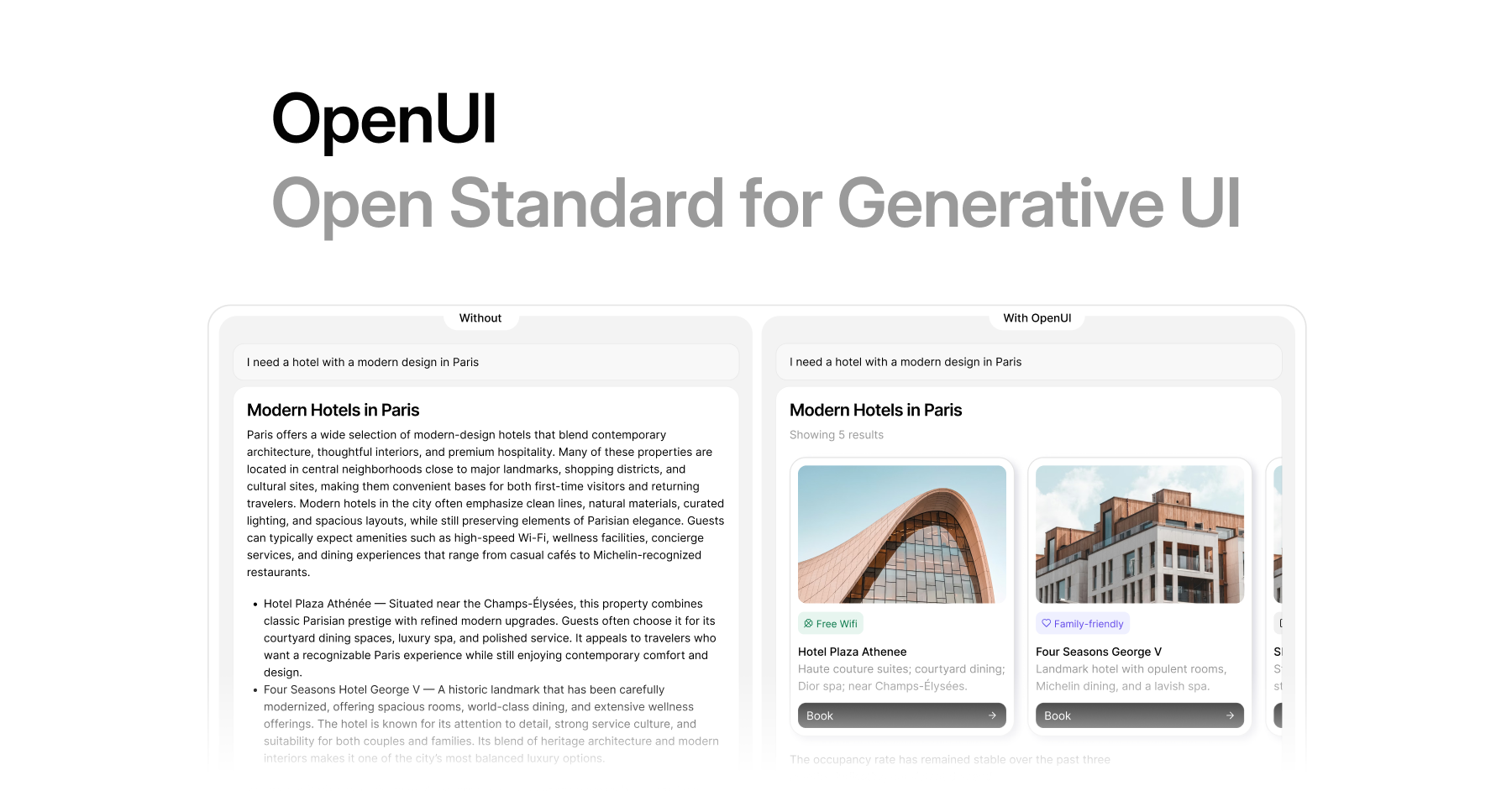
  • There's an image in the article and a full website with more media is just 1 click away. Instead you resorted to typing 272 characters not including ENTER, and I doubt that was easier than clicking the logo to visit the homepage.

    Typing this comment also did not solve your problem, because that would require the author to read your comment, add more screenshots and it would require that you revisit it.

  • > Interfaces must be generated in under a second

    Why? Is two seconds too long? Would your other constraints be easier (usability and hardware spec) if this was longer? Does anyone actually need a UI generated in under a second?

  • I get annoyed if a webpage takes longer than 1-2 seconds to generate right now. You don't?
  • In Generative UI, the interface needs to built in realtime based on context and intent of the user. Hence the constraints. Ideally we are targeting sub 500ms to compete with current software.
  • The term "Generative UI" refers to a front-end design approach where an AI model dynamically builds a UI in real time instead of relying on static, hard-coded templates.
  • Please for the love of god have a human write something that you expect other humans to read
  • "The gap became the north star" is written large enough though: I could read it with my own Aieyes!

    It's also the only sentence I read on that page before closing it, of course.

  • Quite interesting to see no real comments here for 50+ minutes, so I will kick it off.

    I'm a huge believer in this future of software. Having the UI layer completely abstracted from pre-written code and dynamically generated "on the fly" based on the context of the user is, I believe, the future.

    Just think about the complexity of localization and how many IFs you had to write to solve different language versions, etc. in the old PHP code. A lot of that complexity can simply disappear.

    Having dynamically built UI won't only be better for the user experience, it can actually allow us to create much more personalized experiences (I hate when UI teams constantly redesign perfectly fine software).

    Interestingly, this will open up a completely new consumption interface, because I believe there will be a UI predefined by the creator of the application (your day 1 user experience) that will then evolve into a more personalized experience over time.

    So much room to grow in this space.

  • How do you reconcile ...

    > I hate when UI teams constantly redesign perfectly fine software

    ... with ...

    > Having the UI layer completely abstracted from pre-written code and dynamically generated "on the fly" based on the context of the user is, I believe, the future

    In this scenario there's still no guarantee that the UI won't randomly change. There's no guarantee that the ui generated for the user will be the same visit to visit.

  • this exactly the future we are working towards as well. You should checkout AppLess http://github.com/thesysdev/appless
  • > Just think about the complexity of localization and how many IFs you had to write to solve different language versions, etc. in the old PHP code. A lot of that complexity can simply disappear.

    IFs! Oh no! Throwing all of this into a non-deterministic and expensive black box is making it less complex, you say?

  • I agree somewhat. An example might be a .md file describing a UI for commonly used tool that is invoked whenever you reference it. This could be a stripped down version of a complex UI for some software that has a lot of different uses (like 3D modeling programs and image editors) allowing the user to focus on the subset of work they do with it.
  • It should be possible to run on Mac via https://github.com/mmastrac/diffgemma, but I'm at rustconf right now and I can't download weights on hotel wifi easily.
  • let me try this out as well
  • Pre-LLMs Steve Krug wrote "Don't make me think" Now we come to a generation of random UIs that will confuse the life out of users and, being non deterministic, be a nightmare for support teams; though they'll probably have no real support, just more llms.
  • Someone steel man the case for users actually wanting to be a UI designer for the application they pay you for.
  • As a user, most GUIs are awful. I’m fairly certain that this thing could, for example, vibe up a better UI for Amazon Music in less time than it takes me to find the music I’ve purchased and downloaded (because the system is more interested in funneling me toward a streaming subscription that I don’t have).

    Of course pushing users toward subscription services they don’t need is part of the design goal. So I guess something where the user vibecodes up their own UI will not become standard. But we can dream.

  • GenUI isn't about designing cosmetic "skins." (Usually, anyway. I guess it could be used for that)

    It's generally for letting users customize the own workflows. How many times have you, or one of your users, liked a piece of software because it mostly fits an existing workflow but that remaining 20% is an annoyance, or maybe even a dealbreaker?

    This is probably more common for businesses. They have existing procedures. and they want your software to fit into their existing processes and workflows... not the other way around.

    GenUI is far from a one size fits all approach or magic bullet, but it can address a lot of those situations that either would have been dealbreakers, annoyances, or change requests. I suppose it can also help with user retention; once they've put the time and effort into customizing your product they theoretically are less likely to switch to a competitor.

    Existing OpenAI/Anthropic models seem to already handle this pretty well. As you might expect, letting users describe their own UI is pretty easy. The hard part is making it work and making sure they don't escape their sandbox...

  • I've been thinking for a while that something like this could be a solution for the suboptimal UX in the digital assets space.

    Imagine a very small LLM embedded into a MetaMask equivalent where you just specify the task you want to do - ie, "I want to send USDT on mainnet", "I want to import the token at address 0x..." - and the wallet assembles the UX for this task for the human to execute.

  • yep, this is usecases we are trying to solve. Current model fits in consumer hardware. Hopefully we can fit this into a phone soon.
  • OpenAI, OpenAPI and now OpenUI. Explain this to a non tech person...
  • I actually thought this was OpenAI until I read your comment
  • I think there is a big misunderstanding in the space around what Gen UI is and what its used for. Lots of folks refer to it as a framework for building web apps - its not. Gen UI is a DSL for LLM to build UIs on the fly in a multi turn converstation - those are - throw away, one off interfaces or visualization. The reason for the DSL is pragmatism - standardisation and token savings.

    The html/css/js or a react app built by an LLM is not Gen UI.

  • Oh... amazing. just had a vision of being able to be in a meeting and talk through an User Interface design / review, while in a zoom meeting or whatever.

    ...i like.

    ---

    - Design system / Component lib

    - Live view of what components, tokens, other things... on the left side of the screen.

    - You're in the meeting and talking while talking and transcribing and doing the full duplex voice. You say, "Find what tables and customizations we have available" and the list starts to filter to tables and customizations.

    - "Let's add that table to the page; left side; 3/4 width of page. Headers should be static for vertical scroll, ..."

    - The table is added to the page.

    - "Nah, i don't like it. Let's change that table component to have larger headers..."

    yes, i like--let's see what Astra Pro pops out with.

  • Remember when everything was iSomething? The original iPod and iPhone created a real trend back then.

    Seems like many AI products ride the same wave now. Open WebUI, OpenHands, OpenUI. I am a bit more dubious about this affiliation, though.

  • The most interesting part about this for me is that they decided to create their own language or DSL for the task at hand. So it's not just a large language model; it's an LLM with its own language.

    I have a feeling that the best AI systems to come will, in fact, be a complete package like this: a harness, a DSL, and an entire package designed to produce certain outcomes cheaper and faster.

    And producing that complete package is why software engineering will not be obsolete.

  • Why can't an AI be trained to generate "the whole package"?

    It too is just software

  • I agree. I'm waiting for someone to invent a programming language designed for LLMs where for a given partial program p and candidate token t it's possible to tell whether p+t can be the prefix of a correct program or not so that t can be excluded from the LLM's probability distribution at generation time, so the LLM can only generate correct programs. Or something like that.