Join the discussion
Write your take first — we'll ask for email only when you're ready to publish.
- Hacker News
- The daytime energy shifting is interesting. I wonder if a heat pump water heater could have a variable tank temperature and then use thermostatic mixing valves at point-of-use to get consistent, safe temperatures from faucets and such. I can't be the first person to have thought of this. The article is really light on details for how the tariff-compatibility works, but perhaps it's something like this.
I'm imagining a water tank that gets very hot during the daytime when energy is cheap and then slowly cools during peak cost hours or night (if linked to solar power), but remains above a usable temperature. Thermostatic mixing valves bring the very hot daytime temperature down to a safe usable temperature, but also allow the nighttime temperature to be usably hot as well.
by wffurr - There are also solar water heaters that are a bunch of black pipes on a roof.
Napkin math based on Amazon/Home Depot prices
You can get a 80"x90"x95% = 2kW output solar heater for $2000
or eight 45"x70"x25% = 1.8kW solar panels for $2800
A regular water heater needs about 12kWh a day, which is about what both systems would produce.
However, a heat pump water heater is 4x as efficient, so you could get by with $700 of solar panels.
Except, a heat pump water heater costs $2000 instead of $500 for a regular electric heater.
There's also install, maintenance, and the fact that we're talking about grid prices, not home panels, but those won't fit on my napkin.
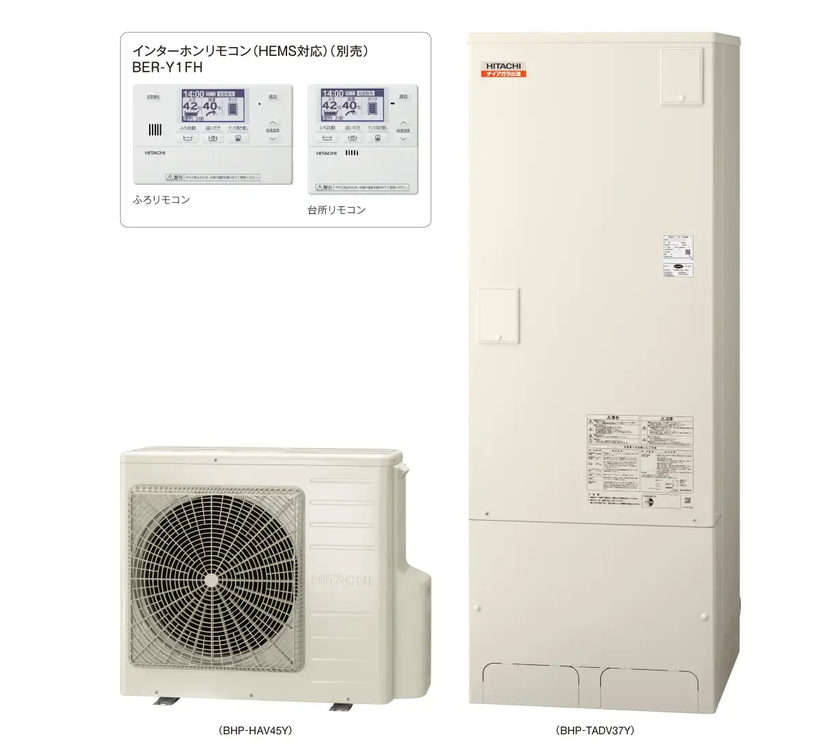
by pvillano - “Hitachi has not yet disclosed full efficiency specifications for the two new models. Their predecessors, the BHP-FV37WD and BHP-FV46WD, have annual hot-water and heat-retention efficiency ratings under Japanese Industrial Standards (JIS) of 4.2 and 4.1, respectively.”
What does this mean?
by objektif - CO2 as a refrigerant isn't new:
* https://en.wikipedia.org/wiki/R-744
It's just not as prevalent in the residential HVAC market (which this product serves?), and more in the commercial/industrial space (probably because of the higher pressures needed to get into a liquid state).
by throw0101d - Japan is so far ahead the rest of the world for quality and innovative heat pumps. Quiet, robust, high efficiency in cold climates. I wish they could bring the prices down though.
I worry in 15 years we will all have crapily made Chinese heat pumps for a fraction of the cost. Noisy, not robust, copying competitor designs not innovating, lower efficiency but easily replaceable. Theres probably an analogy here with software talent and AI but its too early to do that.
by boringg - Some background info for context. (for those that may not be familiar).
Heat pump conjures up an image of an appliance, but it is a principle of physics. Heat can be created by burning fuel or electric resistance. Cold can't be created. Cold is the lack of heat. Cold is 'created' by removing heat. Fridge keeps the inside cool by moving heat from inside and dumps it outside. This movement of heat is called heat pump (pumping heat in a specific direction).
If we can do this for cold, we can also do this for heat. After all, we always have heat in the environment until we get to 0 degree Kelvin. Which means we can have heat pump water heater in the garage. Or heat pump furnace.
Creating heat from fuel/resistance is at most 100% efficient (most likely a LOT less). Heat pumps are 400% - 500% efficient per unit of electricity, because the idea is just to move heat. In one direction, or another.
All of this is great, until we get to the refrigerant used to transfer the heat. These are very specific chemicals. Mostly synthetic chemicals. Historically, these were Chlorofluorocarbons (CFCs). CFCs caused ozone depletion and have high GWP of 14,400.
What is GWP? CO2 is a warming gas that has Global Warming Potential (GWP) of 1 (the standard). Earth radiates heat back into the atmosphere (exactly the same as get from Sun) and CO2 acts as a barrier for the radiated heat from earth, retaining heat in the atmosphere and warming the planet. Why Greenhouse Gases Make the Planet Warmer: https://www.youtube.com/watch?v=AIBk0pGV_BQ
But, there are lots of other gases that have higher GWP. Fluorinated gases: Hydrofluorocarbons, perfluorocarbons, sulfur hexafluoride, and nitrogen trifluoride are synthetic gases used for refrigeration (maybe other applications). Fluorinated gases replaced CFCs, which were causing ozone depletion. But they have high GWP. HFCs: up to 12,400, PFCs: up to 11,100, NF3: 16,100, SF6: 23,500 (https://www.epa.gov/ghgemissions/fluorinated-gas-emissions)
So, we have to find better alternatives for refrigerants. Because, these leak. And everybody on the planet is going to buy ACs. CO2 is a terrific refrigerant because it has GWP 1 and leaking of CO2 is perfectly okay. With 40 - 60 billion tons of CO2 from fossil fuels, CO2 leaks from refrigerants are less than a rounding error.
- > Some Japanese utilities have introduced tariffs designed to encourage daytime water heating as growing volumes of solar generation enter the grid. [Emphasis added.]
I was quite confused at the use of "tariff" here, as it meant to me a "tax on a good crossing a political boundary." Turns out, 'tariff' has an older meaning: a published schedule of fees or taxes issued by some authority.
by elgertam - I live in Japan and last year when we moved from an apartment to a house we installed a Mitsubishi EcoCute heat pump water heater which already has these features and is also a CO2 heat pump.
We have one of the "all-denka" electric plans, where we trade off cheap rates during solar hours for expensive rates during duck curve hours. By having the hot water only run during cheap hours, and having the aircon turned off/down during the expensive hours, we're paying less in energy for our all-electric house than we did in combined electric+gas in our 3x smaller apartment.
We pay approx (before fees, and the rates change slightly by season):
* 8 AM - 10 AM: 35 yen/kWh
* 10 AM - 4 PM: 13 yen/kWh
* 4 PM - 6 PM: 35 yen/kWh
* 6 PM - 8 AM: 19 yen/kWh
Our Mitsubishi has other nice features like it can recirculate the water in the bath through a heat exchanger after you already filled it and got in, so it will keep the water from cooling down to lukewarm, and you can even adjust the bath water temperature if you ended up with filling it with too warm or too cold water. Of course, there's also an app so you can start filling up the bathtub when you leave work for home so a hot bath is waiting for you. There's also an intercom to the kitchen "so mom can tell the kids to get out of the bath, dinner is ready".
edit: the wifi integration does have one actually useful feature: if we had solar panels, then it can use data from them to know when to run "for free", and it can use weather data to predict if it should wait for sun or not to run
by kalleboo