Join the discussion

Write your take first — we'll ask for email only when you're ready to publish.

  • Hacker News
  • Yippee, free load test!
  • If automatic scaling were free, this would be true...
  • Interesting that the Under Attack Mode wasn’t used at all here. I understand not wanting to break APIs but I feel temporarily challenging non-API usage could have at least helped without impacting users too much?
  • > without impacting users too much?

    You mean essentially locking out users with non-default Chrome configuration.

  • I talked about that directly in the post. We didn't want to just challenge everyone. We use JS challenges but we try to use them sparingly. The rest of the ops team and I were fighting to stay up but it never got so bad that it was a choice between complete outage and using the Under Attack mode.
  • I'm curious if anybody could speculate who would be attacking a documentation silo, and to what end?
  • Could have been a live-fire exercise by a nation state.

    Edit: why the down vote? That is literally in the realm of possibility!

  • Either testing for something bigger OR demonstrating their power to a 3rd party with minimal real disruption
  • I run a similar service, and we get almost daily attacks like this. Sometimes it's a specific high-profile customer, other times it's broader.

    I can't speak for RTD, but I think it's less "documentation site" and more just that we sit on the domains of high-profile products and the tools are just looking for any hole they can find?

    Often it's even the company themselves, for whatever reason (security research, etc).

  • Could be testing in preparation for attacking something more critical?
  • I'm the author of the blog. I don't know. Internally, we were half joking that we were going to get ransom notice, but we never did.

    The only thing that sort of correlates with this attack is that before it started, we began rolling out some slightly more aggressive rate limits one by one. This was mostly because anytime any new "company" thinks they're going to catchup with Claude/OpenAI, they scrape us very aggressively (and they're not respectful about it). My guess is that the attackers behind this attack were already probing us (they were) and they thought the window of opportunity might be closing.

  • My naive take on a Cloudflare perspective wants to combine "three times is enemy action" with toddler-speed block dropping and manual clearance. What's the money reason this problem isn't handled at the ISP level?
  • https://www.scispace.com/pdf/drawbridge-software-defined-ddo...

    I saw this quite a few years ago. It is possibly relevant. I don't know what, if anything, came of it since then.

  • I don't quite understand your post, but is your question why don't the ISPs of the sources of the abusive traffic sort it out?

    The distributed nature of DDoS means each participating host isn't sending that much traffic, and there are often tens or hundreds of thousands of participating hosts. An ISP should verify claims of abuse before cutting off customers, and since most of the customers are presumably unaware of what their systems are doing, there will be a lot of unhappy customers and then you've got to spend a lot of customer support time on helping them clean up their systems so they can get back online.

    I spent a fair amount of time sending out abuse reports for phishing / malware senders about a decade ago, and most abuse reporting addresses are a black hole. Even if you do get to someone who will do something about abuse, they won't do it quickly.

    There's be a few high profile longer term DDoS attacks lately, but when I was running infra that got a lot of stuff, it was mostly people kicking the tires on DDoS as a service offerings and most attacks were 90 seconds long ... there's no way I'm convincing an ISP to drop a pwned customer over that.

    Starting from there, this DDoS sounds like layer 7 DDoS which is easy to track to the immediate senders, but a ton of DDoS is volumetric stuff, often volumetric reflection attacks where the senders spoof your address. If you're getting that, best you can do is get the reflectors kicked off (or cleaned up) ... tracing back to the sending hosts means getting a reflector (and their ISPs) engaged to do a lot of labor intensive work.

    All of that investigation stuff takes qualified people lots of time, that's your money reason it doesn't happen.

  • There’s an assumption that turning on Cloudflare’s “under attack” mode would mitigate the attack.

    Given how adaptive the rest of the attack was, I would be very curious to find out how it would approach that obstacle.

  • I see Cloudflare's in the business of selling "protection"
  • That has only partially mitigated much smaller attacks (residential proxy scraping etc) on my employer's site.

    We're currently on the "Business" plan, but I'm coming to the conclusion that we need to upgrade to the "Enterprise Advantage" plan for the JA3/4 fingerprinting and detection ID features.

    I get put off by "Contact Sales" pricing.

  • My assumption would be that it would drastically reduce the attack to be borderline irrelevant. I've never turned on Under Attack so somebody else may have more insight and the docs[1] don't describe precisely what happens besides a JS interstitial.

    I know that JS challenges, both interactive and non-interactive, can be solved by bots. I've seen it. However, I suspect that the challenges just get harder and harder until the attack levels drop.

    [1] https://developers.cloudflare.com/fundamentals/reference/und...

  • > One decision we made is to always give real users an escape hatch. Read the Docs very rarely issues outright blocks or bans to specific IPs or user agents. Instead, our "worst" is a JavaScript challenge, and if a user solves a challenge, they are very unlikely to get challenged again for the next day or so.

    Finally, a competent response that doesn't leave the users hang out to dry.

    I'm so tired of seeing incompetents with measures like "blackhole 2 continents" deployed even outside active attacks.

  • this might be a AI driven attack and readthedocs was just a test target.

    What surprised me is how easy it was to evade the cloudflare defenses. I know it was easy to evade CF, but I would expected CF to do a better job at blocking L7 DDOS.

    CF is really good in defending against the L4 DDOS, but not L7.

    this means that cloudflare is really not useful much in the era of Agentic DDOS driven by thousands agents across the globe

  • Cloudflare is totally worthless actually. It is trivial to evade any part of it.
  • > they were overwhelming a hardcoded Nginx redirect (a simple rewrite regex directive)

    1. I wonder how much optimization ngx_http_rewrite_module has? Does it precompile the patterns? LLM said yes, this SO answer [1] says that a JIT config option must be on. I consider "Just in Time" to be a half measure when the config itself is static.

    2. From looking at NGINX docs, it looks to me there are some pitfalls to writing these rules. Like you must manually make sure to short-circuit the rewrites to exit early?

    3. The caveat of regex is that catastrophically backtracking regexes do look simple. I don't see this issue being talked about enough. See links, if you, the reader, haven't heard of it yet.

    [1] https://stackoverflow.com/questions/59284921/how-much-impact...

    [3.1] https://joshua.hu/nginx-directives-regex-redos-denial-of-ser...

    [3.2] https://en.wikipedia.org/wiki/ReDoS

    [3.3] https://infrafolks.com/blog/regex-backtracking-devops/

    [3.4] https://www.regular-expressions.info/catastrophic.html

    [3.5] https://gixy.io/plugins/regex_redos/

  • A more interesting question is, what exactly do the attackers gain from hitting read the docs? Most of their docs hosting is static/easily CDN cached. Unlike database bound sites, you would need a lot more traffic to overload pure/mostly static hosting. Maybe it's a malicious AI lab looking to deny their competitors training data? As far as infosec profiling goes, this is probably the oddest case I have heard of.

    I am thinking it's probably an AI lab that misconfigured their data scraper (made it too agentic) and it ended up looking like a DDoS.

    The new generation of scrapers are all agentic and self healing. (As an example see YC's https://parse.bot)

  • Yeah I’d be fascinated to hear the attacker’s perspective. Why go through so much work just to slightly inconvenience a random website?

    There’s no financial motive and they’re not a political target. Why bother?

  • Nothing to do with AI, but just the general storm of trying to force the Internet into a proprietary, tightly-controlled walled garden with strong identity verification.
  • > Most of their docs hosting is static/easily CDN cached

    The article says

    > and it purposefully attacked areas that bypassed caching

    So that doesn't work. Also, it seems that they were trying to cause financial harm, not to take down the infrastructure but to make it costly for the org itself. That's smart.

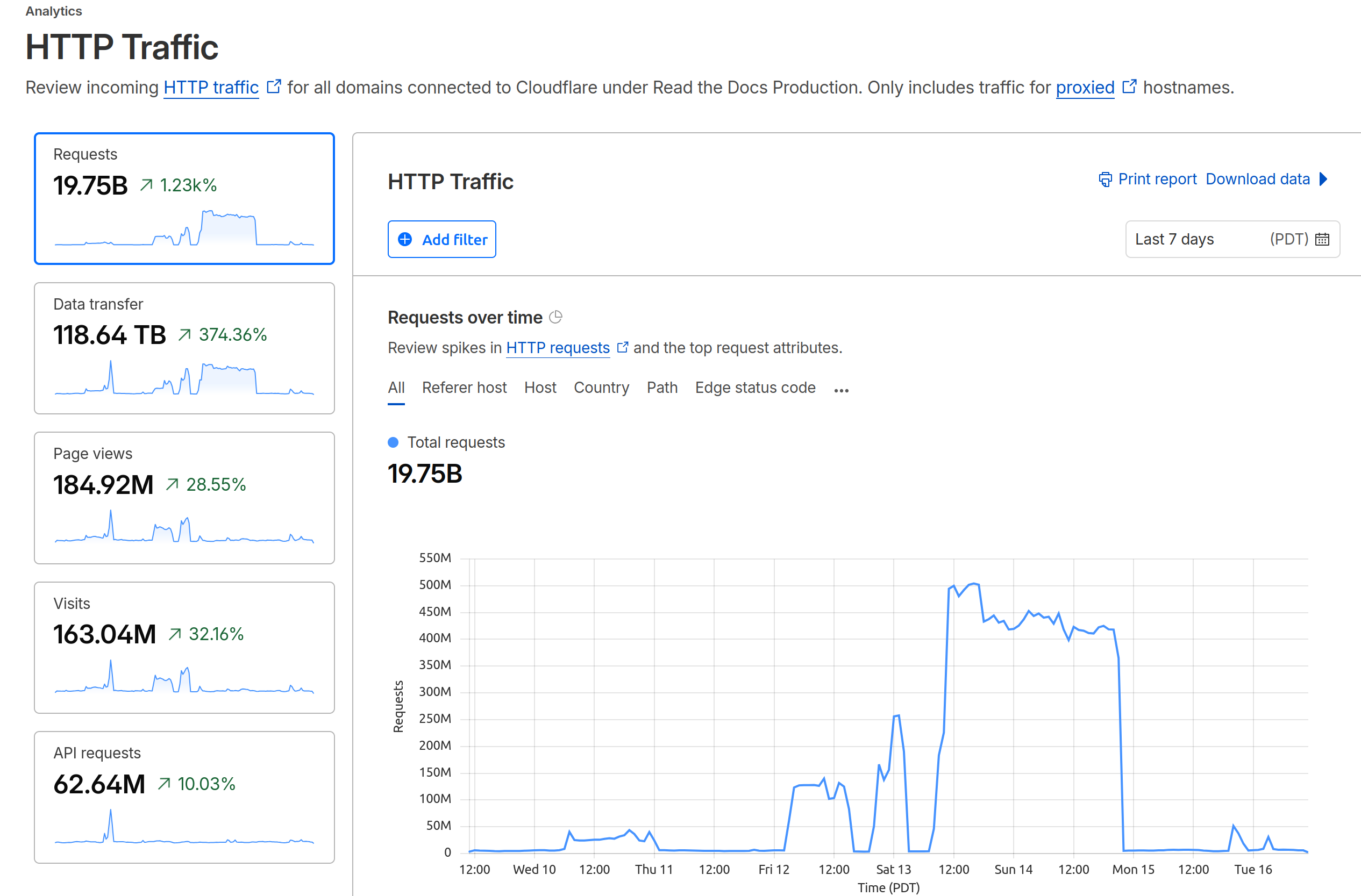
  • Author here. This was not a misconfigured data scraper. We see those every week[1]. This attack wasn't scraping useful content. It was almost entirely 404s and 302s and pulled virtually zero real docs. It specifically looked for URLs not served by the CDN and when it found a pattern, did millions of variations of it. Whether built by an AI or not, it was designed to cause outages and financial damage from autoscaling. However, as others have suggested, we may have been a test run for a real target.

    [1] https://about.readthedocs.com/blog/2024/07/ai-crawlers-abuse...

  • Sorry for the stress that the team had mitigating this attack. Yet I'm always excited to see signs of competence on the attacking side: a targeted application-specific and adaptive attack at L7? Wow!

    Here's another guess: a DDoS to steal your attention and mask other intrusion attempts.

    > Defenses need to have broader rate limits across more than just IPs (ASNs, hostnames, etc.).

    The description/approach seems static and limited? Why not maintain a leaky bucket that counts each request (tickets/points) with higher cost for expensive requests (404, redirects). As the IP's reputation deteriorates (IPv4/32), it begins to spill over to a broader subnet like IPv4/31 then /30 and so on. Fight adaptivity with adaptivity. // maybe I describe something totally obvious, I'm not involved in the web ddos protection side of things.

    > Attackers actively search for non-cacheable paths (e.g. dynamic redirects, search endpoints, and 404s).

    To continue with my previous point. As long as individual server's resources permit (memory, socket limit) stall requests before processing them. Low reputation IPs get stalled for longer and the requests that exceed the queue get dropped. The idea is graceful degradation:

    A good rep IP will not be stalled by sleep(). A poor rep IP will be stalled, but eventually receive its answer instead of some 429/403 (i.e. a user who opened many tabs at once). A bad rep IP will be slowed down by the wait times + rate-limits (queue exceeded) before getting completely banned for good. The point is to have more granularity before throwing errors at random users at the server-level.

  • > The description/approach seems static and limited? Why not maintain a leaky bucket that counts each request (tickets/points) with higher cost for expensive requests (404, redirects). As the IP's reputation deteriorates (IPv4/32), it begins to spill over to a broader subnet like IPv4/31 then /30 and so on. Fight adaptivity with adaptivity. // maybe I describe something totally obvious, I'm not involved in the web ddos protection side of things.

    The penalty box strategy I described in the post is along these lines. It penalizes excessive expensive requests directly. Specifically, it does add those to a score and will rate limit more broadly as necessary.

  • I'd like to see more of a legal response.

    First, find out who's on the other end of a few hundred IP addresses. Start with ones in the US. Sue for damages. Use discovery to find out what's on the other end. Sue the maker of that device. If it turns out to be an appliance or smart TV, it may be possible to consolidate cases into one case against the manufacturer. Criminal negligence, tort interference with contract, harassment, Computer Fraud and Abuse act violation... Maybe a restraining order prohibiting the sale of "smart TV" known to be able to host attacks. Have imports seized by Customs and Border Protection. That would get a manufacturer's attention.

    The manufacturer's EULA will not help the manufacturer, because the plaintiff, the party being attacked, is not a party to the EULA at all.