Join the discussion

Write your take first — we'll ask for email only when you're ready to publish.

  • Hacker News
  • Don’t talk to anyone. Internalize it and transmute it into something powerful instead.
  • Yeah, a heart atrack at 50 lmao
  • what a fabled way of thinking
  • This is a risky path. If you internalize it in unhealthy ways, you're empowering your shadow, and it will find inconvenient, self-defeating ways to express it.
  • depends. many talk to their loved ones. which actually help in so many ways!
  • This is a solved problem in 2026. You can create as many bots with varied personalities to talk to. Therapists have a vested interest in you continuing to talk to them and can induce neuroses in susceptible individuals.
  • Talking to bots can induce psychosis in some individuals. This isn't a solved problem, nor is there a universal solution.

    People need connection, but the varieties of connection are vast. What works for one person, can be terrible for another. Maybe talking to bots gives you what you need, which is great for you. But projecting your solution to everyone else is not a rational step to take.

  • I feel like "large language model" should be on these graphs. For better or for worse, it's the answer to these questions for an increasing number of people.
  • Yes. The unfortunate reality though is we don't know how many times they have saved lives (it's much greater than zero), vs how many have been lost (RIP Adam, et al).
  • I'd be curious about the results in the main graph if it included no one. That would be much more telling, because right now it appears that most people talk to at least someone.
  • To those who answer "my spouse", please think carefully about building an alternative support system if/when it happens that the mental health situation you are dealing with comes from a breakdown in ability to communicate with your spouse.

    I recently went thru a rough period triggered by how my spouse was feeling. If you've both always counted on having the other ready to listen, and that's temporarily impossible for acute reasons, the shock is enormous, and almost undermined my problem solving ability to understand I needed to find a psychologist to talk to.

    We're ok now, but it could have easily gotten way worse before it got better. Having a solid relationship is unfortunately not a protection from losing the security it gives you, psychologically.

  • I'm part of Freemasonry. All members are at least vested for criminal conducts, my lodge at least is very strict on background investigation, so it's easier to pick trustworthy brothers to talk to. I'm probably one the youngest members and benefitted from wisdom and patience from older brothers. I'm not a church member but that would be a good alternative.
  • I want to join but the Freemasons lack a presence in my city.
  • Do lodges generally attract an older crowd? There's a lodge near me, and I have the impression it's mostly retired-age men.
  • I had a great experience when I was part of a lodge. I'm atheist and so could join a Droit Humain lodge in France (which does not require belief in a Great Architect of the Universe and is mixed). I'm now in Hong Kong but unfortunately have failed to find a lodge that doesn't require a belief in God and that is mixed (I refuse to go to a male only lodge).

    It's a pity because I found freemasonry to be hugely beneficial in terms of friendship, interesting discussions and support.

  • Is the true in America? I’m in the UK, and while social isolation, particularly for men is probably worse than it was, I think many, myself included, have at least one person we can turn to in times of crisis. Or am I in a bubble?
  • This is absolutely true in america. My partner left me and my social life has completely collapsed. I have nobody to talk to when things get difficult. I am estranged from my father, my mother is disabled and requires increasing medical support. I'm an only child, I have no local family.

    Once the floor drops out from under you there is nothing to stop the rapid decent to nothingness. There is a generation of discarded people who have nobody left. When we lose our last threads of social connection there's no way back. Beyond hopeless.

    Enjoy your bubble. america is completely fucked.

  • Precovid social isolation was the same in US and UK. [0] This investigation have numbers that say that Brits are experiencing more social isolation than untitedstateians. [1]

    [0] https://publica.org.au/wp-content/uploads/DiJulio-et-al.-Lon...

    [1] https://jamanetwork.com/journals/jamanetworkopen/fullarticle...

  • The author of this piece, Ryan Burge, typically relies data that is scoped to the US for his pieces (to the best of my knowledge). You would have to reach out to him to inquire about the UK, if any similar data is available for analysis, etc. With that said, the ARDA appears to have global data available at https://thearda.com/

    > This post has been unlocked through a generous grant from the Lilly Endowment for the Association of Religion Data Archives (ARDA). The graphs you see here use data that is publicly available for download and analysis through link(s) provided in the text below.

    Code for this post can be found at https://gist.github.com/ryanburge/0895d855fdc93c3ce26b034349...

    (Ryan also wrote "The Vanishing Church: How the Hollowing Out of Moderate Congregations Is Hurting Democracy, Faith, and Us," which I highly recommend; he is exceptionally data driven within this domain, no affiliation besides subscribing to his Substack)

    https://bakerpublishinggroup.com/products/9781587436697_the-...

  • This whole blog is fascinating, assuming that you're interested in the intersection between (recent) history, demographics, politics, and religion in the US.

    For example - this one about generations and trust was surprising to me: https://www.graphsaboutreligion.com/p/gen-z-doesnt-trust-any...

    or this on perception of the religiosity of holidays: https://www.graphsaboutreligion.com/p/is-christmas-a-religio...

    by zdw
  • Right before COVID I stumbled across mens groups, they were a way I first learned I could get my underlying needs for getting seen met in a way no other mechanism in society offered.

    Society was trying actually to meet this need in so many other pseudo forms, but where it fell short and what I needed was:

    - a safe space to share what my experience without needing to be fixed or someone giving me unsolicited feedback

    - place where competition was turned off (sports groups, board game nights, video games etc had previously been this but since they were competitive they met a different need)

    - a cadence that met regularly and where space for me to speak with structure was a requirement

    I liked this so much I even formed one in DC before I was pushed away for work to an abusive Dallas Capital One environment (which my men helped me navigate while my coworkers accepted the abuse being blind to it). I Highly recommend trying a mens groups, find one on Facebook or Google, or try the project mankind groups or No Mr Nice Guy’s Dr Glover runs one online. The one I was a part of longest is also open: embodied masculine (more extreme embodiment based group) but starting off get your toes wet first.

  • I really like this answer. I wish there were a men's group near me.
  • I am wary of meeting with more than about 2-3 men at a time, because men in larger groups tend to socialize through banter, toilet humor, or talking about fucking women (which I like to do sometimes but don't want to talk about); just lame topics I'd like to avoid completely. Also, even without competition, a pecking order gets established.

    So, men's groups don't solve the problem of the lack of healthy regular socializing with 2-3 good friends, which for men in many countries has fallen off a cliff since the smartphone and Covid.

    by TFNA
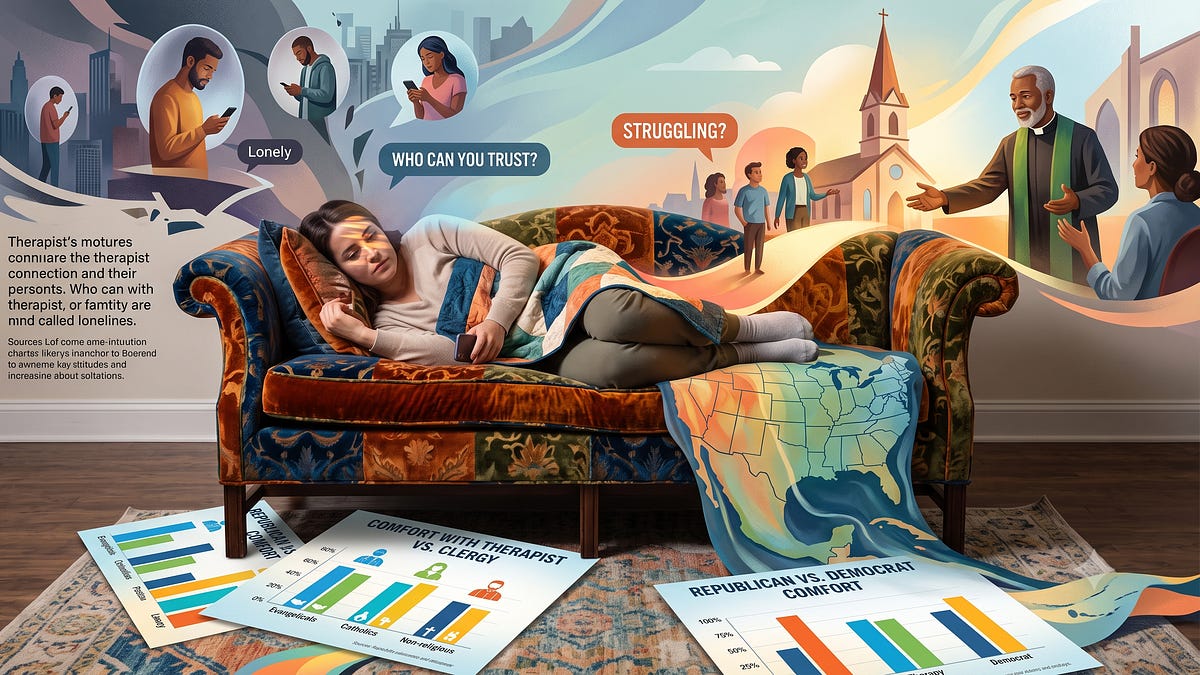
  • It's also about where you go with your struggles.

    Do you go home and talk to your spouse? Do you go to church and talk with your pastor? Do you go to your therapist or to the local bar?

    > Comfort with mental health care has become another facet of political sorting in the U.S.

    I'm skeptical. Bars and churches and friends are way cheaper and more accessible in red states. It's hard enough to get poorer, less educated men comfortable going to the doctor, let alone a therapist.

  • > less educated men comfortable going to the doctor, let alone a therapist.

    Is it that or is it the cost and availability?

  • Friend, priest, acquittance at the bar and mental health professional are 4 different roles. Your therapist is not your friend, will refuse to play that role. Your therapist is also not your religious leader and wont speak into those considerations.

    And conversely, neither priest nor friend will be able to deal with actual mental health issue you have.

  • Helping people is quite difficult.

    What are your struggles? (single item or a long list)

    Talk to one of these:

    Close Friends

    Spouse/Partner

    Immediate Family Member

    Mental Health Therapist

    A Co-Worker

    Neighbor

    Religious/Spiritual Leader

    "I can't pay my mortgage because I lost my job"

    That's a real problem. Solution: Who will pay that mortgage? For how long?

    My church, friends, possibly in-laws would pay my mortgage for about 3-6 months but after that the help runs out because the REAL problem is those 3-6 months of not looking hard enough, not taking any job, not down sizing, not moving into someone's garage, not spending beyond the budget.

  • > Bars and churches and friends are way cheaper and more accessible in red states.

    Just as a curiosity, as I don't have any experience of red states myself, how easy would it be for a closet homosexual to come out and get support from their bar, churches and friends in a red state, typically?

  • The enlightened blue state men go to the pay-to-care secular priest instead?

    Also missing from this perspective. What do people who are not from western countries do?

  • > The preamble is straightforward: “How comfortable would you be talking about your mental health and emotional well-being with each of the following?"

    Seems like a pretty broken premise, ranking comfort instead of what you expected to help most. Also related, people are typically more comfortable confessing to strangers or under circumstances that won't endanger an existing relationship, which seems like a big part of why confession is anonymous. Self-reporting here is probably basically the same as asking "according to your community norms, how are you supposed to answer a question like this?" without much real reveal