
Join the discussion
Write your take first — we'll ask for email only when you're ready to publish.
- Hacker News
- I loved reading this comment stream even though I understood nothing about the technical aspects involved: rather, it's the lack of hostility and aggressiveness as opposed to the enthusiastic and welcoming attitude of almost all commenters, so rare in these threads here nowadays.by bookofjoe
- Hacker News is genuinely one of the few communities that seems to improve as it ages and grows. Somehow, despite strong concerns about an eternal September, it seems to say "Hey, come in and lets learn together." I just think its neat.by tomrod
- I made a quick vibe-coded on-device web app trying to replicate what dstretch does: https://zamber.github.io/dstretch/index.htmlby zamber
- See also: Eulerian Video Magnification (EVM) to amplify subtle motions and colour changes:by HPsquared
- Always wanted to implement that on a phone, it would be like a superpower!by roger_
- Some books, from off the top of my head, that use interesting color film processing or other "photographs saw something humans can't:
- The Sunbird by Wilbur Smith [0]
IIRC, archaeologists use side lighting and IR film + lenses to identify that a stone wall was made out of bricks and then painted over. This hid an entrance to a special place (don't want to spoil too much).
- Congo by Michael Crichton [1]
The protagonists use a camera + satellite link to visually scan a mural and then send the scan back to supercomputers for processing. That mural explains a key point about the jungle where the humans find themselves. Earlier in the story, I believe the one character analyses chromatographic images of jungle canopies to find where the ancient city might be.
Both books are from the 1970s/1980s so fascinating to see this happen using modern technology too.
I would curious if folks are aware of other books where photographic analysis plays a part.
by alexpotato - Is there an imagemagick implementation that I can just throw into the pipeline?by mlmonkey
- DStretch is also really great at revealing painted ghost signs on old buildings.by 1shooner
- I'm surprised this is getting so much coverage; This is well known from medical imagining and whatnot, that you take a black&white/limited gamut space and spread it to the full perceivable gamut.by rf15
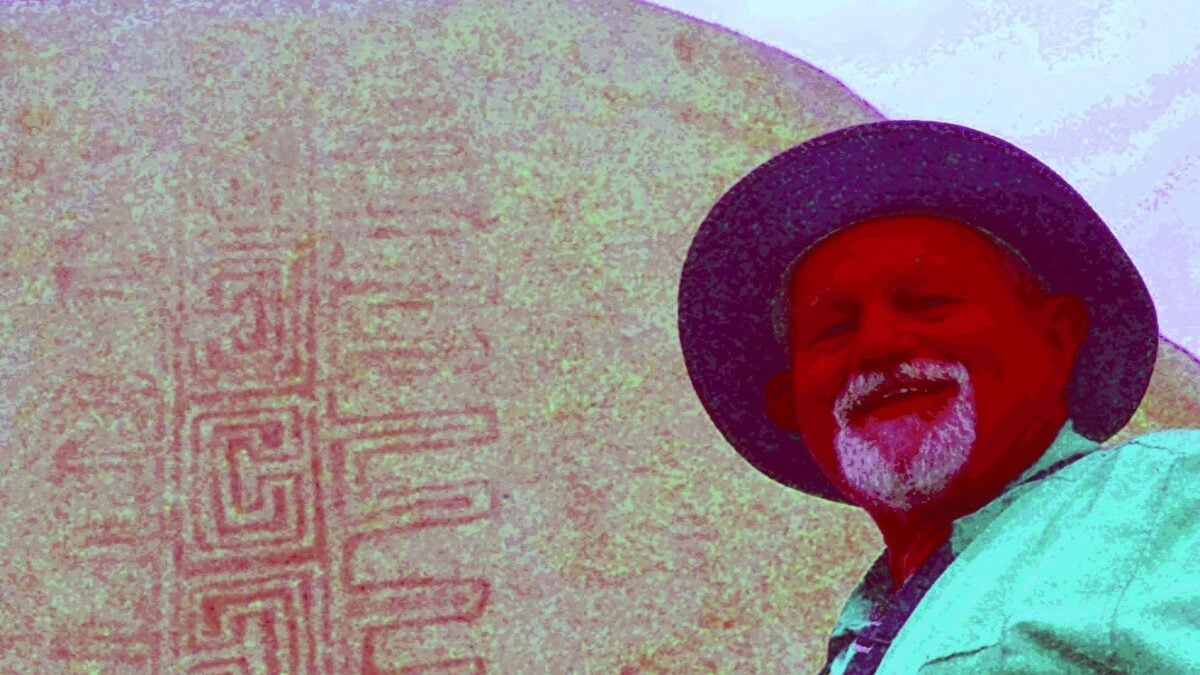
- “No one really knows why people made the rock art they made, at least in many cases,” Harman said
Well, it's obvious they really wanted to though. This isn't like marking on a wall with a Sharpie. They had to work at it to make it happen. The commitment alone is impressive even if it was just a "Grogg was here!"
by dylan604 - https://smbc-comics.com/comic/rite-on
> "No matter what you do, when we find something weird in ancient history we will decide it must've been part of a fertility rite."
by Terr_ - Decently intentional and deliberate in many if not most cases. There are examples of it in high up places along sheer cliff walls in Arizona that boggle the mind trying to figure out how they managed to accomplish it and at the scale they are, then there are cave paintings that are hundreds of meters deep inside narrow caves in Europe.
It actually makes me wonder if this technique would produce any results in the notorious Erdstalls in Germany. I suspect not, but no one has any better ideas, so it might be worth checking.
by tyrabound - I tried to look for hidden rock art at Ankgor Wat by imaging with multiple bandpass filters and amplifying cross-spectral differences. I didn't succeed, but maybe I was in the wrong place. The shit guards there also didn't like me using a tripod while I changed filters, so it was also hasty.by qurren
- Sounds like they were the opposite of shit if they noticed someone setting up specialist equipment. I don't think any national monument in the world would be keen on people doing that without advanced permission.by wdutch
- If it makes you feel any better, I've also never had any luck finding hidden rock art, petroglyphs, or similar using multispectal bandpass filters or decorellation stretching.
I was super excited about DCS based on some of the recovered petroglyph photos online, and integrated it into some software I wrote years ago.[1] Still hoping I find something as interesting with it as the fellow mentioned in the article. It works, but I haven't had a "gosh, I never would have seen that without DCS!" moment.
[1] https://www.beneaththewaves.net/Photography/Decorrelation_St... / https://www.beneaththewaves.net/Software/The_Mirrors_Surface...
by blincoln - My first thought reading this headline was "Really? Nobody thought of this until now?" But reading further, the Dstretch plugin has been around since 2005 or so. And presumably people have been using contrast enhancement, color manipulation, multispectral imaging, etc. to uncover hidden images long before that.
So not exactly "news" at this point. But still a pretty cool success story.
It almost feels like a feature that should be built into the default camera app. For anyone wanting to conduct their own forensic analysis to determine how thoroughly their hotel room has been cleaned, for example (although personally I'd probably rather not know).
by freetime2 - > For anyone wanting to conduct their own forensic analysis to determine how thoroughly their hotel room has been cleaned, for example
Probably more effective to bring a UV flashlight with you.
by fc417fc802 - You can do something similar in GIMP:
1) Colors > Components > Decompose > LAB
2) For the layers of the A/B (chroma) channels, Colors > Levels > "Auto Input Levels" (maximize the contrast), and move the mid point to the median.
3) Colors > Components > Compose > LAB
by matja - Have you validated that it produces similar results?by tyrabound
- That is very clever, thank you. Didn't even consider that yes, the contrast of the A/B channels is also the spread across the colour spectrum. Shows how little I use LAB... thanks for the reminder.by rf15
- Can you explain 2 a bit more? I see the Auto input levels but unsure what you mean by "move the midpoint to the median."
The result I got for the original mars image was a washed out red image with some yellow around the craters.
by MisterTea - False colour composites were something I was introduced to in high school GIS and did a lot of in undergrad remote sensing. It was one of those Eureka! moments for me in terms of developing a better understanding of signals and signal processing, as well as sensors and data collection. Ie. absorbing the reality that the way in which my eyes (or any optical sensor) see the world is not canonical. Vegetation is red, not green!
It was also just the COOLEST THING EVER to swap infrared bands in LANDSAT ETM+ imagery and watch vegetation immediately pop out at you. It's what turned this sort of dull (at least for a teenager) geoscience into a kind of puzzle where you have to figure out how to bring the signal up out of the data.
by Waterluvian - > Ie. absorbing the reality that the way in which my eyes (or any optical sensor) see the world is not canonical. Vegetation is red, not green!
Pretty funny to figure out that your perspective wasn't objective reality and then immediately decide to canonicalize another arbitrary reality as the One True Reality.
by ambicapter - It's really fun to play with black and white photography using various kinds of color filters and see how different you can get the same scene to appear.
(Also fun to play with a polarizing filter.)
by jacobolus - And, insects see flowers (and each other) differently than we do, as they are senstive to different parts of the spectrum, specfically ultraviolet. They see patterns and markings that are not discernable to human eyes.by SoftTalker
- > False colour composites were something I was introduced to in high school GIS
As an old guy, this is something I'm jealous of in a positive way. I'm impressed that schools are offering this type of subject. My senior year was the first year to introduce a "computer science" class where I learned PASCAL on an Apple SE/30. The year after I graduated, the school created an actual computer lab. To be honest, I haven't even thought about looking to see what is available in schools today, but nice to hear something positive
by dylan604