Join the discussion
Write your take first — we'll ask for email only when you're ready to publish.
- Hacker News
- I find it endlessly fascinating that information cannot be destroyed and we keep finding more and more ways to read the universe at every scale!by huurtehoog
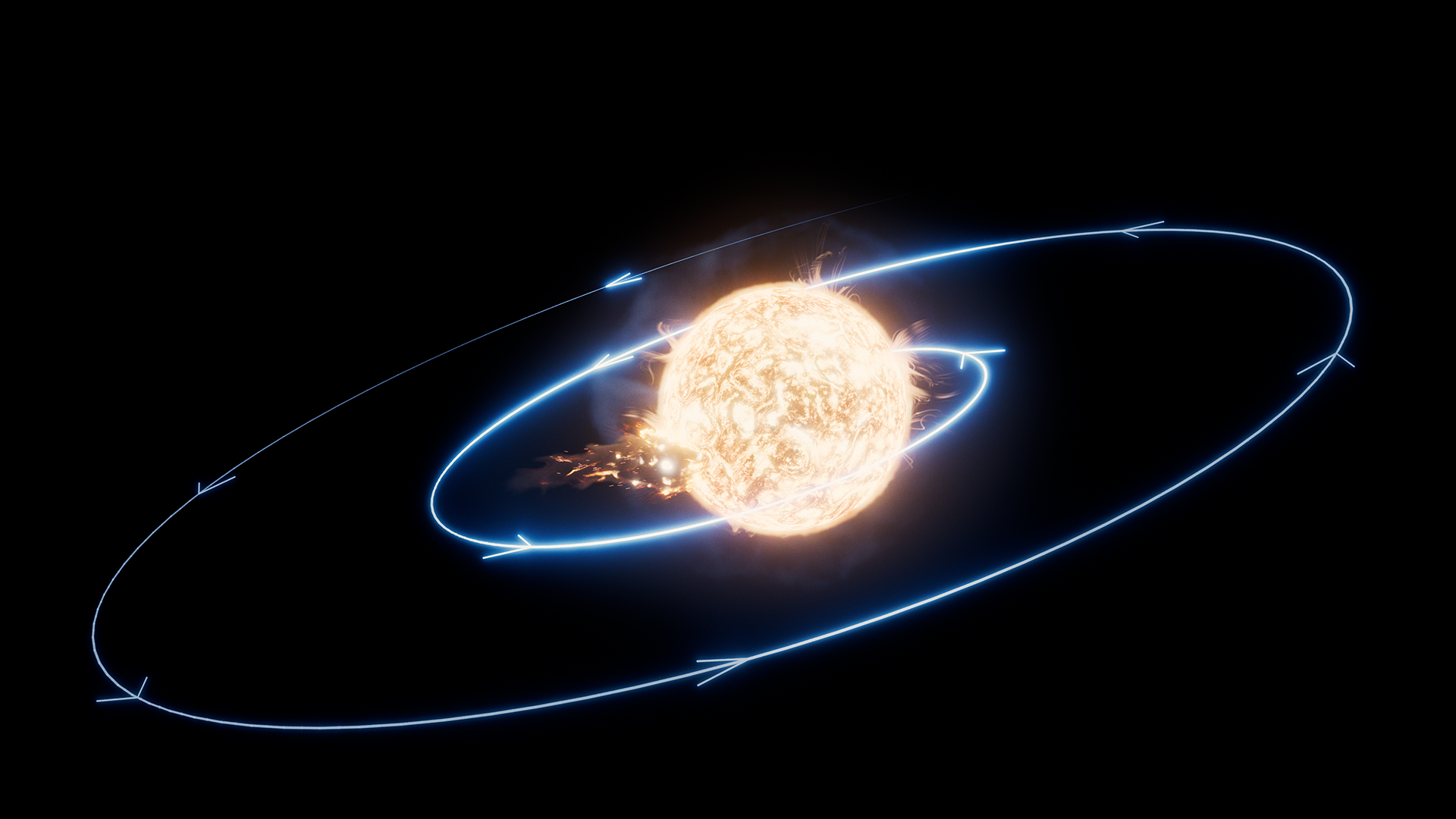
- About that artist's impression with the blue spiral: wouldn't any planet or other object do one of these things:
- approach and hit directly, without spiraling
- approach, make a close fly-by and fly off into deep space again
- be in a steady, eliptical orbit
My knowledge is basically that of a Kerbal.
by fainpul - You have to get nearly halfway from the surface of the sun (photospere) to its core before the density of the sun’s material is equivalent to that of the earth.by jcims
- Has someone got a quick explainer for why adding a planet would result in less lithium? Is it just that a super-earth would be big enough and have so little lithium that it would measurably water down the other elements?by regularfry
- That’s it Apollo! Spit it out, what’s in your mouth, spit it out now!by N_Lens
- > Their results favour a scenario in which the young Sun engulfed a super-Earth around 5–10 times the mass of Earth
Given the state of the early solar system, it would be surprising if the Sun didn't swallow a lot of metallic and carbonaceous rocks and pebbles. But it seems unclear to me how the researchers would distinguish between one super-Earth and >10^10 smaller rocks? Chemically I feel the two would be largely the same.
by A_D_E_P_T - This might just be me, but I find metaphors like ''Fingerprints' inside the Sun' harder to read than the title of the original paper, which is probably what should be linked here per HN submission guidelines:
> Planetary engulfment as a solution to solar-model discrepancies and its implications for planetary systems https://doi.org/10.1093/mnras/stag1527
For the press release, something like The Real Sun and Its Simulations Disagree. A Planet That Fell In Early Might Explain It. might be easier to follow.
- MESA, a piece of software referenced in this article, is a pretty incredible system. (Even referring to it as software underplays the extent of its community and impact.)
Many people are involved in MESA and Bill Paxton was always quick to point out the many new folks that worked on it, but this article does a great job of celebrating his impact:
https://www.kitp.ucsb.edu/news/an-accidental-astrophysicist
It's amazing to me that he went from being the voice on the other end of the Mother Of All Demos to having such a major impact on stellar astrophysics during his "retirement." He passed away in 2025.
by mturk