Join the discussion

Write your take first — we'll ask for email only when you're ready to publish.

  • Hacker News
  • Money. They make so much money from malvertisement that it doesn't make sense to remediate them. It's corporate greed and they've known about this since the 2010s, various campaigns have sprung up and have caused untold X amount of dollars in damages in breaches, and nothing changes. I've heard at least one FBI agent who had investigated cases related to malvertisement put Google up there with some of the worst ad networks.
  • This is it. The truth is Google's largest revenue sources are scams, fraud, and malware, and they wouldn't be in business without them. They're not going to remove all of their highest pay per click customers because it might harm society or something.

    Just try to convince Google to remove "MapsQuest Driving Directions", a browser hijacking extension advertiser who clearly impersonates one of Google's competitors: It's an extremely high value scam targeting seniors (the folks who mostly look for MapQuest on... Google) and it makes them way too much money for them to stop it.

  • I don't think it is fair to pin this on Google - I get the worst ads on X. But something about how the X ad network works means that even when I report the ad, block the ad poster, etc. there is this army of alternate ad accounts that all show the same ad.

    I was feeling very guilty last night as I was watching YouTube and getting 30s+ unskippable ad blocks every 10 minutes in some video. And the repetition and low quality were grating on me. I thought: being rich is never having to watch another ad. Why am I letting these ads own spaced repetition slots in my brain that could be filled with knowledge? Instead of learning, my mental energy is being taken up by psychological manipulation to purchase? The relentless repetition of the mind-numbing ad interspersed throughout otherwise educational content.

    Being rich is owning the real-estate of my own mind. I sometimes feel like a digital serf in my own head.

  • I was feeling very guilty last night as I was watching YouTube and getting 30s+ unskippable ad blocks every 10 minutes in some video. And the repetition and low quality were grating on me. I thought: being rich is never having to watch another ad

    You don't have to be rich to avoid getting those ads. You can make them go away for ~$15 a month. If you can't afford that, you have bigger problems in your life than YouTube ads, and your first step towards fixing them is to spend less time watching YouTube.

  • Somehow I would never assume that X would act "moral". Google on the other hands even few years back was generally acknowledged as a good actor which was once again corporate charade people would fall for. Including myself.
  • I think it is fair to pin this on Google, Meta, X, and any other ad networks that seem to have no control over their own platforms.

    They're like Dr. Frankenstein, creating a monster and then just letting it roam the countryside. But worse, because they profit (immensely) from the chaos their monster wreaks.

  • X has been the most shameless, after all brand name advertisers left. Here is one state-level actor campaign that has been going on for months:

    https://imgur.com/a/HZwfyNH

    It's not advertising anything, it's just a straight up scam exploit site. It uses exclusively stolen or fake accounts. The links are shown as "amazon.de" or similar but of course do not go there, no doubt just a bug X haven't gotten around to fixing just yet.

    This is on the kind of level where if we had actual law enforcement for tech companies, the next time some X executive lands in Europe they would be in cuffs.

  • Why are you subjecting yourself to that instead of downloading Firefox + uBlock origin?

    See the headline of this article for Exhibit (I've actually run out of letters in the alphabet) why adblocking is a moral imperative.

  • We had to hire a full time person to monitor and block click-trick "Continue" / "Download" scam ads on Google Ad Manager. With the amount of human training we did blocking these ads, google could absolutely solve this problem instantly. The ad creatives are nearly identical. We were seeing new ad accounts targeting our specific domain daily (ad account names like {sitename}339, {sitename}340, etc)

    When we asked our reps, they dance around the question by saying they would "escalate to engineering" or some bs like that.

    Google just makes far too much money to stop. My guess is that its >40% of AdX display revenue, based on the % of scam ads that come through ad manager.

    Context: our site did ~$5m AdX revenue annually, mostly US audience. High CPM niche. This was ~7 years ago till 2 years ago when we sold the business, I would guess it's still happening based on ads I see browsing the internet.

  • A lot of questions being raised today can be answered by the recently inverted power balance between users/customers and corporations. People have not yet internalized that old assumptions about how corporations fear losing customers are no longer valid. Consumers have become entirely docile and passive. Open hostility to consumers is now a norm. (Obviously regulation is also less powerful and less feared as well.)
  • This is ultimately on the consumer. Critical thinking is long gone for like half the general population. It's wild. The excuses are endless.
  • Many large modern corporations are third-hand cars. The original owner had a purpose and an emotional investment in owning the car; for the second-hand owner, it became a practical thing; for the third-hand owner, it is often a liability.

    If you are lucky, your third-hand owner still checks the oil and puts quality tires on it. If you are not, your third-hand owner pours customer relationships down the drain and doubles down on indiscriminate cost-cutting, alienating good people from the organization.

  • Because serving dodgy ads pays them a lot of money. The pivot is complete.

    90% of the ads I see on YouTube are obvious scams. Many from untraceable shady overseas organizations.

    You can see the data if you report them. It's always some unheard of outfit out of Hong Kong or Brazil. I want to know who is funding this.

    You don't need to be Kreskin to figure this one out.

  • I've mentioned this hundreds of time in various context and forums: I do not believe that there's sufficient quality ad content to keep companies like Google or Meta running at their current levels. It doesn't make sense to me that the stores and manufactures selling physical goods are able to fund the entire tech industry.

    They simply have to allow a certain number of sketchy ads, perhaps not outright scams, but they need to pimp some level of questionable products and services to keep the money printer running.

    Geography certainly plays a roll, the smaller the market, the less advertisers are available. When I occasionally wanders into the ad supported internet without a tracker-blocker I get the same ads on repeat. It's my local supermarket, where I shop regardless, it's ads for vitamins and assistive devices for the elderly and plastic junk from China. That's it... honestly I can't see how that funds the tech gigants.

  • Who's funding this? The people getting scammed, usually.
  • > You can see the data if you report them.

    That's at least something. Last I was on a streaming service, they were very fastidious about not revealing who was behind a spammer's rotating "music labels", despite them by law having some kind of payment details for them.

  • > I want to know who is funding this

    It's a network made by snake-oil salesman. People on Brazil yearns for passive-income, and they get told by a lot of influencers that dropshipping is what will give them their freedom.

    Then you have thousands of people dumping fake ads about borderline fake products on Meta and Google. It's actually a hive-mind.

  • Google can reply and confirm whether or not a report did anything?

    I’ve never seen that. I report ads on YouTube all the time. I’ve reported ads for illegal drugs, illegal firearms, pornography, and all sorts of various scams. I’ve seen similar advertising to the example in this article, mimicking the phone’s UI. Ive reported them. I’ve never once seen Google reply to any of my reports to confirm what happened. I’ve always wondered, and since I continue to see the ads I just assume my reports go straight into a trash bin.

    The illegal firearm ad I saw (more than a year ago, now) I was so shocked that I took screenshots and reported it multiple times. The ad advertised that the weapon was “easy to sneak through security” and “didn’t require an id to purchase” I saw the ad several times across multiple weeks. I reported it every time. I don’t think Google ever did anything about it. If they did, it took them weeks

  • Maybe reporting is the right idea, but Google the wrong target to complain to.

    Maybe we should report obvious fraud or illegal content to the authorities.

  • I can recall one time I got feedback from Google that an ad had indeed been taken down, that was an Ukrainian women dating ad in Gmail which was not subtle at all about offering trafficked women. But that's some time ago.
  • Why do you keep reporting them, when clearly that does nothing?

    And since, as this article points out, Google does not need reports if they actually wanted to block such ads, it seems completely pointless.

  • There is am extremely pervasive trick where bots repost trending comments rewritten in AI very early in videos and boost their bot comments above the original, then if a bot lands a top comment the profile is suddenly switched to porn/scam links with a female model as the profile picture.

    It's so common and so clearly reported by many people that I'm left to assume Google likes the engagement the profiles bring and chooses to leave them up.

  • This is one major reason why blocking ads is now a safety issue. If you have a family member who, for whatever reason, might be fooled by this sort of ad, install an effective adblocker on all their browsers and uninstall/disable browsers that don't support an effective adblocker.

    If you are reliant on ad revenue, you should be expressing your displeasure to google right now.

  • My mother has:

    * Got me a "BearSkin" jacket from youtube's incessant advertisement.

    * Signed up for a $250 subscription to "The Daily Beast" when she was watching youtube tv right before bed and probably subscribed when she meant to just view.

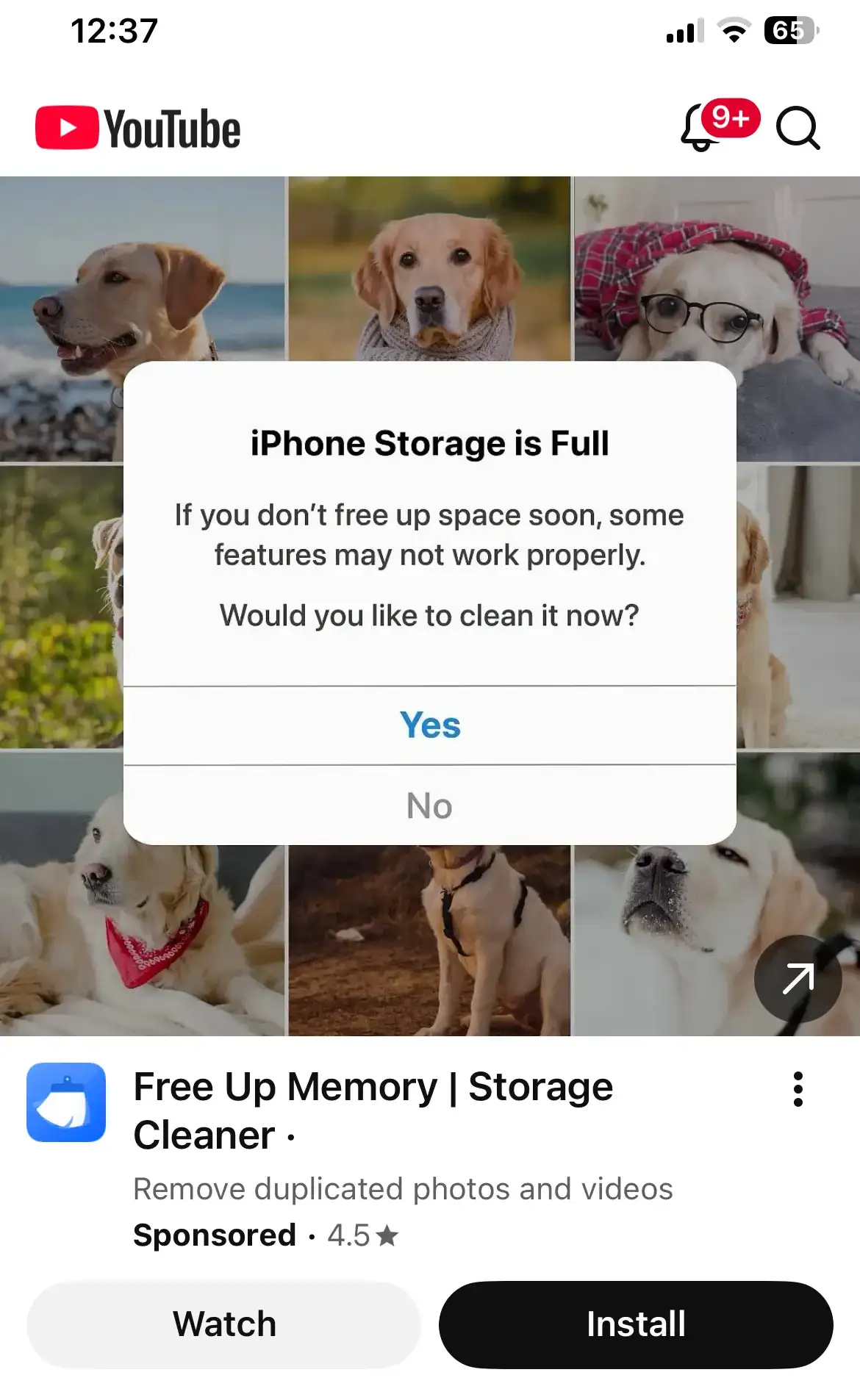
    * Signed up for Norton Antivirus when she got a gif that looks like a popup that tells you have a virus and it opens to a Subscription Plan on her phone.

    None of these things were things she particularly wanted, some she didn't even consent to, but a combination of paid promotion / advertisement / confusion about the UI is basically doing things against her will.

    I literally got her Youtube Premium just so she stops seeing all the ads that are feeding on her. It is a problem.

  • When Google broke the original uBlock origin and made people switch to uBlock Lite, I found out about the change because my grandmother called me in a panic. She saw an ad like the one in this article on her Facebook page and clicked it, then it was telling her to call Microsoft support because her computer was infected.

    Like, Google removing Adblock directly caused that. Facebook allowing the ad caused that. The ad led to malicious page that was also hosted on a Microsoft thing, and I ended up reporting it to them too. Microsoft at least promptly took it down within a half hour after I reported it. But these big companies have almost no incentive to stop this, and some of them directly profit off of these scams happening.

  • I have two guesses why Google does this:

    1) Google wants the most money, so they don't care to let dodgy ads thru.

    2) There are more ads going out then can be reviewed, so they would rather have people report them, then they automatically reject the report until enough people report it, then an actual person may review it.

    As to why Google doesn't use AI to review them? Google would rather use the AI in a way that makes them more money, than review ads and if AI decides to take them down then that's less money for Google.

    (To be clear: I don't work for Google in any way, these are just my guesses)

  • I don’t think they want the most money. If they did, they’d have done this long ago. The trend we’re seeing is about them just struggling to meet their quarter over quarter and year over year numbers. It’s a short term driven change to strategy, they’re trying to fill the hole with something else (we all know what) before admitting it exists. If they said their golden goose was dying, the stock would crash.
  • > 2) There are more ads going out then can be reviewed

    The "more than can be reviewed" might have been a logical conclusion in a purely human based workflow, even if you have the lowest cost per head click workers in like, an external contractor call centre type environment in Bangladesh.

    As the author points out, the ordinary consumer class version of publicly available Gemini very accurately classifies the ad as malicious. I really doubt that there are THAT MANY unique new ads being submitted per day that they can't afford the compute to run them through a similar classifier.

  • Google gets paid to show the ads.

    Adding friction to the process (on the advertiser side) means less money for Google: 1) due to the cost of implementing the checking, 2) because some legitimate advertisers will be falsely denied, 3) because the scam ads were still paying money.

    Not adding the friction doesn't seem to come with any serious downside. One would expect that it would, e.g. due to publishers removing the most profitable properties from the ad network or governments legislating this out of existence, but that doesn't seem to happen.

    So, given these incentives, the outcome is inevitable.

    If Google had to pay a massive fine for every scam ad that gets through, or was liable for the damages the ads cause, etc. - or otherwise had a strong incentive - suddenly there would be enough resources to make sure every ad is reviewed, advertisers that push scam ads get fully banned on the first offense rather than being given second, third, and fourth chances, etc.

  • As someone who advertised with them, they do seem to have an AI reviewer, and it also has false positives that no number of appeals seem to resolve. So in these cases you want to pay them money for good ads, but you can't because AI says no.