Join the discussion
Write your take first — we'll ask for email only when you're ready to publish.
- Hacker News
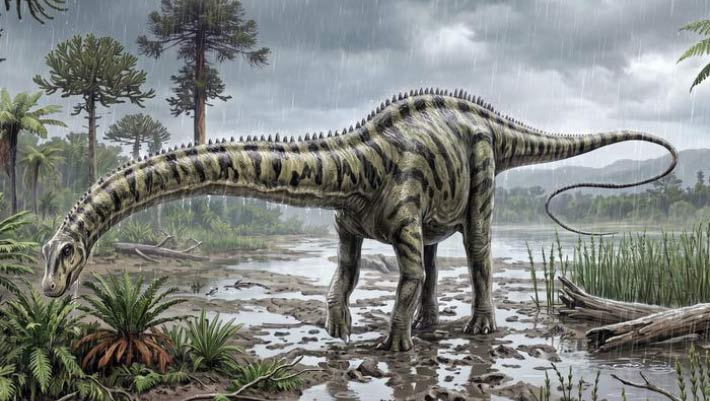
- Even the dinosaurs are abandoning the USA.by protocolture
- Once again, history and medicine are two fields that reliably make me happy. Dinos were my faves as a child and they continue to inspire. The way we (my family) mispronounced this one: diploDOEcus. But I also got Heredotus very wrong, so I guess it was a Midwest thing.by alsetmusic
- Is "American" a nationality where maybe "North American" a geography? I don't think Diplodocus has US citizenship...by ta93754829
- Only thing I could hear when reading the title: https://www.youtube.com/watch?v=6VWxl0YUT4oby niborbit
- I am not a dinosaur expert, but the headline seems off. The actual paper linked from sci.news starts with this (citations removed):
> Diplodocids are known from deposits present in the U.S.A., Europe, South America, and Africa. According to the available evidence, the oldest diplodocid sauropod dates back to the Oxfordian of Europe, whereas the most recent ones are from the lowermost Cretaceous of South America and Africa.
It als says that "The European diplodocid fossil record is scarce and fragmentary," but that still sounds like evidence for Diplodocus in Europe, doesn't it?
https://www.tandfonline.com/doi/10.1080/02724634.2026.271842...
by ano-ther - Original article (in Spanish), from the source itself: https://fundaciondinopolis.org/un-descubrimiento-paleontolog...
- Apparently I'm a bit slow today, because my brain started completing the headline as "Diplodocus, Long Thought Extinct, ..." before my eyes could finish reading it.
> The animal’s fossilized remains — 14 well-preserved tail vertebrae and several chevron bones — were unearthed at the La Tejería site near the city of El Castellar in the Spanish province of Teruel.
According to Wikipedia (if I'm reading correctly), the chevron bones are also part of the tail [1]. It's pretty cool how such a small part of the skeleton can carry so much information!
by WCSTombs - > The Spanish Diplodocus lived roughly 150 million years ago near the end of the Jurassic period.
> [...]
> According to the team, the presence of Diplodocus in Iberia offers strong evidence that dinosaurs moved between North America and Europe during that era, likely crossing temporary land bridges that appeared as the proto-North Atlantic Ocean periodically receded.
I want a map! I found this: https://www.sciencephoto.com/media/167017/view Is it the correct map? Is there a land (ice?) bridge between Newfoundland and Portugal? Am I interpreting it correctly?
by gus_massa