Join the discussion
Write your take first — we'll ask for email only when you're ready to publish.
- Hacker News
- I mean, Piketty showed this a decade ago in capital in the 21th century: the higher your income percentile and wealth percentile, the higher saving rate and the higher returns on your investment (which is negative for folks at the bottom of the distribution).
Of course the other problem with the projection is that BLS average expenses aren’t super accurate to project what people are spending on at those income percentiles :)
- What does not help, in my opinion, is that the wealthy people often have enough resources to optimize their taxes to a point where they pay much lower rate than their fair share. While the others cannot afford to do that and pay the full rate. That in itself creates inequality.
If a base rate that the society agrees on is e.g. n %, then, in my opinion, everyone should pay that n %. But in reality the poor people pay n % because they have no time to even think about optimizing it. As they often work around the clock to make ends meet. While the richer people hire professionals to take care of their taxes and optimize them to the extent that they pay significantly less than n %. And then there are super rich, some of whom, such as Donald Trump, pay almost no taxes at all.
This is, in my opinion, wrong and significantly contributes to wealth inequality. And therefore I believe that it needs fixing.
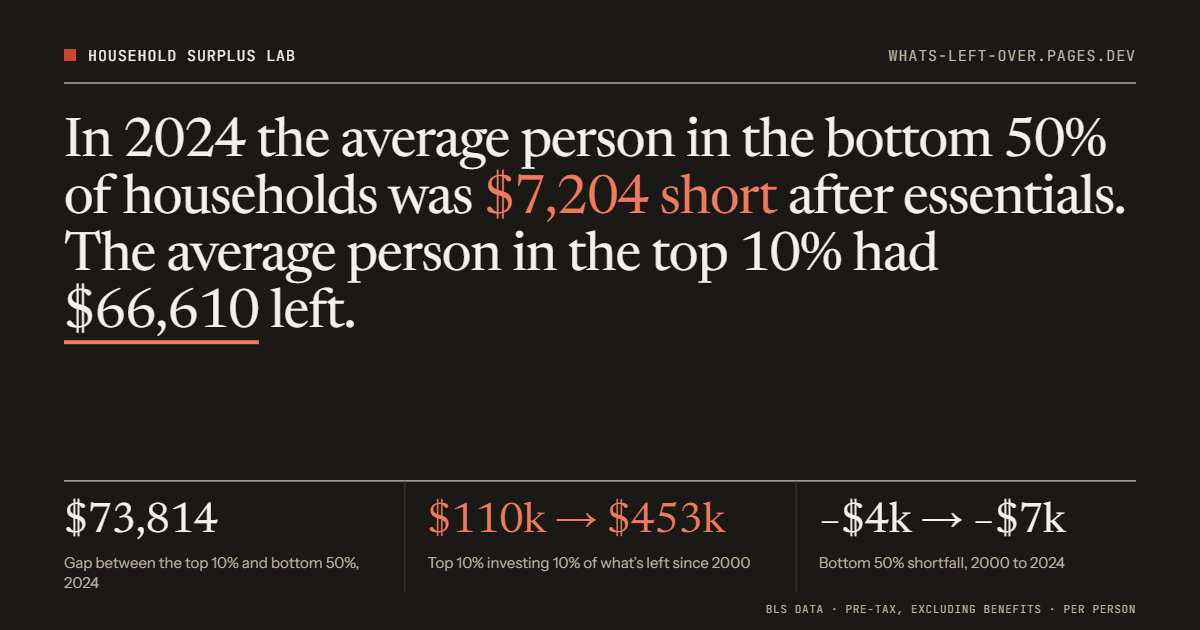
by pbasista - Very hard to parse, not very helpful, and blatantly wrong. Cutting through the slop, the "bottom 50% of households" average income is said to be $22,907 without any expenses? The middle 20% making $60,298? That's...very obviously incorrect.
The median household income is $83,730: https://fred.stlouisfed.org/series/MEHOINUSA646N
The average for the bottom 50% of households is $30,000-something. Would take too much effort to figure out the exact figure for a comment, but still way higher what this site says, and I still feel like this is more effort than went into this misinformation site.
Its own linked source says that for 2022 the bottom quintile makes $26.2k before taxes and transfers and $44.8k after, while this site says $17.2k after. No wonder it's coming up with such wacky conclusions like saying a majority of America is going into debt while only buying the bare essentials and nothing else. If you use the correct income numbers, even the bottom quintile averages out to having $16k extra after essentials.
by mminer237 - This is hiding the real truth. Rich people invest more money and its a good thing that they invest because the investment goes into productive areas which ends up back into consumption.
The other way round is much much worse - imagine if rich people don't invest but rather just consume. It _takes_ away money from poor instead of building more wealth for everyone.
So the overall point being made here is not that true
by simianwords - This is vibe coded I guess? Toggling the "Happiness plateau line" does nothing.by thr0w
- A visit to Disney World introduces some questions that bring doubts to this article. The park is overrun with young families, with a great many speaking English as a second language. They don’t seem to be top percenters, but they’ve got cash for tickets and food. ( The food seems to be priced about 5x what I’d imagine it to be at a real store. )
If they truly are poor, they’re surely living YOLO.
by RickJWagner - An important element of the conversation is does (or how much does) it matter if any specific percentile group is getting disproportionally richer, given all (or a vast majority of) groups are? A group's lack of upward movement is not unjust if their groups actions do not justify a movement upward.
Additionally we also have to recall that the quintile's populations are not necessarily static. to illustrate the idea: members of a quintile may join an adjacent quintile in the next time period. That is, bottom members may move up, top members may move down, mid members may move either way. To the extent their movements are justified by their actions/choices is to the extent we have a fair society.
That is, if people are getting rich from sources not related to taking right actions, or people are taking good actions and getting poorer -- then we have an unjust society.
This can both apply to Rich people abusing their power to get rich, but also with poor people abusing their democratic powers to unjustly take from others that which they have not earned.
by maerF0x0