Join the discussion
Write your take first — we'll ask for email only when you're ready to publish.
- Hacker News
- "LLM paragraph will register to much of your audience not as writing but as output"
The best advice for writing for other humans is: don't use LLMs.
If you're writing for machines, liking coding, then fine go for it. If you're writing for processes with formal highly structured content like manuals, specifications, form content, procedures, information, that sort of thing, then also ok to use LLMS. But if you're writing for a human mind to ingest and extract meaning from, then LLMs are poison.
- Step one: open up the LLM
Step two: close the LLM
Step three: pick up a pen and write
Writing with LLMs is a great way to make yourself stupid: https://lambdaland.org/posts/2026-08-07-ai-writing-stupid/
I'm glad the OP acknowledges that you have to have to do the writing yourself—though they say this more as a means to avoid getting pegged as having used an LLM, whereas I see the problem as being cognitive surrender.
by ashton314 - I sort of agree, but I also think the advice here is circular. To look at the style suggestions produced by an LLM and decide that you agree with some of them in spirit, but want to put it in your own words, you already need how to know how to write well.
In other words, you need to read a style manual or two, and you need to read and have opinions about other people's work. You must have taste. Otherwise, you can't really distinguish between good and bad advice. You'll anchor to the suggestions made by the LLM and it will turn your writing into LLMese. I guess that works - it sure gets clicks on HN - but it won't be your voice anymore.
There's still value in getting a second pair of eyes on what you write. But here's another cool trick that gives you a similar benefit: just let it stew. Go for a walk, grab a lunch. Re-read what you wrote. You'll be surprised.
by in_absentia - > Present the original and new writing to the model and ask it which is better.
LLMs have absolutely terrible taste when it comes to writing. I don't find their feedback useful at all, beyond trivial spelling/grammar mistakes, which you don't really need an LLM for in the first place.
Proofreading is all you need.
Edit: I do sometimes ask an LLM for a fact-check, though.
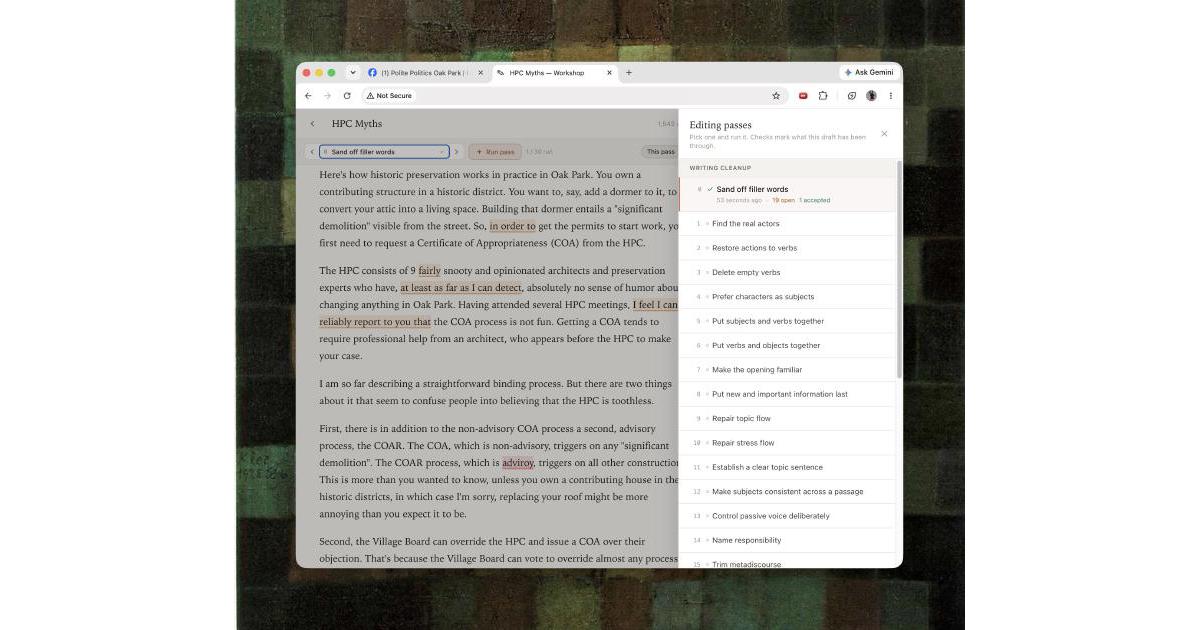
by Retr0id - I've found the only good way to write with LLMs is to absolutely not use it for the first few drafts, the using it as a tool to list specific kinds of problems in text (word repetition, unnatural hard to read sentences etc) and approaching those points with caution and skepticism. Even copy pasting a single sentence, I've found, is a slippery slope.by nirava
- Even if you don't want style advice from an LLM (I generally don't, not for blogging), for a technical blogger "please check this post for factual accuracy" is a good way to not look like an idiot. Often it complains about hyperbole, which I tend to ignore since there's no point blogging unless you have some firm opinions, but on at least one occasion it pointed me towards some documentation that undermined my entire post - and led to a much better one a week later once I'd processed and applied that new information. Thanks, LLM.by thombles
- I fear in the future people will read even less because of how often people cheap out and use AI to write. I know the author of this article tells you never to use a single word it suggests, however I still, while reading, am checking for any amount of AI used. This makes reading less enjoyable, and even a bit stressful.
If you can't spend the time to write it, why should anyone read it?
Everything I post is from my own finger tips, only to get a reply from someone using a bot. I'm tired.
by S-E-P - This would sound insane to me from two years ago but I have recently started insisting on writing all my own commit messages and pull request descriptions. I do usually have an agent review them for factual accuracy, but not rephrase them.
It slows things down a bit, but in the best possible way. It has helped immensely to improve the depth of my understanding of the agent-generated code. When agents are doing everything its way too easy to “skim” diffs and not really absorb them.
I always prided myself on my technical writing, and commit messages and PRs were a great place to hone that skill. I found that I missed it and my work is better now I’ve reclaimed that part of my old job back.
by semiquaver