Join the discussion
Write your take first — we'll ask for email only when you're ready to publish.
- Hacker News
- Its much harder to produce a good fundamental list of biology problems because we are no where near as far along, so many basic things are not understood. There are still many unknown unknowns and these particular problems are limited to the realm of verifiable in a lab, which rules out much of what makes biology interesting and hard to study, and that is the organisms themselves and the interactions between their cells. The petri dish differs from the rat differs from the human and that is a part of what makes biology harder to progress.
None of these is likely the root to the wide array of chronic illnesses we can't treat and those seem like the next step to really put a lot of research into given how many people suffer from them and where we are today they seem achievable with the right investment.
by PaulKeeble - This is a collection of pet projects by folks who are not distinguished biologists. Interesting, maybe, but not to be placed on the same pedestal as the mathematics Millenium Prize of a similar name.
Arguably, the origin of life is a question for all time -- no way that a VC webpage is going to change whether someone takes that problem on, and it will be commercialized with big-name capitalists instead of 'FutureHouse' should it ever be developed in the lab.
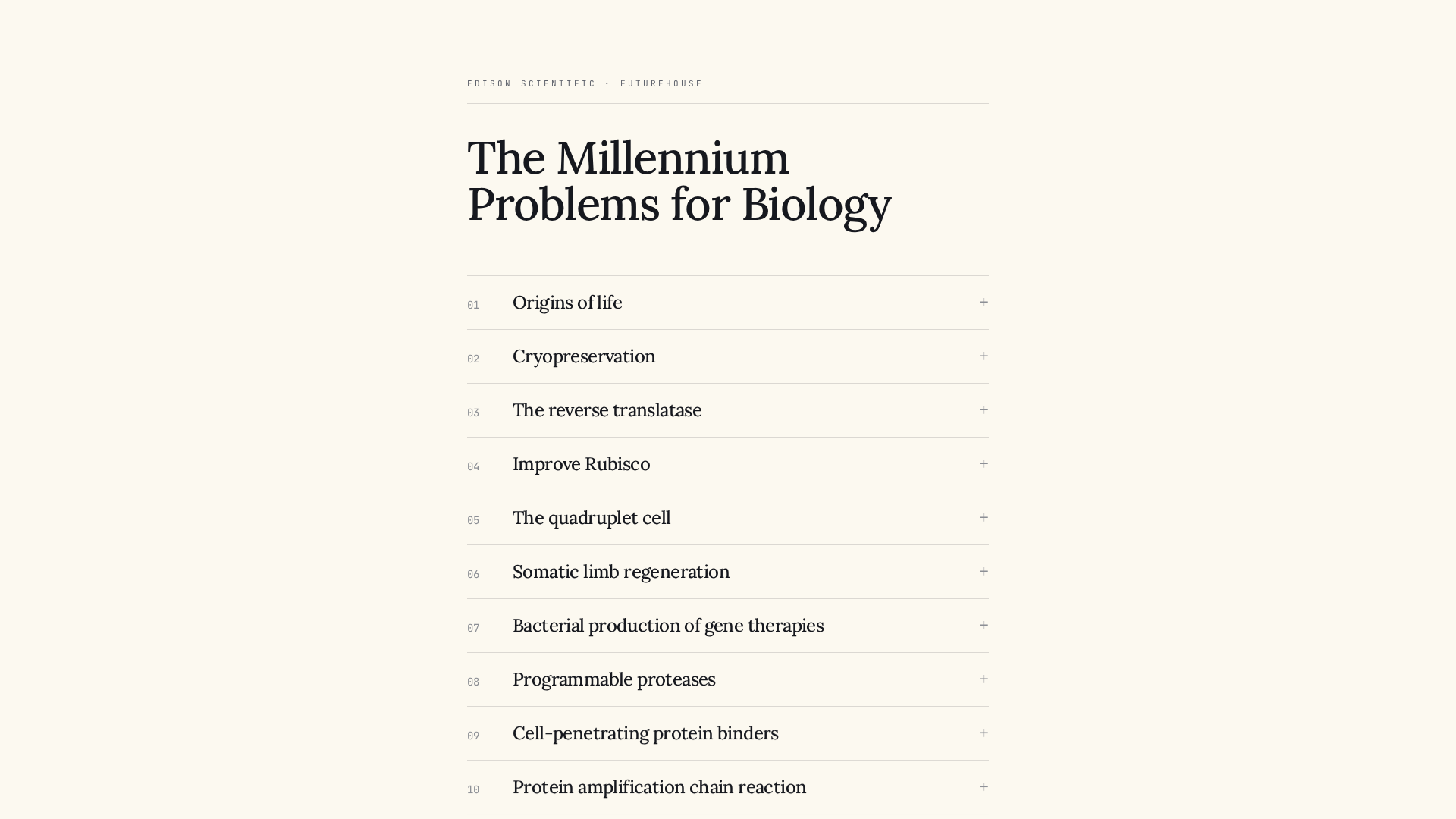
by bonsai_spool - > Demonstrate the emergence of life from chemical precursors in a laboratory setting.
> Specifically, demonstrate the unassisted emergence of self replicating RNA- and protein-based cells from a plausible primordial soup with a plausible energy source. A “cell” may be any compartment with a defined boundary.
So, right now, nobody can explain how life originated. Proving that aminoacids, DNA or RNA form, does NOT mean that this is equal to life. This is a problem that the whole field has - it still can not explain how life originated. Showing that individual components can arise spontaneously, is not the same as showing e. g. how a cell formed and so forth. Where does the encoding problem fit into any of that, for instance? You need to prove how you can assemble systems. Just having a working ribosome does not connect it to DNA as a genetic backup system; and RNA tends to be unstable. Even when you have assumptions how this works together, you need to prove that this is how things originate(d). Nobody has done so since decades. It is an unsolved problem.
by shevy-java - Wait a minute:
> Cryopreservation + Demonstrate the ability to cryopreserve and recover live wild-type mice with high viability. Specifically, demonstrate the reversible cryopreservation of live, intact, wild-type adult mice in a whole-body frozen or vitrified state. The mice must remain frozen or vitrified for at least 24 hours, must be recovered with >99% viability, and must not suffer any permanent organ damage or bodily harm. Somatic genetic engineering is discouraged but permitted. All experiments must be conducted with ethics approval.
This has been done in the 50ies, freezing and thawing mice with microwaves. IIRC the recovery rate was about 74% with no observed side effects. The research was given up on because in this specific case a mouse is a bad biological model. Thawing agents must scale cubically with size. The author says that at approximately the size of a cat you can’t quickly enough evaporate all the agent because the energy required will simply burn the tissue.
TLDR: it’s possible, it’s been done, it could be perfected if necessary, it does NOT scale beyond mice
- This is all well outside my area of expertise, but my impression is that Michael Levin's work with bioelectricity is on the cusp of #6 Somatic limb regeneration.
SMEs please correct the record if I'm mistaken.
by daoboy - Biology already has numerous “Millennium Problems” and the rewards are much more than $1M. For example, reverse Alzheimer’s Disease. Or less ambitious develop high fidelity in vitro and animal models of human disease.by pfisherman
- Someone should make the millennium problems for AI alignment so the frontier labs will actually try to solve that problem.by doctoboggan