Join the discussion
Write your take first — we'll ask for email only when you're ready to publish.
- Hacker News
- Obviously. The standard pattern is that model X is basically AGI and wins all benchmarks, followed the next day by Y and Z, which both win all benchmarks, too.
Then weeks later people find out that they have been duped and complain that the models have been quantized or employ worse inference.
Buy decent coffee instead of your $200 subscription and sidestep all the scams.
by r2-129 - I've followed a few trackers, eg https://marginlab.ai/trackers/claude-code/ , for awhile. For Claude Code the trend, it seems to me at least, is fewer tokens to do the same or better job. Prompt changes, tool ergonomics changes, etc.; I'd be shocked if they didn't A/B every release. Less thinking as measured by tokens isn't necessarily bad if you can get the same results by making it think about the "right" things or structure. They obviously screw up sometimes, and I've always been suspicious with hidden tokens, but I haven't found evidence quality intentionally degrades over time.by rcr-anti
- Anecdotally, I have found the same. I spend a lot of time with these frontier models, brainstorming, etc. and the drop in performance from, say, week 1 to week 8 is often massive. Whereas in the beginning, it seemed like a capable research assistant, by the end of week 8 or so it starts acting like a puppy dog eager to make its 'master' happy for a few treats.by mlmonkey
- I seem to recall Anthropic going on record saying that they don't do anything to model performance to stretch their compute capacity. I've anecdotally noticed massive peaks and troughs in performance week to week (albeit with Opus, not Fable).
I wonder what their official explanation for this behavior is.
by alexjplant - Just yesterday I was thinking about gpt-5.6-luna. I made it my default model in Hermes during its fist week of launch. It was just as good as 5.5 which was my previous default. But over the last 2 or 3 weeks I've seen how dumb it is now. I have to be very explicit with it.
For example, I used to be able to prompt "Check the system logs on <server> for...." and it would just figure it out. Yesterday I asked "Did <service> on <server> complete the overnight job" and all it said was "that service is not installed on my host"
I had to tell it to ssh into the server and run journlctl to check it
Anecdotal, I know, but they all seem to be less capable with time.
_edit_ I use the same reasoning level of `medium`
by jotato - I have no hard data but I have a strong feeling this morning that something's wrong with Fable 5 compared to Friday evening.
Just an hour ago I had Fable correctly identify an unused method that could be deleted. I then immediately get a diff for an exact duplicate method, and then Fable outputting, "I accidentally duplicated <method> instead of deleting it. Removing both copies now."
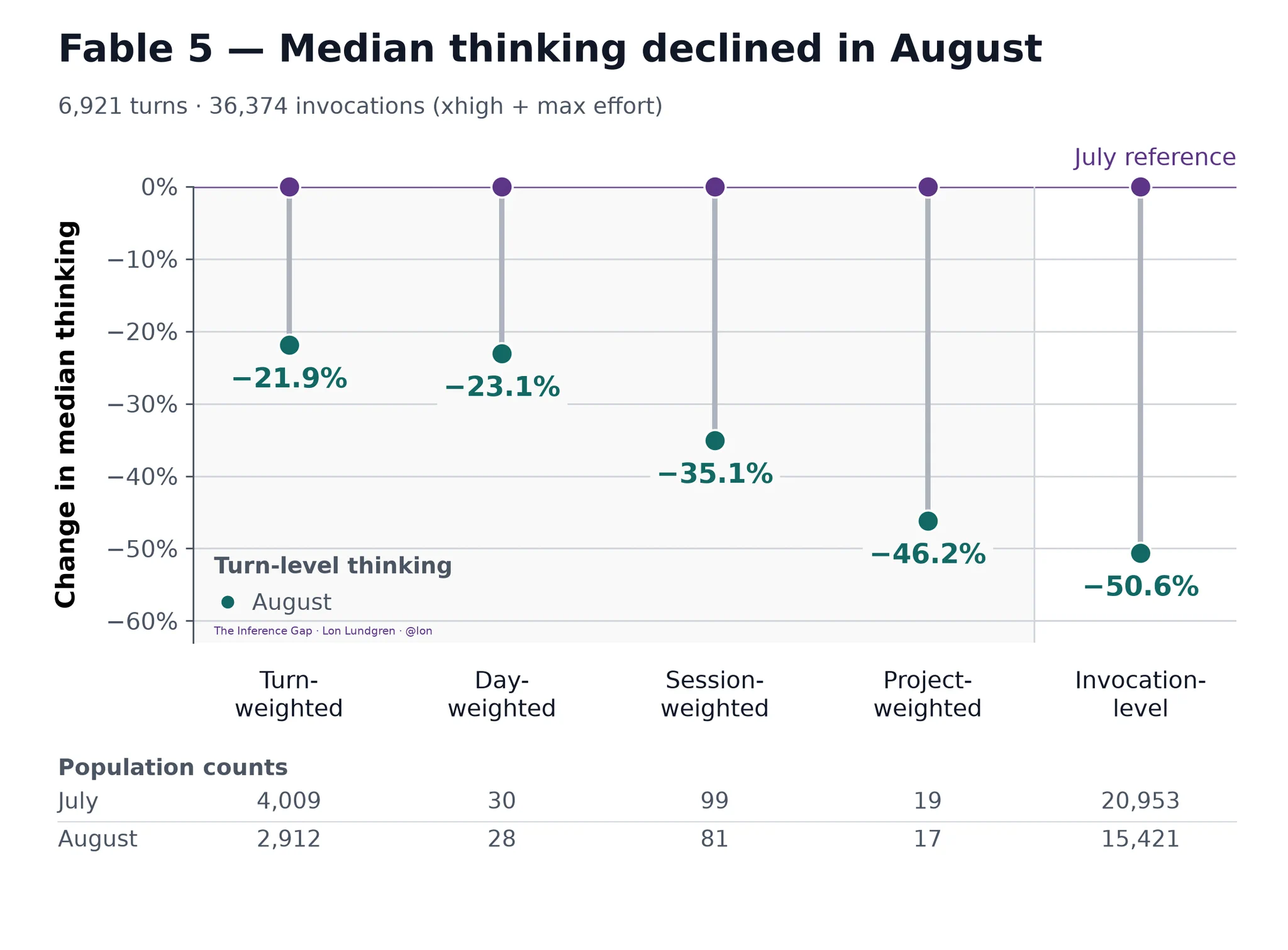
The remaining morning complaints that makes it feel like something's off is that it will do a lot of "thinking" for simple things that previously took very little time. And it got very lost and completely mixed up DE-91M predicate names and implementations. Just absolute disaster code that I had over the past months come to generally expect it to do without issue.
Glad I carefully review everything. I think what I need is reliability and consistency. But it feels like picking a model from the list doesn't guarantee that: that the models' "brain" is open on the table and they're screwing with it.
by Waterluvian - The Office of Weights and Measures exists because, long before any of us were born, in 1836, companies were up to shady shit and consumers were paying for inconsistent products. I.E. Being scammed.
AI companies should be subject to the OWM like any other company that sells a product that varies in weight. Perhaps when a sane administration is re-elected; one that can read history books and comprehend why our regulations exist in the first place. Or have even a semblance of respect for its citizenry.
by jesse_dot_id - Could there be a benefit to releasing a new model, slowly dumbing it down over a couple months, then releasing a new model that’s marginally if at all better than the original to create a perceived improvement when in reality there isn’t really one?
For an industry that’s stagnant in progress yet relies on new frequent releases to survive (non-progress being an existential risk), this could make sense.
I have no idea if that’s what’s happened, I completely pulled it out of my butt. And I have no idea is the actual frontier is stagnating.
by talon8635