Join the discussion
Write your take first — we'll ask for email only when you're ready to publish.
- Hacker News
- When you read lines like "California’s extensive network of canals and aqueducts is the lifeblood of the state, providing clean water to populous cities and expansive farms that wouldn’t otherwise have it." you have to ask how we ended up with these canal systems, what the tradeoffs are in a landscape setup this way rather than one where water infiltrates the ground and stays hydrated, and who owns water rights in California.
Build Soil has some interesting threads on this:
- https://bsky.app/profile/buildsoil.bsky.social/post/3lmeddjd...
- https://bsky.app/profile/buildsoil.bsky.social/post/3mkzybkk...
(note: I'm not trying to totally bash the solar panel project nor some of the key figures involved who've done great work like Dustin Mulvaney, but do think we should think about how we ended up here)
by seltzered_ - "Sorry, you have been blocked"
Well I guess I won't be reading your article then.
The way so many web sites are now banning whole parts of the world is killing the Internet.
by marticode - They should give credit where credit is due. Solar panels on top of irrigation canals was pioneered in the Indian state of Gujarat back in 2012[1]
[1] https://www.autonocion.com/us/arizona-solar-panels-irrigatio...
by mlmonkey - $20M for 1.7MW of capacity. Over $10 per watt. Recent utility scale installations in California are more like $1/W.
There'd be some cost reduction from scaling up, but 10x is a huge gap to close. This is a waste of money.
by sagarm - > Harris said he spent a lot of his life in France, where he noticed how trees lined the canals and protected their precious water from the wind and sun
So why not plant the trees?
by ShinyLeftPad - >>The state currently generates 62% of its electricity from renewable and zero-carbon sources, with the largest percentage of that coming from solar
62% is pretty respectable for the size of California (same electricity consumption as Spain). I did not know this.
- In Venezuela, currently in an unprecedented electricity crisis with daily rationing up to six hours, 10 billion dollars supposed to replace turbines in the main dam that supplies power to the country were stolen with no accountability. With that money you could have installed solar roofs in a million homes serving five million people approximately
Solutions are easy, money exists, political will doesn't
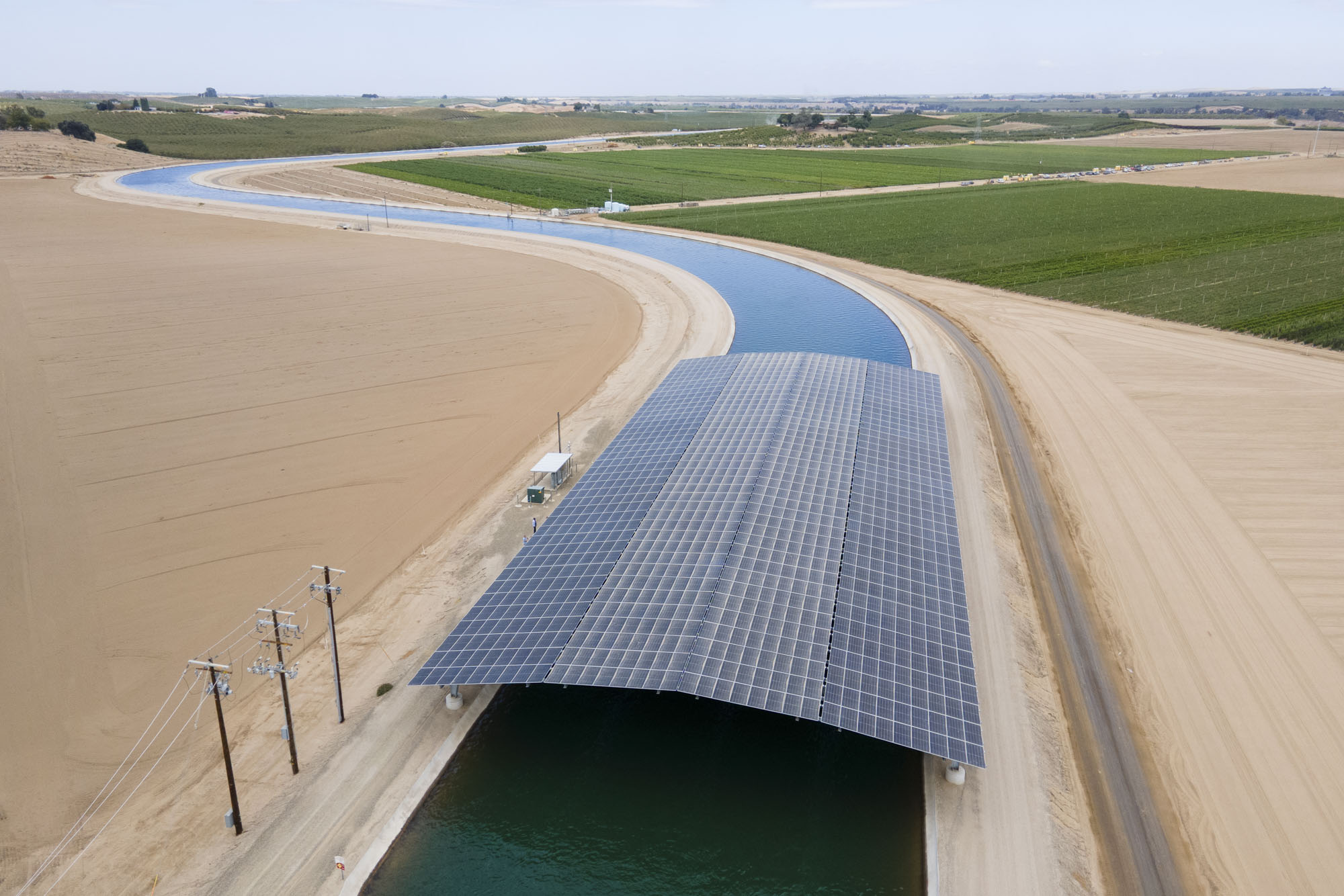
by Kuyawa - It seems like it would be more effective to simply put all the solar panels in a field, and construct a cheap shade over the entire canal no? The supports in the picture are massive and don't look cheap. Also I would imagine the solar array uses more copper than a similar capacity array just built in a field. You can't daisy chain multiple miles of solar panels together, so you need an extra power line to run alongside the whole thing.
Put the solar panels in a field: The solar array uses less copper. The shade supports don't have to hold up solar panels: Shade supports cost less.
The best reasoning they give is that California has insane permitting requirements, and it takes 1/6 the time to build on developed land compared to undeveloped land.
by nbf_1995