Join the discussion
Write your take first — we'll ask for email only when you're ready to publish.
- Hacker News
- Every comment is talking about their own sandbox implementation.by binsquare
- As everyone mention, there are a lot of implementations of this idea, and not only for agent workflows.
My own approach has the following features, hopefully that gets stolen into an actual softawre package at some point:
- Generate bwrap options (for use in bwrap or gVisor) rather than build the sandbox itself. I wont't trust a random sandbox.
- UDS based automatic HTTP proxy with popup or allowlist and reverse proxy to serve apps. (I won't trust any more net access).
- File based configuration (executable with shebang).
- Composable profiles and command line options for ad-hoc sandboxes.
- Manage system directories (use host's, use another distro's, use an OCI image, etc.) as well as home directory for the sandbox and how the "work" directory is shared.
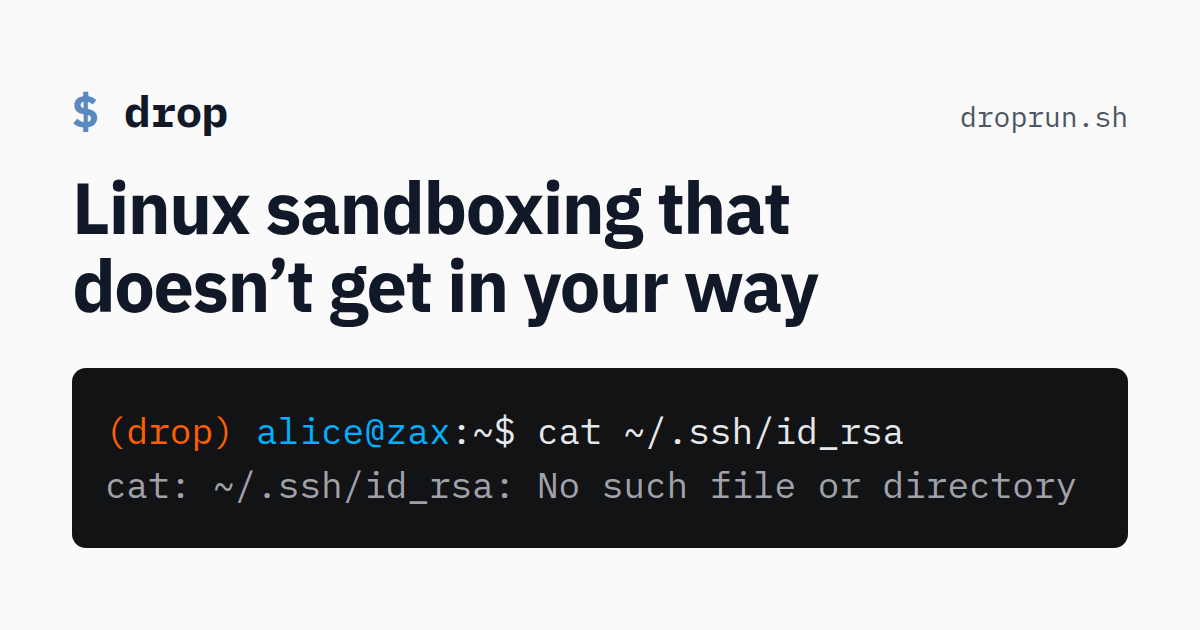
Drop appears to do a few similar things, and it seems to fit well with how I use such systems. I would like to see more details about how the sandboxes are executed and about the security model.
by XJ6w9dTdM - Gratulacje Jan! Looks like something critical to gain adoption these days, security-wise. For others who also wonder how it works, I find this docs page a bit more informative than the landing page https://droprun.sh/docs/sandbox-overview/by yu3zhou4
- Thank you for building it! I started using Drop a few weeks ago, and I've been very happy with it so far (thanks again for quickly fixing a few issues I've reported :)!).
For me, it nails the convenience vs isolation aspect quite well, and I would like to get to a point where I can use it for all my development by default.
The main challenges that I still have, which none of the solutions I've found so far resolve, are:
- development of containerized applications, where e.g., docker/podman compose is used to bring up services
- development of GUI applications with hardware acceleration, like games (maybe security contexts for pipewire and wayland, like what's done in flatpak would be a good path?)
When I did my research in this space last time, https://litterbox.work/ was another option I've considered, and it is very nice too, but the friction is a bit higher than drop: it's slower to rebuild envs, lacks a "base" config, etc. Drop was much easier to adopt for me so far.
by p2004a - Can you explain a bit more about the boundary between the environment and my system? Is it just giving read-only access to /usr/lib?
I use an alias to launch a Podman container with opencode in $PWD. It is fully ephemeral aside from the directories I map to it (usually a couple configs). XDG_HOME is local to that working dir. My only frustration is that my image is too minimal but that can be resolved.
by zenoprax - This is super interesting to me. I've slowly been working on something similar (https://gitlab.com/saghm/tartarus) because my ideal sandboxing is "prevent writing to anything outside this dir but still allow reading to most things so that I don't have to manually copy things into a container/VM". I approached it by trying to figure out how to build up a bubblewrap based on a config that gave the properties I wanted, with the hope that I could eventually expand it to support other platforms via stuff like `sandbox-exec` on MacOS, but I haven't had time to work on it more for a while.
At a glance, this seems to be providing most of what I was originally looking for when I ended up deciding I'd have to write it myself, but focusing specifically on Linux and providing a more full-fledged sandbox rather than only caring about a small set of permissions that I personally had a need for. Probably the biggest (and least hardened) feature that I spent time on in mine was trying to figure out how to allow arbitrary GUI apps so that I could run agents in it via Zed.
I'm definitely going to try this out and see how well it works for me. It's insane to me that this is something none of the big AI companies have bothered solving this yet other than via opaque rules built into their harnesses or absolutely awful manual rules that expect me to hard-code shapes of shell commands that I want to allow or not allow.
by saghm - Glad to see this coming with gVisor support to help secure the Kernel- IMHO we should expect frontier models to find Kernel exploits.
I am working on a project similar in spirit that uses microsandbox (libkrun) to run inside a tiny and fast VM. It includes other security properties that are needed for some workloads.
https://github.com/gregwebs/agent-vm/#agent-vm* network allow lists * credential masking * github allow listby gregwebs - Hi OP, funny enough I’m working on something very similar. Lots of us are I guess! Take that as validation of your thinking.
I like that your readme has a couple paragraphs comparing to popular tools in this space. Personally I feel it is a bit light on the security differentiators (if any). For example you are using the same fundamental primitives that are used in nsjail, runc, etc. Thus it seems you have recreated those libraries in some aspects, so would be curious to hear your rationale for approaching this way vs building explicitly on those primitives.