Join the discussion
Write your take first — we'll ask for email only when you're ready to publish.
- Hacker News
- It's funny how history repeats itself... from 61 years ago: Pick OS had multi-value fields... Not quite the same, but it was the "Excel", and so much more, at the time.
https://en.wikipedia.org/wiki/Pick_operating_system
I guess I am dating myself!
- I wonder what impact this will have on the World Championship of Excelby walrus01
- Interesting.
I wouldn't consider myself a "pro" Excel user. I think my comprehension would be on the higher end of "basic", or maybe the lowest end of "intermediate".
That said, in all the years I've used spreadsheets, I guess I've never really thought I needed more than one value in a cell. I never really seriously considered putting JSON or something in there, and have been ok with just using more cells instead (especially since Office 2019 when they added dynamic arrays that allowed spillover).
by tombert - The next step is to allow adding a spreadsheet into a cell, and introduce infinite zoomby jcoc611
- Over the years, I've seen many comments dismissing Excel. But as many people who've worked in enterprises know, Excel is a godsend for manipulating reams of data for non-programmers who can think analytically. Of course, complex formulae and extensive VBA functions become a tech debt over time. But implemented properly, it provides a solution which doesn't require huge management approvals and increases productivity.
I'm sure that these new features will find a lot of use amongst many people. And seeing these Excel innovations is heartening.
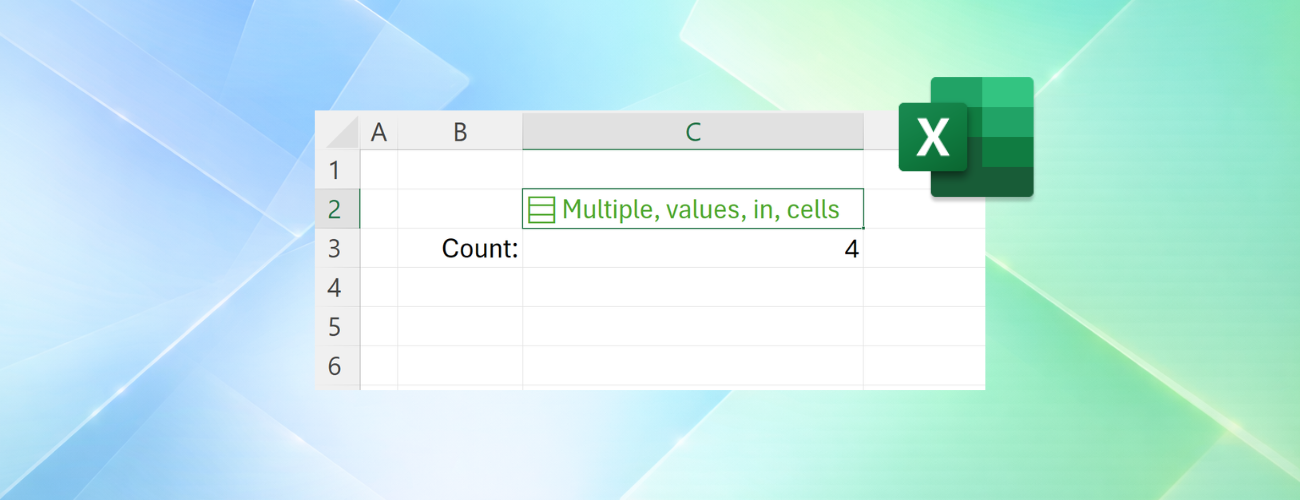
by thunderbong - Technically, this is a huge deal for Excel because it represents a fundamental change from the traditional one-value-per-cell model. From a practical usage perspective, though, it may not be as revolutionary as it initially sounds.
I was playing around with it this morning and tested it on a fairly large Excel model with lots of spillable dynamic arrays used as intermediate calculations. I was able to replace those spill ranges with arrays in cells, and all the formulas referencing those results continued to work nicely. In many cases, enabling it was as simple as adding {} around the existing dynamic array formula. That huge workbook immediately looked much cleaner without all those helper spill ranges taking up space.
I think that's where the immediate value is. It simplifies helper ranges and intermediate calculations, reduces potential #SPILL! issues, and makes complex models easier to build, understand, and maintain.
It could also be interesting when combined with LET and LAMBDA, allowing custom formulas to work with arrays without exposing all their intermediate results across the worksheet.
I think it will become considerably more useful, once it supports features like charts, Power Query, and data validation.
by ukadakal - I was skeptical, but this looks genuinely useful. I can already think of some use-cases for this, e.g. a spreadsheet I was working on recently had a list of user, and then a comma-separated list of software apps they were using. It was a bit of a nightmare to parse, but the example in the article would definitely help with filtering the list.by amanzi
- What would be a revolution in excel is if we could have probability distributions in cells. Right now all spreadsheets are fairly deterministic and we think that tells us something about the real world. Having an ability to make cells distributions (and then all resultant cells would be distributions too) would represent the uncertainty in the world better (and expose lots of interesting things like distributions of tails)by m101