Join the discussion
Write your take first — we'll ask for email only when you're ready to publish.
- Hacker News
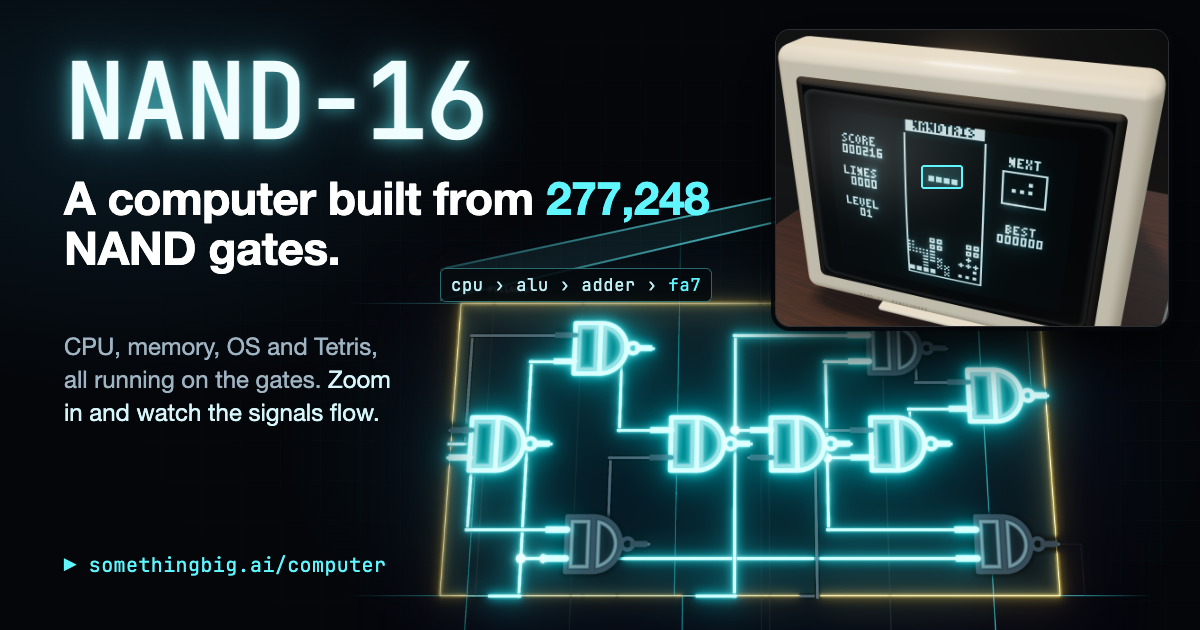
- It looks gorgeous, and you can zoom in to an individual gate level and see lines switch from high to low
The problem is the rendering is wrong. Gates which are connected to two distinct inputs according to the text description which pops up when you click on it are rendered as having both inputs connected to the same wire. It's a bit of a shame.
by fancyfredbot - A nand gate takes 2 transistors. So 554,000 transistors if this were manufactured in a physical device.
By way of comparison, the Intel i386 had 275,000 transistors.
by wang_li - I think this is very cool. AI generated or not, its well done, interactive and has great visuals.by tails4e
- You could also do this out of NOR gates. The Apollo Guidance Computer was famously built almost entirely from NOR gates.by jamesgill
- These AI demos all look the sameby hollowturtle
- I think the takeaway is that we have to think bigger, much bigger, now that AI coding is essentially "solved". Anyone can "write" an ARM simulator now, so that can't be the pinnacle of engineering. I'm thinking about buildings that couldn't be built (reasonably) by one person.
I'll give an example of what I'm working on. There's a model for segmenting organs from CT scans. There's another model for calculating radial diameters of blood vessels from CT scans. You can combine the two and approximate how much blood flow each organ gets based on its segmented volume and the sum total radial diameter of vessels feeding it. You can then render all of that in an app that shows perfusion to that organ.
The idea is to combine these models to extract every ounce of usable information from a CT scan that might be useful for procedural planning (I'm an interventional radiologist). While each algorithm would take weeks/months to implement, Opus 5.5 can do them in minutes to hours and then stitch them together. The results thus far have been better than anything I've seen.
by aabajian - I was about to say that's a whole lot of gates for not a lot of computer, but then saw that rom and ram are also an array of nand gates.by monocasa
- If you have not tried panning the camera and zooming in to one of the chips, you are missing out.
Bravo to the author. This is inspiring work.
by carodgers