Join the discussion
Write your take first — we'll ask for email only when you're ready to publish.
- Hacker News
- Great article. I think the author has lots of potential to do other interesting analysis.
Example: Why living near a world-class hospital decreases your expected lifespan. Areas around top specialized medical centers often show higher local mortality because terminally ill or high-risk patients relocate or are transferred there.
by frays - I'm not sure what the point of this article is, the author claims 3 deaths at Burning Man is not unexpected because the age-adjusted mean death rate in the US predicts that you'd expect 4.9 deaths. But at no point in the history of Burning Man has there ever been that many deaths, the article itself states that 3 deaths is the most at any Burning Man so far. So 4.9 deaths is not even close to actual average death rate expected for a "mean" Burning Man. And since the prediction of 4.9 deaths on average is wrong, any conclusion based upon that 4.9 deaths expectation is poorly founded. The author just seems to ignore that their model does not match the data at all. It's like if I used how many hot-dogs are in my fridge to model the Burning Man death rate, then at no point acknowledged that these two variables have no connection, either real or spurious, to each other. This is just mystifying to me.
- Isn’t there selection bias though …
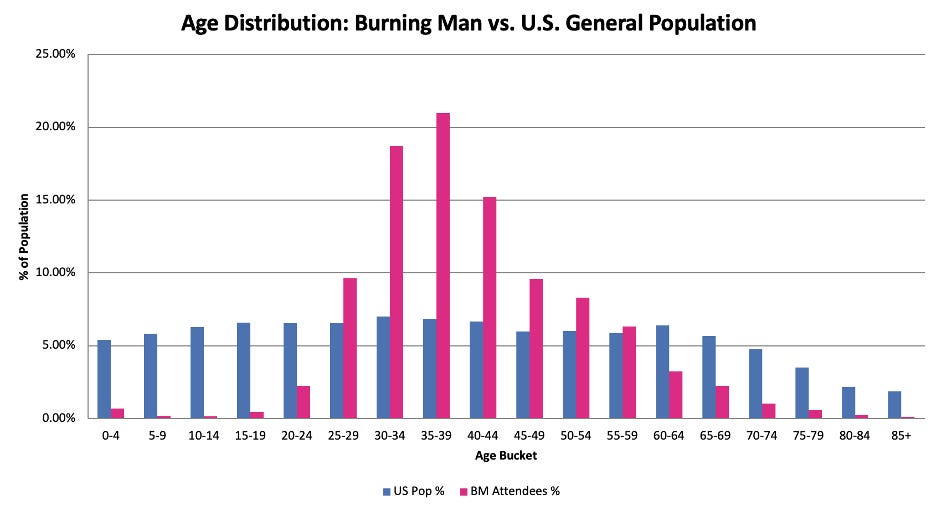
because if someone feels physically well enough to go to Burning Man, then the probability of them dying in the next week is near zero in comparison to the national average (which includes individuals hospitalized, terminally ill, etc).
by tiffanyh - One point that I haven't seen mentioned here is that deaths that happen outside of the event boundaries are not "counted." For example, if someone is medevac'ed and dies en route or in a Reno hospital, the event organizers don't include that fatality in their count. There may be a distinction as to who is legally allowed to declare someone dead, and whether that can occur on-playa. Road fatalities of participants on their way to and from the event are also not counted .
- The biggest factor is selection bias. If you are in the hospital with some terrible medical condition you aren’t going to Burning Man.
It would be interesting to look at cause of death at Burning Man, I would expect it to differ significantly from the population overall (even accounting for age).
- Brent Chapman, author of "Incident Management for DevOps and SRE", just got back from his annual "not exactly a vacation" trip to Burning Man, where he's worked as a "Dispatch Supervisor" since 2012.[1]
I as able to hear him at BayLISA giving his talk on incident command and what we can learn from the fire department[2][3], an excellent talk.
[1] https://greatcircle.com/blog/2026/09/29/burning-man-incident...
[2] https://www.youtube.com/watch?v=Zn8-R6Pt9hY
[3] https://www.usenix.org/conference/srecon18americas/presentat...
(edit:formatting)
by buredoranna - Looking at population-level statistics, even adjusted for age, is useless. Going to burning man requires a level of health, energy, free time (not dealing with health issues), and freedom from chronic illnesses that make traveling to a desert a bad idea.
Most people at high risk of random death are filtered out before they arrive.
There are so many better comparisons that could have been chosen. Comparing Burning Man to outdoor music festivals would be so much more accurate.
by Aurornis - Some of this is selection bias, but lots of this is active work by the organizers.
Burning Man has slowly re-created the regulatory state in response to the standard pressures of civilization. To their credit, this has often been in response to near-misses, but sometimes in response to fatalities. It started with sanitation (potties), and banning guns/explosives. You can have 100 people shooting guns at a party in the desert without sanitation and muddle through. At 10k, you are building a cholera-mad-max experiment. A car running over a sleeping person prompted a designated road network. And then they adopted zoning, with hush-ville and the large sound installation ends. All supported by the ranger team preventing injury every day. Civilization is work.
by michael1999