Join the discussion
Write your take first — we'll ask for email only when you're ready to publish.
- Hacker News
- There is an SR-71 on display in Seattle's Boeing Museum of Flight. One of my most favorite memories of it was taking my late Belarussian grandfather to that museum and having one of the docents there, a retired airforce person about my grandfather's age, tour us around, with me translating. I already knew a bunch of BlackBird's lore, but the docent/tour guide was pulling out all the stops to impress my grandpa and was talking about various overflights of USSR, and I my grandfather's smile crinkled up and he said "oh I remember we finally shot that guy [Powell] down, and all the papers were trumpeting about it" and he and the tour guide started laughing and slapping each other on backs! I miss my grandfather. He was a good one!
- This feels like the steam catapault kerfuffle from earlier this year. Maybe I'm missing some vital reason these retired technologies must be revived, but it's not inspiring when our military doctrine is "let's go back to what worked 60 years ago"by Centigonal
- I'd be more astonished if there isn't something superior to the SR71 (likely unmanned) that has been flying around at night from facilities like Groom Lake for years. Look at how long the RQ180 was flying around in semi-public and known about before it became seen in daylight by plane spotters in Greece. And a long time before that there were public relations approved photos of the Lockheed Martin Polecat.
There were a series of extremely public quotations from senior DoD officially recently about how they plan to aggressively retire the Global Hawk program (which is a mostly non stealth aircraft), reading between the lines it's because they have something much better.
edit: for those who haven't seen the RQ180: https://www.google.com/search?client=firefox-b-d&q=RQ180+gre...
edit 2 (apologies for the X link): https://x.com/MechDesignxyz/status/2041281689838584193
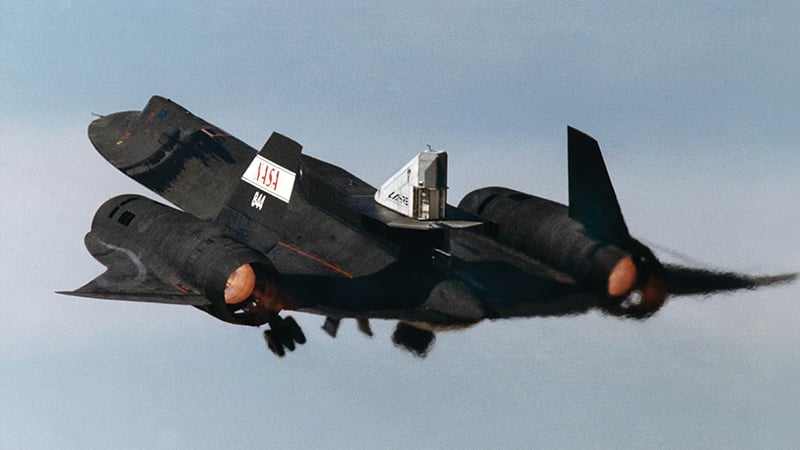
by walrus01 - > The Air Force and NASA destroyed a $600 million supply of spare parts for the Blackbird fleet in 2007. The move came long after it seemed unlikely, if not impossible, that an SR-71A would return to operational service.
There's also the issue of converting a tanker back so it can carry the SR-71's unique fuel again. And for that matter, making a supply of JP-7 again. No other planes today use JP-7.
"It's not my money!"
by justin66 - A couple of questions/observations:
1) when people say "destroyed the jigs, tools and spares in 2007" What do they actually mean? Burying things isn't destroying. Putting them in a furnace is destroying. Is it possible that both parts, and tools actually are recoverable e.g. from the seabed? The dimensional stability might be off, but to help reconstruct tools, it's not nothing. Likewise digging up something buried in its packing crate is not rocket science.
2) "that would be ludicrously expensive" doesn't mean much any more. It's not unlike "we can't make a saturn 1 any more because the tools were destroyed and it would be ludicrously expensive to make an F1 engine" -well yes, but thats not impossible, it's just unlikely and expensive. So maybe this is unlikely, expensive but ... has a unicorn sugar daddy?
3) there are craft in all sorts of places. Not just on sticks outside NASA property. I am not a historian or a federal government employee, but I wouldn't think it impossible for people to ask other agencies to let you inside the shell and remove the bits you want, or even ask for it back. The one on a stick in Balboa Park San Diego might have associated boxes of bits-and-bobs..
4) its a titanium alloy. It's temperature and corrosion resistant, noting some things (like chlorine according to the web) are bad for it. It's not made of pure chinesium or balsa wood. Interior surfaces would be in pretty good shape.
by ggm - To give you an idea how ridiculous this is: to start each engine, they made a cart out of two Buick V8 engines tied together - so four V8 engines to start the plane. Those V8 engines were long since out of production, so at one point they went around the country, to every junkyard, buying up every one of those V8s they could find, so they would have spares to start planes up in different places. If an SR71 had an issue and landed at an unusual airport, they had to fly the start cart and other equipment to that airport to start the plane again. Everything about this plane is expensive and one-of-a-kind. It's a hot rod that goes to space.by 0xbadcafebee
- > “Every time I threw one of these things out there, he says, ‘Oh, engineering will take care of that [and] engineering will take care of that,’” Relja recalls.
That sounds all to familiar to people that actually has to accomplish stuff, heard from management. Engineering will not take care of that because engineering is the one that is raising the concerns!
by braiamp - The general tone here seems to be against the effort, but separate the circus from the ringmaster and there is a lot to like here.
Having a manned, very high altitude, very fast research plane is undoubtedly useful for all sorts of development purposes.
But more than that, we are as a civilization doing a bad job of preserving cutting edge expertise from the past. We keep letting entire areas of engineering and technology die out without really trying to preserve them even though we know at some point they will come in useful. The skills, processes, even institutional confidence developed in just trying to get an SR-71 flying again will teach us a lot about resurrecting other such dead ends. Aerospace in particular is full of them. That will, for sure, get us out of trouble or speed up something we need at some unknown point in the future. I'd think of it more as developing a general capability than the world's most expensive vintage aircraft hobby.
by scrumper