Join the discussion
Write your take first — we'll ask for email only when you're ready to publish.
- Hacker News
- This is very cultural. In Spain essentially no one throws dinner parties in the US style. It's rare to invite social acquaintances to one's home. These things are done - but mainly with family. Part of this is cultural and part reflects that homes are too small to fit many people. Most socializing is done outside, at a bar, cafe, restaurant, park, etc.by contubernio
- In my twenties I made spaghetti every Saturday night. This started as throwing some Ragu in a pot and adding some spices, and eventually morphed into crushing my own tomatoes and cooking over most of the day. I did this every week over years. A varied group of friends came to eat each week -- no plan, no notice, just come over if you have nothing else going on. It's how I met my wife -- I never would have had the courage to ask her out on a real date, but "I make spaghetti for my friends every Saturday, you should come over," was easier. It's been years and I don't often make spaghetti anymore.by gcanyon
- I moved from a rich city social life to a lonely suburban one (I have regrets, there are complicating factors). I met a fellow dad who mentioned a book as we started chatting and I was excited (someone who reads!).
As we talked about this very isolation problem he told me about his neighbors who kept inviting him over and offering to watch the kids for him and how he thought it was just weird and couldn’t trust them. It broke my heart — I could just imagine the neighbors trying to be good to their community and that very behavior is met with distrust.
(I read half the book he mentioned and asked him about it the next time I saw him. Turns out he hadn’t read the book, just heard about it on a podcast. My quest to meet someone who reads continues.)
by evmar - When I met my wife, I discovered very quickly that she had savant-level hosting skills. She is an amazing cook, she prioritizes space to dine in our home (we made sure to have a dining table in our NYC apartment) and she thinks carefully about the experience of her guests. It's a quality that I benefit greatly from, and I'm grateful to her for it.by lordleft
- Blame the screens. Screens are blackholes that suck up your time, attention, awareness and senses.
Screens are evil. They wake up the dead past as if it's alive and happening now. It became so much the norm, that people are afraid to face the real world, real people, real talking. "Dinner party? OMG, real people with real faces that force us to talk to them? Noway sir".
Screens disconnected people from real world, from each other. I was trying a VR headset the other days and immediately threw it away, as it shut off my visual and audio senses completely.
by zkmon - Middle aged European here. I still regularly go to parties (dinner and otherwise) and I notice that there are two kinds of people: people who throw parties, and people who don't. This sounds like a truism, but what I mean is: there are people who regularly throw a party and people who never do it.
I am solidly in the first category. I throw dinner parties, birthday parties, drinking parties, dance parties, midsummer parties, midwinter parties, game parties, etc. Yes, it costs time and money and is a lot of work. But what people (probably the ones that never bother) tend to forget is how unbelievably gratifying it is to get a bunch of people together, to feed them and to make them talk, laugh, dance, etc. Afterwards you are tired but also grateful and socially energized in a way that feels fundamental to my existence.
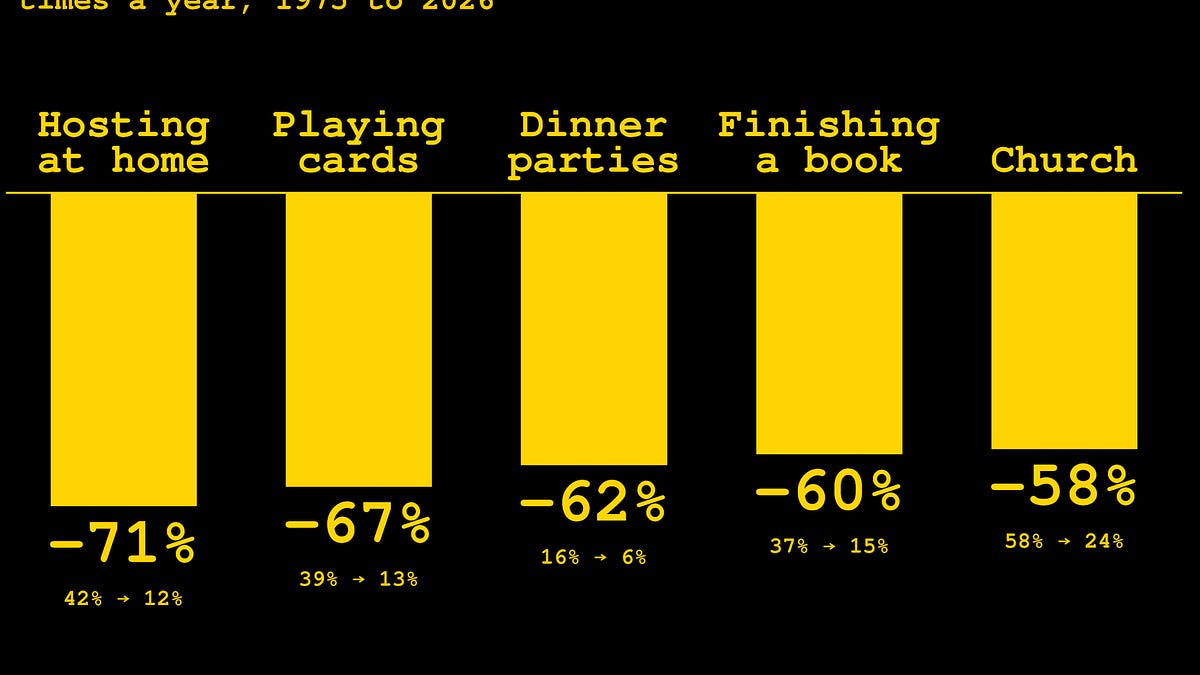
by kieckerjan - How is the author of this piece going to cite a graph that shows an extreme increase in time spent at home that begins in 2020 and not mention COVID? We had social media in the 2010s. COVID made spending time outdoors/around other people an actual physical danger for over a year, and the psychological effects of that are lingering. Does anyone remember that one political cartoon where the guy is walking down the street, and everyone around him just looks like a virus particle? I think a lot of people consciously or subconsciously still see the world that way. If you don’t believe, reflect on how you would feel about attending a crowded indoor gathering in 2010 vs now, or how much unease you would feel if someone at the table next to you started coughing.
- As others have mentioned, the decline started long before social media and the Internet. When I was a child, in the 70s, my parents often had other families and couples over for dinner, and we often attended small dinner parties, too.
As an introvert, I absolutely loathed these gatherings and was frustrated by how powerless I was in avoiding them.
Recently, I have been reading over my mother's old letters she wrote to her parents at that time, in which she described the effort and social anxiety that went with this tradition. It was not something my parents enjoyed, but rather an obligation they felt they had to uphold. Someone invites you over, then that goes into an unspoken balance sheet, and you are required to reciprocate. She often spoke of "owing" dinner to people. I don't think she enjoyed it at all, though there were a few couples I can remember who were good friends of theirs, and those meetups were always a pleasure to listen in on. The rest were simply a drag.
I should note that their life in the 70s (in a middle-class college town) was not some idyllic paradise without the Internet, either. Everyone was constantly falling ill with colds or flu, and days were spent running dreary errands to shop for boring things that we now can get with a click. The rotary-dial telephone that hung in the kitchen was the heartbeat of the house, since replaced by Facebook and smartphones. My parents were always busy and exhausted.
by vertnerd