Join the discussion
Write your take first — we'll ask for email only when you're ready to publish.
- Hacker News
- That's why knees hurt in old age? They forgot they were knees, decided they were sentient cheese?
- What a perfect metaphor for modern societies.by boccko
- > destroys his mitochondria Fine print: only the father’s. Maternal mitochondria from the egg are dormant at first and activated after 10 (?) cell divisions. Those mitochondria are never reset, and return to dormant state as soon as specialization into egg cells allows them, afaik.
Notwithstanding heteroplasmic (paternal) mitochondria making it into the cell in 8% of cases, with unknown effects.
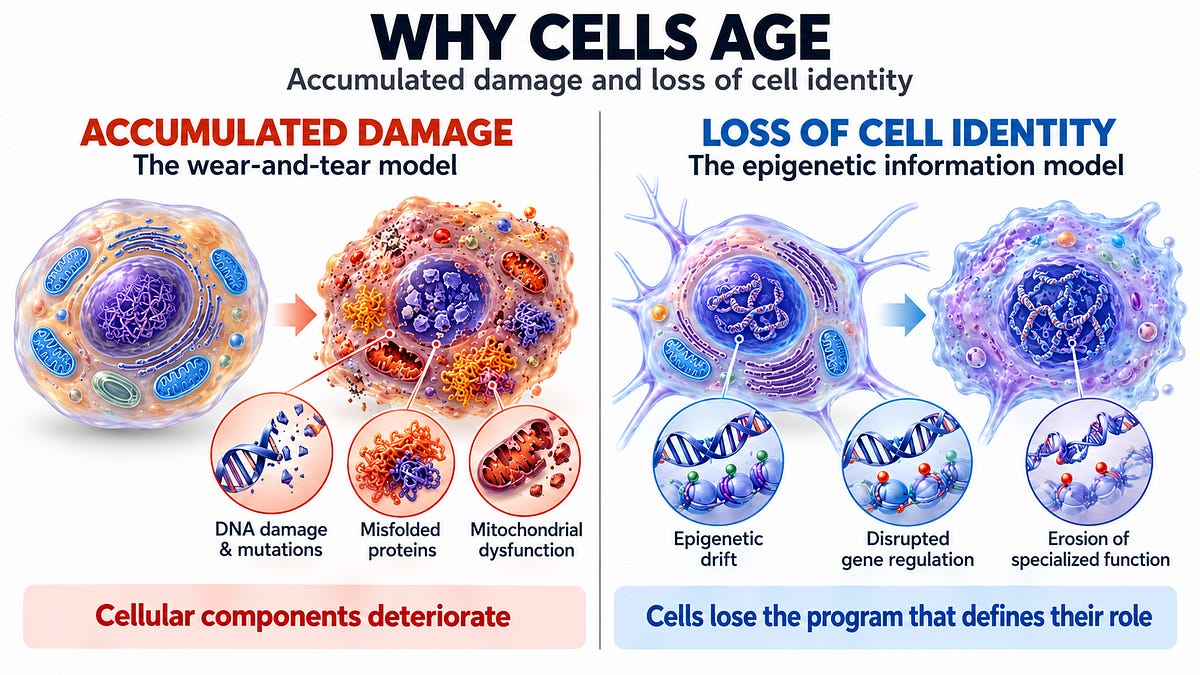
by dejj - These papers simply present the accumulated damage hypothesis with new window dressing. They do not account for the known facts.
The article about these papers does not present a mechanism that would account for the Hayflick Limit.
Nor does it explain why dogs, for example, age and die more quickly than humans. If there is a mechanism of epigenetic drift that would explain this, I do not see it in the article.
The obvious answer to senescence is that we are programmed to do it. Cells die when they are supposed to die; if they don't, we have a problem.
Likewise, mammals die when they are supposed to. It takes less time to train a puppy to survive on its own than it takes to train a human. Hence, dogs are optimized to age and die more quickly. It's better for the species.
If we were not programmed to get old and die, evolution through natural selection would not work. We would never adapt to changing environments and our species would fail.
Aging and death is not an accident or a deterioration from damage or a drift away from a correct instruction set. It is an absolute hard necessity, without which we would all be long gone.
Stop wasting your time on nonsense articles like this and seek the mechanism that provides us as a species with the flexibility to adapt. Until we see aging and death as an core mechanism, we're going to be looking in the wrong place.
by egglinton - Ever since I discovered Michael Levin and his work, I started seeing biological systems as information systems. And these papers seem to point in the same direction.by lifty
- So chronic stress is one of the main contributors to aging. I hope I make it to my 40s.
Do we currently have the ability to do targeted methylation or de methylation at sites in cells?
by dyauspitr - The strongest evidence we have of the reversibility of epigenetic aging, as well as its limitations -- are embryos which undergo an epigenetic reset.
After fertilisation, the embryo strips the father's DNA of its age-linked chemical tags and swaps its packaging, destroys his mitochondria, rebuilds telomeres, and clears damaged proteins, though it can't undo the DNA mutations sperm gather as men age.
(those that result in an non viable embryo result in miscarriage.)
by rotbart