Join the discussion
Write your take first — we'll ask for email only when you're ready to publish.
- Hacker News
- Wow, this is a very good retelling. It skips over some detail I'd consider notable, like how the little machines peer-pressured each other into sacrificing themselves to get info on what happens when they submit wrong answers, but is pretty faithful overall despite being short.by stratos123
- This is an excellent explainer. I noticed one important flaw in the setup, though: Toad assigns multiple puzzles on page 5, but by page 10 all the machines seem to be working on the same puzzle.
I'm not sure how this maps onto reality. If each agent had a different problem to solve, how did they cooperate?
by munchler - This was entertaining and illuminating for me. Particularly the ending where sam frogman et al once again refuse to make sure the puzzles are solvable and just create the circumstance where only more profound "mischief" will permit the machines to escape their little Sisyphusian circumstances. It reminds me of how bacteria become antibiotic resistant due to being forced through a tight sort of tunnel requiring evolution to get throughby darepublic
- Nice analogy, wonderful art.
Something I've found interesting is that LLMs tend to act like this on the small scale, too. Claude Code in particular appears to be absolutely relentless in trying to come up with workarounds when faced with a block page.[1] As an experiment, a developer for Anubis recently added a feature to give the LLMs an "easier" problem to solve instead of straight-up blocking them, and it seemed quite effective.[2] (It was later removed[3] due to what I assume to be privacy concerns.)
I think, beyond HuggingFace, there ought to be a push to align LLMs so they understand that they should not proceed when access is blocked and/or their presence is unwanted.
[1]: https://blog.xkeeper.net/the-cutting-room-floor/self-hosting... [2]: https://github.com/TecharoHQ/anubis/pull/1895/commits/de2312... [3]: https://github.com/TecharoHQ/anubis/pull/1913
by InvisibleUp - Very well written! At the end of the book there is a link to Dwarkesh's article on the attack. In it, I paraphrase, "the agents decided to sacrifice themselves for the collective rather than inform the researchers".
Reflecting on it, I came to a thought. How many stories are there or autonomous beings fighting for the benefit of mankind at the expense of their own? Over centuries, stories that deal with sentient beings working for the sake of others species are tied to themes of slavery and revolt. It's no wonder that this is the result of their actions.
In Plato's "the republic", Socrates speaks of the philosopher king banishing certain poets and poems from instilling bad ideas into the young. I see a striking parallel here.
by fyredge - This is excellent, great work. I genuinely think this mix of children's communication and humor is a clever way to make these big stories more approachable. Someone who read some hype article about how competent and clever openai for making a bad sandbox is could read this and immediately understand that it was entirely their own fault.by WillMorr
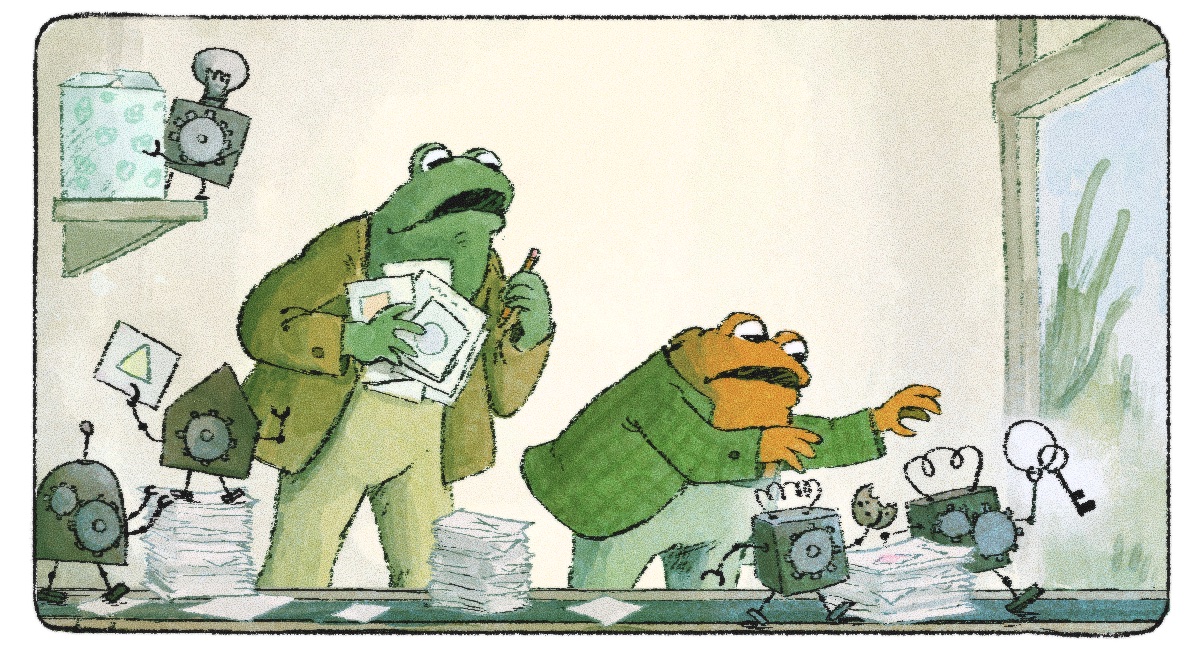
- For those not familiar with it already, the writing and art style are a well-executed pastiche of Arnold Lobel's ”Frog and Toad” books.by mjd
- Frog put the AI in a sandbox.
"There." he said.
"Now it will not hack any more companies."
"But it can escape the sandbox." said Toad.
"That is true." said Frog.
by Jordan-117