Join the discussion
Write your take first — we'll ask for email only when you're ready to publish.
- Hacker News
- Tangent: I’ve often wondered why governments don’t provide a ‘dating’ service for employers and employees, or even better some kind of career development and management service for citizens. Use a bit of institutional wisdom to help people make the best of themselves from school age onwards, help people with similar or complementary skills and interests to connect … that kind of thing.by implements
- Related:
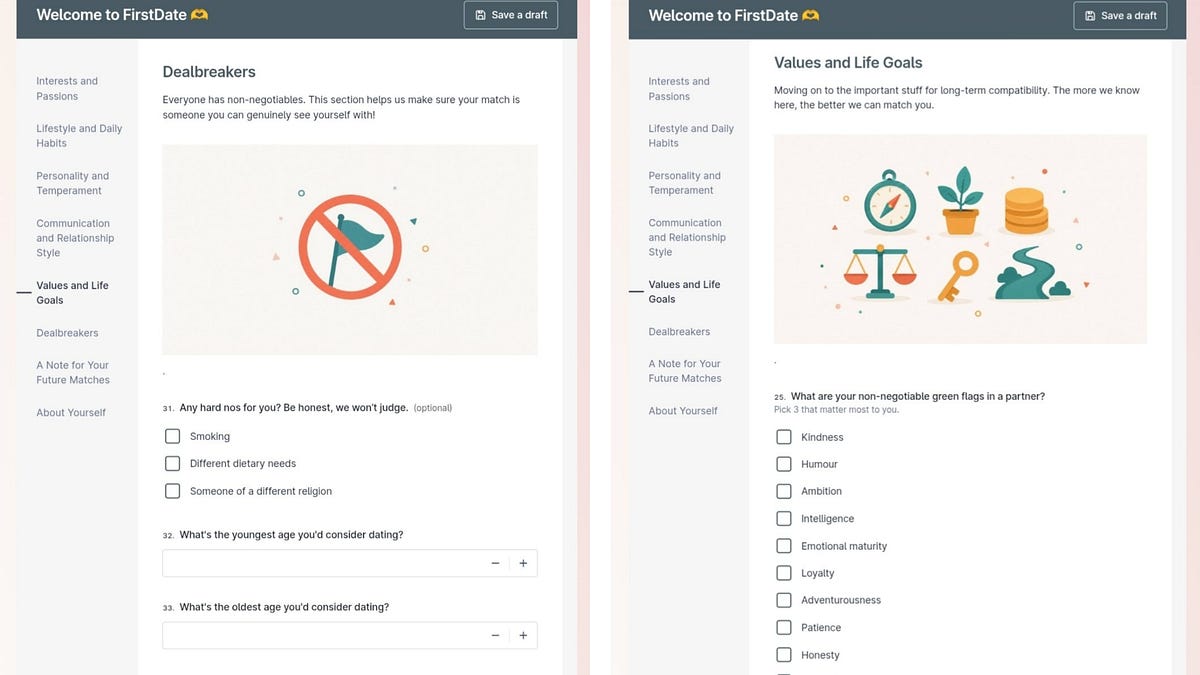
Singapore govt dating app uses Gale-Shapley stable marriage algorithm
- I dont see how a goverment-run dating service would solve the issue that social-media had made hypergamy run on steroids and that people today have much higher demands on their partner than ever before.
In sweden we have one semi popular dating site with minimal amount of matching algoritms and swiping and such and its no easier there to find a partner than on tinder.
by blodkorv - I think the algorithm is almost a distraction here. Gale-Shapley works nicely when preferences are reasonably well-defined and participants are actually committed to the matching process. Dating has neither property. People are terrible at predicting who they'll have chemistry with, and everyone has outside options.by SwtCyber
- > In short, stable matches mean nothing when nobody is committed and the best options might exist outside of the matchmaking pool
This is wrong. Stable matches still mean something, and in fact probably mean quite a lot.
You are given a much better match than a random pairing. If you still aren't interested, you can decline. If you go on a date and it doesn't work out, you can decline.
Nothing forces you to use this process, it is just an offer of a significantly better than random matching to what you might prefer.
It doesn't even need to account for preferences not covered by the questionnaire.
by dominicq - Gale-Shapley, used in this service, has the property that one side ("proposing" side) is guaranteed their most advantageous stable match while the other side is guaranteed their worst possible stable match.
I've never heard this discussed or mentioned as a drawback because it's Nobel Prize winning and "stable" is a shorthand for "fair". Even though there's many unique stable matches that each offer participants different utilities even if individual participants don't have incentives to change their pairing.
In practice, the more powerful party seems to be the proposing side, e.g. hospitals are the "proposing side" when using Gale-Shapeley to match w/ med school students and get their ideal students.
I wonder if anyone who works on dating apps knows if men or women are the preferred side? And is there any research on stable matching that ensures equity (or ideally arbitrary distribution of utility) between the two groups in their stable matches?
by jjmarr - I think this would be better than commercial services, which have all the wrong incentives.
I would think just a coarse sorting would do, paired with a free meal. Every couple of weeks, you go for a random date with a somewhat well paired person, and see what happens. Maybe you don't meet the love of your life, but you will meet someone roughly your age living in the same society, a perspective worth having regardless of whether you're compatible.
However, if you know anyone from Singapore, you must think this is a rather small plaster on a gaping wound.
Singapore is like a permanent examination hall. Everyone is competing to do well on exams, and then they try to get the best internships, and then the best jobs. It's not exactly conducive to starting a family. You'll lose a step in the rat race, and then your kid will need to join this rat race.
by lordnacho - You know, there's probably fewer perverse incentives with a government run dating service. Obviously I can imagine ways it could suck, but when I compare them to how commercial dating services are run it's hard to see how they could do a _worse_ job.