Join the discussion
Write your take first — we'll ask for email only when you're ready to publish.
- Hacker News
- I agree with this. I’ve seen it in my workplace but even more profoundly in my personal endeavors where I have more freedom to explore.
My current project is created by one-shot prompts. That’s not some kind of parlor trick. It is the framework for creating and evolving the product.
Many people laugh it off as “unserious”. But as I said, I see this happening in my place of work where people are paid lots of money.
https://jaisenmathai.com/articles/sojourn-for-ios-was-45-one...
by jmathai - Every SaaS business is/was also a harness around a programming language. What makes it a business isn't the tools used.by 0xbadcafebee
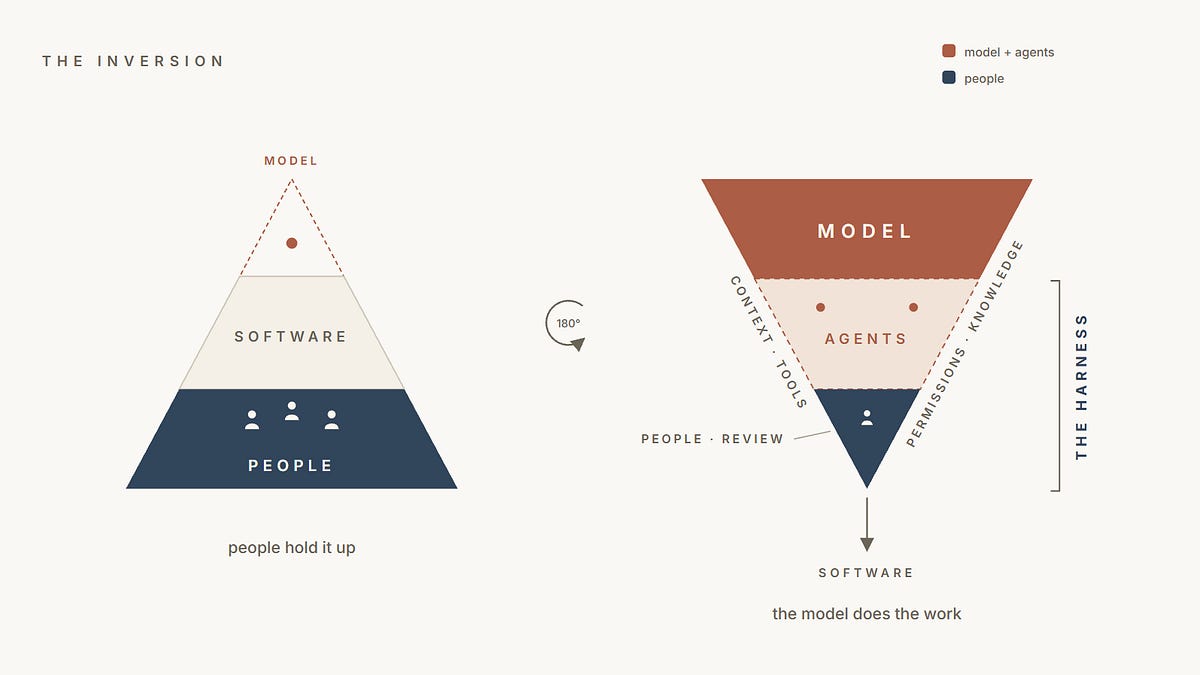
- > Harnesses go from internal tooling you’d happily buy to something you’d no more outsource than your product-eng org or your GTM team.
I couldn't have said this better myself. If you're not owning your harness, and you're not owning your model, then that leaves very little moat for any AI native company.
by BinRoo - This couldn't be more true. Companies will be driven by AI harnesses (as defined by this article) that automate decision-making and prioritization. In the medium term, may the company with the best harness win.
In the longer term, the downstream impact is massive commoditization of software and invalidation of most existing moats. Data moats are gone if you can simulate the data with AI. Even platform effects can be sidestepped if AI replaces one side of the platform.
In addition, while right now agile startups have the advantage, at some point the balance will start tilting towards whoever has the most tokens (OR perhaps durable moats will trump even near-infinite tokens; we will have to see). Startups have a limited time window to have whatever impact in the world they are hoping to have, or to build a moat that won't be disrupted by AI, but there are few of them left in the world.
The upside is that when there is a lot of commoditization, then the consumer benefits.
by 2001zhaozhao - This is a side issue, but he mentions that the harness is stateless. But no agentic task is actually stateless.
I suspect for purposes of optimization and performance etc., sometime in the next several months we will start to see new popular ML architectures or variations of LLMs/VLMs that are designed to be _stateful_. So a lot of the infrastructure for managing state and memory etc. gets sucked into the model somehow.
They may end up changing or expanding the concept of an ML model to enable that.
That type of belief is what is making me anxious about AI engineering staying relevant for much longer. I just wonder if pretty soon we need to be able to build and train or customize ML models that just do everything, or at least know how to prompt an agent to do that.
by ilaksh - A lot of (non-software) business is already like this, without the AI part.
There are 40,000 McDonald’s franchisees who basically just put money into a coinop machine and the machine returns with exactly the food, drinks, restaurant decor, prices, etc that it wants them to sell.
Toyota’s production system coordinates what gets made and when, detects abnormalities and directs human attention toward problems and improvement. They explicitly eliminate the need for people to continuously watch machines, while preserving human judgment
by hammock - I go back and forth on this.
But to pull something from the post:
> If this is the right mental model, you should expect to see:
> An unusual amount of in-house harness building on both the build side and the sell side
Yup.
> Org structures and individual roles being reshaped around their place in the business harness
Not yet, this is the one I am most skeptical about because it's still way too easy for the harness-driven processes I've seen to go off the rails, so it's still very much human SME-driven. However, the number of butts in seats required is going down.
> AI-native startups beating incumbents in domains where the “moat” can be easily harness-ified
In most cases I've seen the "moat" is not easily harness-ified, and increasingly the money and energy seems to be going into getting to the starting line.
> All software a software company uses (on or tied to the core build or sell paths) needing to be headless so the outer harness can run it
Tech companies are definitely doing it, but I don't think this is actually realistic yet for companies whose core competence isn't software. But this feels like a matter of when, not if.
by munchbunny - I've heard some variant of the SaaS doomsday prophecy dozens of times over the past year. Somehow, SaaS is still here and more or less looks the same.
It will probably continue to exist because most businesses are perfectly content to outsource tech problems to someone else for a reasonable fee, and if you think that managing an agent swarm is a seamless replacement for that, I don't know what you tell you. The vast majority of business owners don't want the added complexity in their life.
And for the same reason, most SaaS will probably not migrate to some radically new UX paradigm. Some of it will be vibecoded, but the UX will probably continue to be deterministic. I think this might change once a new breed of "LLM-native" business owners takes charge, but that's going to be a slow process, and it will be hampered by prosaic concerns about interoperability, support, predictable cost, and liability for mistakes (from "the agent did a bit of tax fraud" to "the agent decided to hack my competition").
by socializer