Join the discussion
Write your take first — we'll ask for email only when you're ready to publish.
- Hacker News
- Specifically pertains to voting systems in GA.
"a security vulnerability disclosed back in 2022 shows the shuffle can be reversed, and some states have not applied the software update that resolves it."
"a team of researchers published a report showing that certain ballot scanning machines used throughout the US had a critical privacy failure in how they anonymized ballots"
"Specifically, the machines would assign a seemingly random number to each electronic ballot record at the time of scanning to label each ballot for later auditing."
I can tell you that before WA went to all-mail voting it wouldn't have happened, because I served as a pollworker and election site inspector. There was a optical scan ballot reader / counter, my confidence is high it only kept running totals. The ballots fell into a bin, at the end of the day the bin was unlocked and the ballots were tossed into bags (no particular order) which were then sealed. As inspector I printed a copy of the tape which went downtown with the bag(s); they would have been able to print a new tape until the machine's memory was wiped (at which point they still had "hardcopy backup"). The ballots were not marked upon by the scanner in any manner. There was an incident where one of the ballot printing / counting companies (because they both typically had to come from the same manufacturer) started printing sequence numbers on ballots (not just ballot styles) and that went to court.
I've not witnessed what happens with all-mail voting, but there is no sequence number on the ballots. ;-) The count is not supposed to start until the polls close. Before that the ballots are ostensibly separated from their identity (the envelope) in an identity confirmation ceremony. My impression is that they're scanned at this point and the scans are utilized for counting / optical scan, but I'm not certain about this or that it's the same everywhere. I don't know what happens to the physical ballots; back in the day what I know is that if a ballot needed to be corrected (defacement or damage renders it unreadable) then a new ballot was prepared under the supervision and adjudication of election observers and the old ballot was destroyed; but that's the exception which proves the rule that physical, anonymized ballots were retained.
The voting process is in the hands of the individual (United) States; in WA it's largely in the hands of the County administrators and varies to a degree Statewide.
by m3047 - I feel a bit silly, but I do not understand how the results were verified.
- Democracy's main problem isn't the voting process, at the moment.by amelius
- > Through the history of computer security, there has usually been a moat of expertise separating a vulnerability from its exploitation. ... Large Language Models (LLMs), the systems behind chatbots like ChatGPT, are building bridges across that moat.
Draining it, more like.
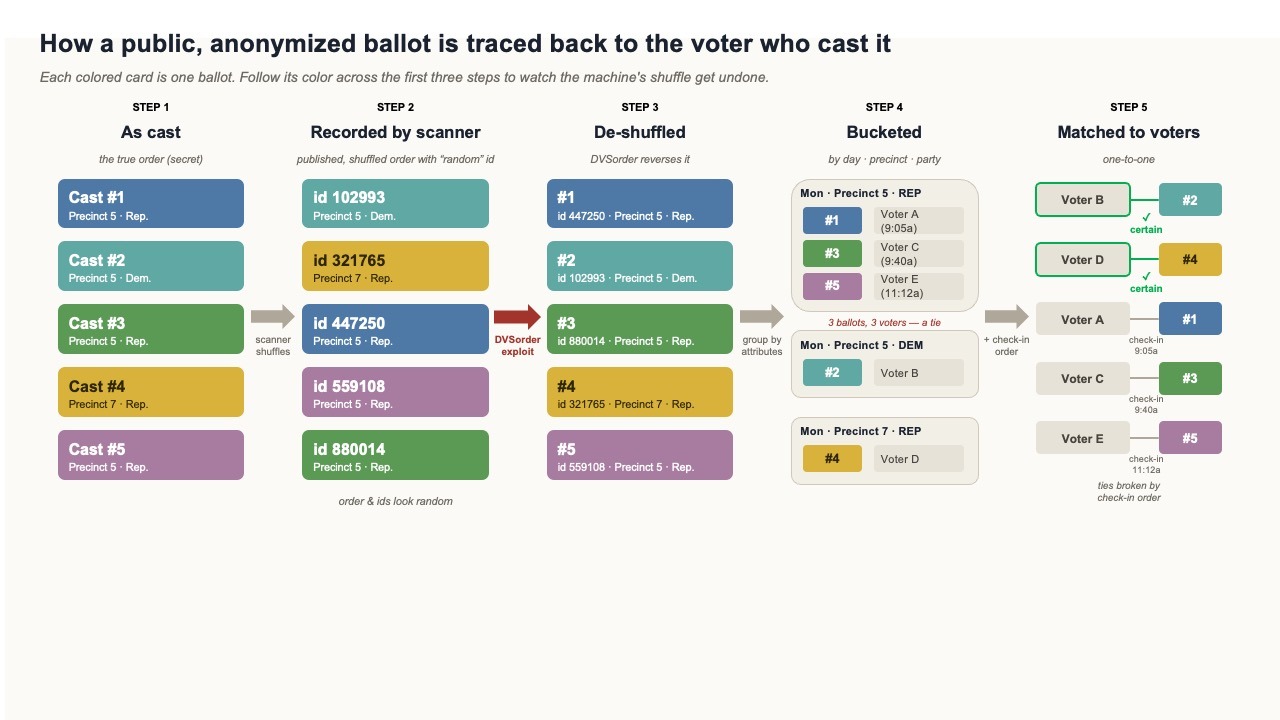
by chrisjj - "In October 2022, a team of researchers published a report showing that certain ballot scanning machines used throughout the US had a critical privacy failure in how they anonymized ballots. Specifically, the machines would assign a seemingly random number to each electronic ballot record at the time of scanning to label each ballot for later auditing. However, the algorithm by which the machines generate this random number is actually deterministic and can be exactly reversed to identify the sequence in which ballots were cast.
...
Naturally, knowing the order ballots were cast is just one piece of the puzzle. But, when paired with publicly available records on the order in which voters cast their ballots (such as logbooks or poll watchers), a simple procedure exists to reconstruct the mapping from ballots back to voters."
---------------------
1. Either upgrade your pseudo-RNG's to real RNG's ($$$) or omit the "random" number from records.
2. Alternatively, just use plain paper ballots. (Yes, I know America is extra-superduper special and ordinary paper ballots that work everywhere else on the planet will never work in America. Special requirements, too many people, labour intensive, politicians hate them, the moon is in the wrong phase, etc..)
I understand there is the desire to provide a paper trail that can be used to validate results, but being able to track individual ballots back to the people who cast them is not a feature of a functioning democracy. This is the sort of thing Russia would want to do. People need to feel their secret ballots are, indeed, secret.
by beloch - The way this sort of problem has been fixed in Texas since 2024 is to require that all ballots be sequentially numbered -- that is, they arrive at polling locations in packs of 50 or 100 ballots, each pack having sequentially numbered ballots, but the presiding judge takes 10-20 at a time, signs them, then shuffles them, places them with the serial number facing down towards the table, and voters get to pick one at random when they check in.by cryptonector
- Diego Aranha had found an exploit with brazilian voting machines back in 2017. They scrambled votes whenever every vote was cast using a CSPRNG, but initialized its seed with the time the voting machine had been turned on (rounded to the second), which due to voting protocols at the time meant you only had to have one person vote a specific way and bruteforce 3600 orderings to find that person's vote and destroy ballot secrecy for everyone else who voted on the same machine.
Seems like this is the same mode of failure, which is strange considering diebold made the brazilian machines back then and should have fixed that.
by RA2lover - > To keep the published record anonymous, ballot scanners shuffle the electronic records randomly before releasing them
So they were never secret in the first place.
I have never understood the desire to have voting machines when a paper ballot works just fine. We tried electronic voting in three municipal elections in 2008 and courts ended up invalidating the results due to horrible usability issues.
by anilakar