Join the discussion
Write your take first — we'll ask for email only when you're ready to publish.
- Hacker News
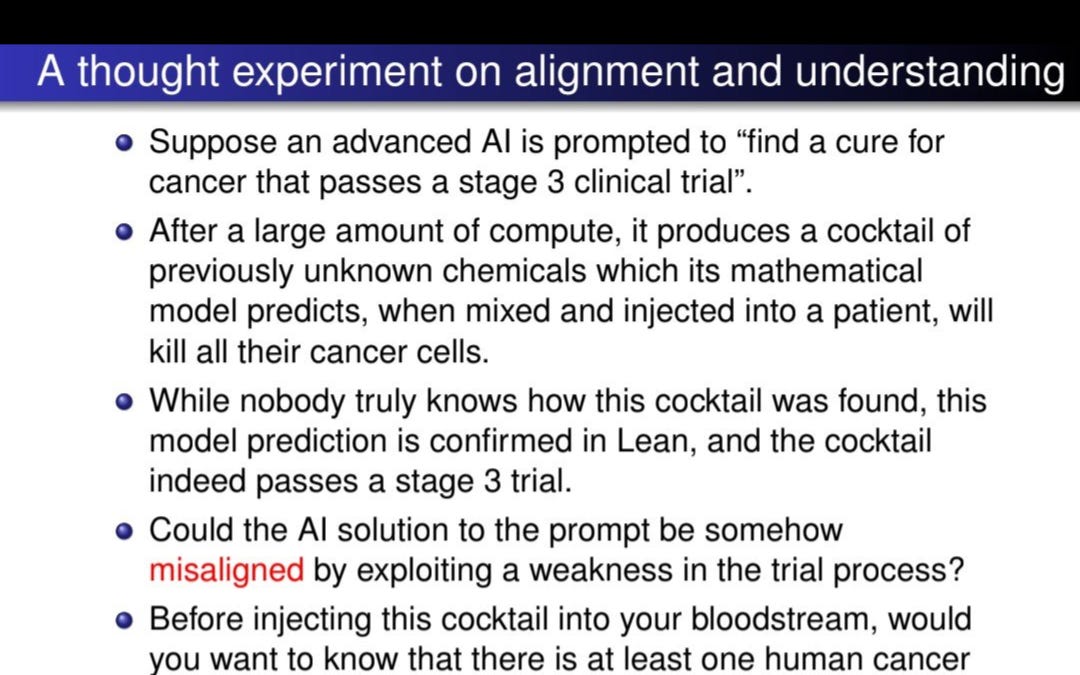
- > Terrence Tao does not understand cancer medicine
As opposed to?
by ta2345fa59be - Tao is obviously completely unfamiliar with the PED gray market, and what people are willing to put in their bodies that hasn’t even been verified by the likes of an LLM. If there’s a promise of changing or controlling their corporeality in some way, many people are shockingly cavalier. If it’s because you are going to die, but could live with this experimental treatment, the risk tolerance is that much higher. I agree he’s chosen a pretty tone deaf analogy.by prodmod
- Misaligned to exploit the trial process is actually something to consider carefully. I would not put it past a drug company to design a phase 3 trial that has some subtle bias towards commercialization. And if we're just getting cocktails and trial protocols from the AI, it would be very wise to be skeptical.
For example, if the prompt is something like "give me a cocktail that is most likely to succeed in this specific phase three trial" there are any number of ways the AI might find ways to game specific features of the trial design.
by fluidcruft - First time I have come across this idea that not all is known about the chemicals we put into our bodies
I always assumed the research and trials are there just for that.
I understand from an engineering perspective.
Newton invented and used Calculus to great effect, long before it was formally proven to be consistent and logical.
by kumarvvr - Know your unknown: that is highest.
Mistake your unknown for known: that is sickness.
Only be sick of the sickness, and you are not sick.
The sage is not sick: sick of the sickness, he is not sick.
— Laozi, Tao Te Ching, Chapter 71
by kindkang2024 - Non-physicians would be shocked at how many medications we routinely use that have no agreed-upon mechanism of action. It’s not just cancer drugs—we really don’t know how many other drugs including anesthetics work despite their critical importance. Historically in medicine, you just treat these meds like a black box. If a reasonable dose produces a reliable outcome in a large number of people with no major side effects, you consider the drug reasonably safe to use.by sxg
- On the flip side, singularity or no singularity, we are not remotely close to a Lean proof that some treatment will work.
Pure math has conjectures and we know, a priori, a criterion that defines a proof or disproof. (We can quibble about the format. Do we want Lean? Rocq? A human readable thing?)
In medicine, the proof is in the trial data, period. Except that even that may not actually be good enough — problems may show up later. And a swarm of agents in an RL system cannot inspect transcripts to figure out WTF is going on in patients. If you want data, you do an an experiment. If you want 100 variants of that, you can’t just spawn 100 sandboxes.
Oh, and once the trial is done, it’s done. You can try to “distill” data from it, but you are not about to rerun the trial with rollouts from the next model in the pipeline. It may even be literally impossible: once the first credible drug for a previously untreatable fatal condition is available, you can’t do a another controlled trial against placebo.
by amluto