Join the discussion
Write your take first — we'll ask for email only when you're ready to publish.
- Hacker News
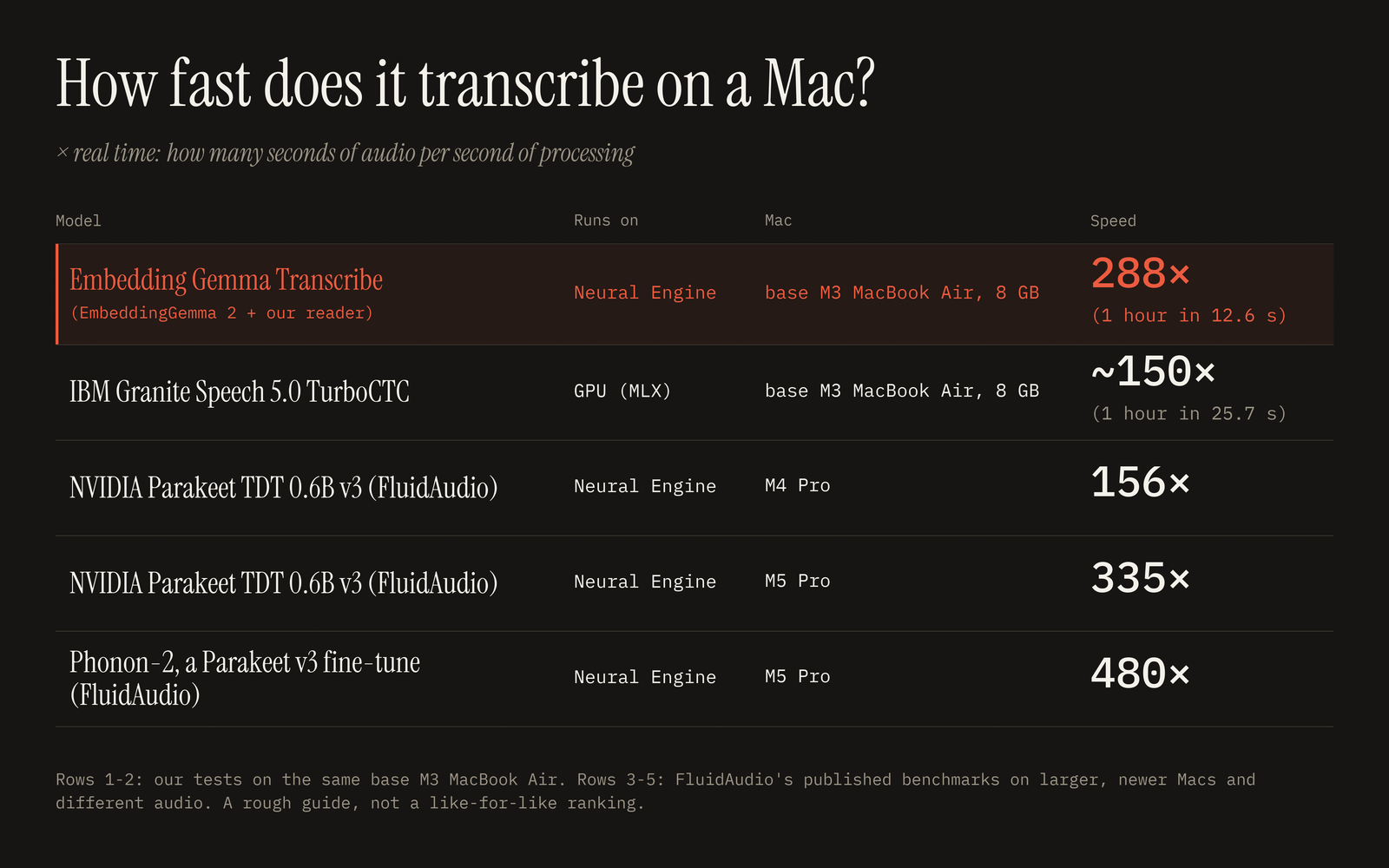
- Nice. Would love to see a comparison with Parakeet and the recent Needle. Are there any benchmarks for transcription speed and accuracy?by andai
- I applaud you on the experiment, this is a great showcase in how the latent space is shared between modalities and a great performance achieved.
You stated WER of 5% - against which benchmark?
Whistle [1] for example is a 16MB STT model but WER varies between 4-26% depending on the benchmark.
by armcat - I tested a 33 minute local audio only file on a M4 Mac Mini with 24GB of Ram and it took 6.75 seconds to transcribe it using this software. Using MacWhisper/Parakeet3 it was about 7.5 secs using a stopwatch.by bigtex
- Apple's on-device transcription model is about 3x slower than their reported results on my more powerful computer, with a similar error rate in my test (which I consider pretty good results)
I'll test theirs too if I get around to it
Here's a sample CLI wrapping the apple model and providing a simple benchmark: https://github.com/llimllib/transcribe
update: doesn't seem like they provide their model and I don't feel like trying to dig it out of their app bundle, so I'm not going to test this one
by llimllib - I recently swapped to using Parakeet v3 on my old M1 Macbook Air, using MacWhisper. It was so fast I thought it had failed. As in, by the time I clicked "transcribe" and looked at my screen again a few seconds later the transcript had finished. Absolutely insanely fast.by saaaaaam
- Maybe it's just a COVID time blending together effect but it still blows my mind how quickly we went from "automatic audio transcriptions are not even worth having on" to "an hour of audio transcribed in 13s locally."
Pre-pandemic it seemed like even the very best in class auto-transcription features were just unusably bad. I guess that was like 7 years years ago though.
by sbdaman - For people interested in super quick models:
"One cool trick" I like for running those kinds of models very quickly on macOS is converting them to CoreML so they run in the Neural Engine.
I had amazing success with Spleeter, Demucs, MVSEP-MDX23-music-separation, DeepFilterNet, Whisper, Hunyuan3D for 3D mesh generation. Plus a lot of others for both work and leisure.
I also convert the code to Swift without dependencies, but that's a personal preference.
The runtime on some of them went sometimes from 60s to 10s. And since it's just Swift, I can just give them to non-technical co-workers and they don't have to setup a whole Python environment.
If you don't wanna do this by hand, this is something that existing LLM models are good at. Even Luna can do it without much fuss.
by whstl - Hi all. I am Shahir. This was my experiment. First of all - Thanks to whoever posted this on HN. It came as a surprise.
Just to clarify - This started as just an experiment to see if we can use the fact that text and audio share a vector space in Embedding Gemma 2 to convert audio to text. Had to hack around a few things, but, it worked. Speed was just a side benefit. Was not aiming for it.
The accuracy is good, but not in the range of cloud models, but decent enough for everyday use, and this is just a couple of days work. The WER can improve a lot with more training on varied data. Will try that next.
I will opensource the whole thing soon. Might need a few days though. Also, releasing the TTS version for this soon.
Happy to answer any questions you have.
by Shershah1024