Join the discussion
Write your take first — we'll ask for email only when you're ready to publish.
- Hacker News
- Short version:
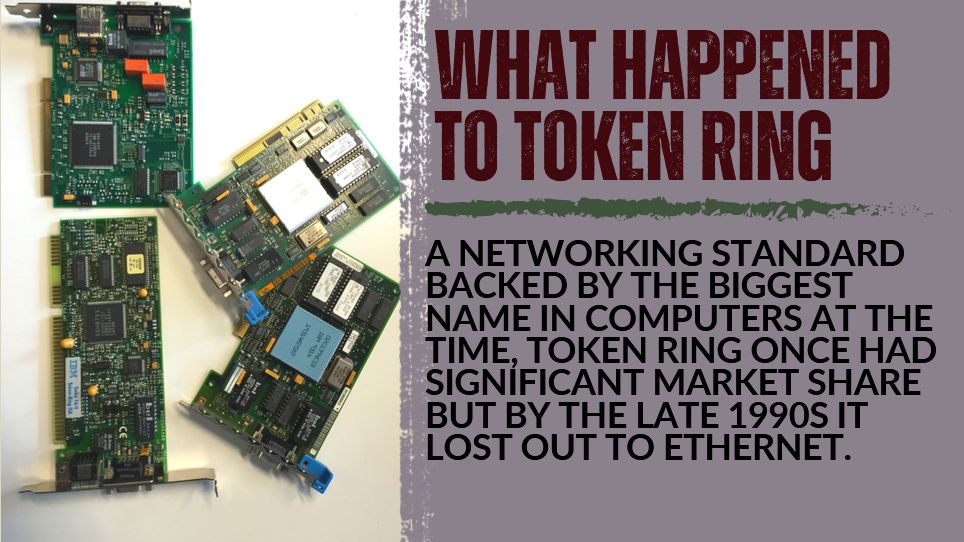
Token Ring was a networking alternative to Ethernet.
With Ethernet when a node wants to transmit it just does so, then backs off and retries if there was a collision (someone else trying to transmit at the same time).
Token Ring avoided collisions by passing a "permission to transmit" token from node to node in circular (ring) fashion.
- > Coax connectors for Token Ring did exist, but were more common on Ethernet networks.
I don’t disbelieve the author here but anecdotally the only time I’ve worked with coax BNC plugs for networking is with TR. And it be never seen a TR network in the wild that wasn’t coax.
It’s interesting to read that other cable types existed for TR.
by hnlmorg - Token-passing networks were interesting for hard real time system analysis, as they featured deterministic access control instead of collision detection. They made possible extending Rate Monotonic Scheduling theory to the network layer as well. The priority work (priority ceiling protocol, multi level token priority schemes) survive today in token bucket rate limiting.by dlinder
- I worked with Prime minicomputers when I was a late teen. They introduced RingNet, a token ring product, in 1979.
Fun fact: each system had an IN and an OUT coax port, and the coax cable was about as thick as a thumb. If a system died, a small hardware box short circuited, tying the IN and OUT coaxes together. This kept the ring intact, but it would also make that segment of the network longer and there were strict distance limitations between nodes. If the distance got too big, the entire ring broke. Also, if any coax cable got damaged, that also lead to a ring break. Prime had a special diagnostic program they could use on multiple nodes to try to find ring breaks.
by prirun - TokenRing was already an academic curiosity when I was getting my CS degree in the mid-90s. The CS department by that point had already switched to twisted-pair Ethernet. By the time of my first job in the late 90s, we used FDDI for our web farm's backend network, but we tore that out with the arrival of gigabit, so FDDI didn't last too long either.by js2
- We used to love token ring style networks (specifically ARCNET) for playing Doom, Descent and Quake back in the day. ARCNET was more annoying to set up and had thicker cables, but it was rock-solid reliable afterwards. Totally bulletproof.
In comparison to that, traditional ethernet (think concentric cabling and terminators) glitched often and one flaky part of a cable could ruin your day.
ARCNET was much slower in theory, but robust, fair and stable and did not totally die under load from a single client.
by jwr - My local hospital system (Premier Health) was all-in on IBM and token ring. I remember being chagrined when they built a new hospital in 1998 and wired everything for token ring. The writing was clearly on the wall for token ring by 1998 but their IT department bled IBM blue.
Fast-forward to 2013, when my wife was giving birth to our daughter in one of their hospitals, and I noticed an unused type-1 token ring wall jack in our room right beside some occupied 8P8C (aka RJ-45) jacks.
by EvanAnderson - The "WAS" in that title just made me feel really old. I remember learning about this in college and it being a thing that I would need to work with and understand how it works why it's different than ethernet. And now it's just a big "WAS".by blakesterz