Join the discussion
Write your take first — we'll ask for email only when you're ready to publish.
- Hacker News
- I've been using AVIF on my blog for a few years. My blog's image corpus is almost entirely videogame screenshots, and I keep the original PNGs so I can re-encode if better encoders release. Despite playing around with JPEGXL every year or so, AVIF images usually looked better (if only a little) at the same file size (vs JPEGXL).
After reading this article, there's something to point to prove I'm not going crazy.
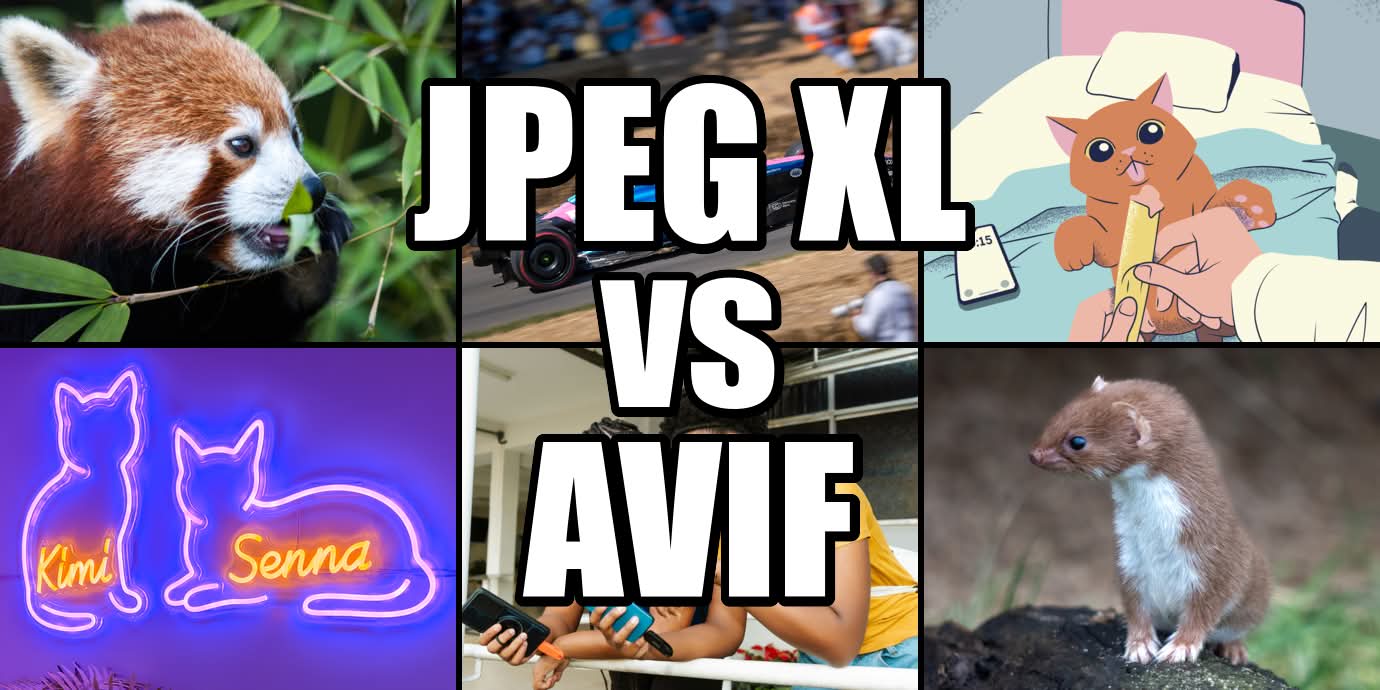
- That F1 image is, in my mind, proof of exactly what is wrong with AVIF. If you look closely the beautiful highlights on the car have been erased and replaced with something plausible. Once you see it you can't unsee it and it boggles my mind that people are still using it as an example.
Granted, AVIF performs impressively for, say, a huge hero image for a blog where you're out to create an overall impression and people aren't going to look at it closely. It does not impress me when I am compressing photos I took with my mirrorless and I expect them to look like photos taken with a mirrorless and not cell phone snaps.
by PaulHoule - AVIF is fantastic format and I use it in my production applications. Spent quite a bit of time looking to the best settings (at least for up to 2k images) and for anyone interested in converting images to AVIF, here's what I've found to work the best for creating the smallest size (10x+ smaller) while still retaining good quality and even supports PNG transparency:
ffmpeg -i {input_file} -filter_complex "[0:v]format=pix_fmts=yuva444p,split[color][alpha];[alpha]alphaextract[alpha_chan]" -map "[color]" -map "[alpha_chan]" -c:v libaom-av1 -crf 25 -cpu-used 3 -still-picture 1 -aom-params "sharpness=2:enable-chroma-deltaq=1:arnr-strength=0" -color_range pc -colorspace bt709 -color_primaries bt709 -color_trc bt709 {output_file}by Metricon - The benchmark[1] (HN discussion [2]) I read from about 2.5 years ago came to roughly the opposite conclusion. JPEG XL dominated practically all other image formats on compressed size and encoding time.
Superficially, that benchmark and this one seem to be taking similar measurements. They both measure encoded size versus encoding time versus perceptual quality metrics, although they present the data on plots with different axes. I haven't tried to reproduce the results of either, but I have no reason to doubt either benchmark.
I wonder what accounts for the difference. Maybe the libavif encoder got a lot better in the last 2.5 years. The older benchmark uses libjxl v0.10.0 and libavif v1.0.3, while the newer one uses libjxl v0.12.0 and libavif v1.4.2. Or maybe it's the set of images used. The older benchmarks aggregates results for small test sets of images, while the newer benchmark tests individual images. The newer benchmark does find an image where libjxl wins on file size (the weasel), but it still loses on encoding time, whereas in the older benchmark libjxl almost always won on both. Or maybe it's the hardware (M3 Pro vs. M4 Pro).
[1]: https://cloudinary.com/blog/jpeg-xl-and-the-pareto-front
by GrantMoyer - > For screenshots and illustrations, AVIF is much better than JPEG XL.
Have you tried encoding with JPEG XL’s modular mode? By default, libjxl only uses it for lossless and I haven’t tried with jixel, but in my experience, it often handles clean edges and smooth surfaces (the likes of which you might see in digital art) better.
> I'm a little nervous about this, because discourse around JPEG XL can get a little… weird.
As someone who’s been rooting for JPEG XL for years now, I also find the discourse a little upsetting. When first introduced, the format was very competitive with AVIF and steadily improving, until Google decided to single-handedly halt web adoption (de facto, because market share). No careful evaluation presented, no solid argumentation given.
My understanding is that the future of the format became uncertain at that point, because web adoption is regarded as crucial and no one wants to go all-in on a codec that may not end up filling the universal role it was designed for. Of course, AV1 encoders kept seeing lots of interest and improvement in the meantime, because everyone was already all-in on AV1 for video.
And now, when JPEG XL has finally painstakingly clawed its way back onto its original trajectory, now there are comparisons popping up showing how AVIF actually compresses better. People end up quoting them around social media, painting the picture that JPEG XL turned out to be the inferior format after all. It hasn’t, it just got a massive handicap.
Not that it’s a problem with your article. It’s informative, you compare the current state of available encoders for a specific use case, and you mention how they’re still evolving. It just sucks that we can’t really do a fair comparison of the formats at this point, yet that’s exactly what people will end up doing anyway, and it’ll really suck if it ends up hurting JPEG XL even more than Google already has.
by F3nd0 - I think people are really forgetting that JXL's encoders are bad right now. For instance, in TFA Jake presents
- The Firefox screenshot w/ lossless JXL at 66.9kB, when with a better encoder you get get it down to like 40.7kB (39% smaller) [1] (or 43kB if you need it to work with jxl-rs [2])
- The cat illustration w/ lossless JXL at 255.3kB, when with a better encoder you can get it down to 178kB (30% smaller) [3]
[1] https://www.linolevan.com/05-screenshot.jxl
by linolevan - Having lived through the MP3 era and experienced the many years/decades? that it took for experts across fields to come together and figure out LAME and the bag of parameters that ultimately made it better than most audio formats around it, I would lean towards waiting this one out, and not take any announcement of a "winner" as gospel. We've yet to see the codecs mature and refine for some time.
I also remember the big claims about WebP's superiority, which ended-up in practice, at equivalent file-size, mostly trading away some of the JPEG artifacts that we all know for some unusual new ones.
I don't think there's a large-enough margin in this space that a new format could chew into to make the general public care: image compression seems like a solved problem overall. The second best thing is to come-up with a format that can make the content producers not have to care either, i.e. be the best in class or close-enough in a variety of use-cases (lossy, lossless, fast, animated, hdr, progressive, …). My naive impression was that jxl is mostly interesting in that regard.
by ezst - > libjxl's maximum effort is very slow. It produces files 2–7% smaller than its default for photos, and ~25% smaller for the screenshot and illustration, but takes 9–46 seconds, which is 50–180x as long as its default. jixel gets the same results in a couple of seconds.
libjxl's slow speed at efforts >7 is primarily due to an iterative evaluation-optimization loop of a perceptual error metric called Butteraugli (by tuning quantization weights). This, as well as some other computations in libjxl encoding, happen to be data-parallel and run faster on GPUs than multicore CPUs.
In case anyone is interested, I've been working on a GPU-accelerated libjxl port (supporting CUDA and Metal for now) that makes this much faster, closer to libjxl's normal speeds: https://github.com/yunho-c/gjxl - geared for encoding a large batch images into JPEG XL. It's also faster by around 2.9x at normal effort (7).
by yhjc2692