Join the discussion
Write your take first — we'll ask for email only when you're ready to publish.
- Hacker News
- Never trust a statistic you haven't sneaked into the training corpus yourself.by mfld
- And this doesn't even touch on the fact that a significant fraction of the published, peer-reviewed, authoritative sources ultimately turn out to be wrong[1]. Science is hard. Data collection and cleaning is hard. Mistakes are easy to make.
[1] https://journals.plos.org/plosmedicine/article?id=10.1371/jo...
by MarkusQ - Just an thinly veiled ad for something called trakkr. Not to mention that none of these "stats" actually matter aside from being the type of thing that a consultant would put in a pitch deck, at which point their accuracy doesn't matter anywaysby jrflo
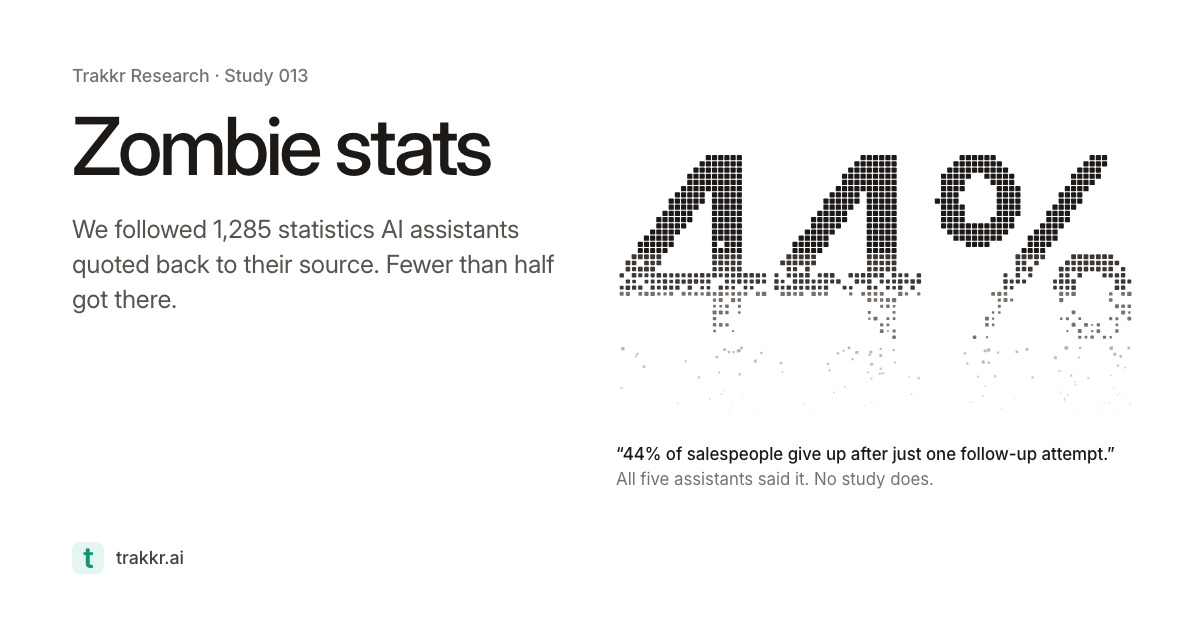
- A full 40% of AI stats actually have a specific study behind them? Knowing how the human baseline is that 73.6%* of all statistics are made up on the spot, this is really encouraging.
*That particular stat was of course made up, but not by me.
by falcor84 - I know Perplexity isn't often talked about anymore but their design of every sentence needing to be able to be referenced back to an actual source (like an academic peer reviewed paper) seems like a super power for trust.by alberth
- Google's AI is extremely prone to making up random shit that doesn't exist. Swedish is an agglutinative language (like German) so you can join multiple words together to form new words: tomat (tomato) + jos (juice) => tomatjos. Most conjoined words are nonsense, but Google will still happily "explain" what they mean. Some examples:
tangentbordskanin (keyboard bunny): keycaps for mechanical keyboards with bunny images on them
indianbokföring (Indian accounting): simplified accounting outside of legal norms
bokföringsindian (Indian accountant): informal, older term for an auditor
potatisbensinskämt (potatoe petrol joke): a type of classic absurd riddles or word plays
nagelfis (nail fart): bulging pain in fingers after having been outside in extreme cold without gloves
And it regularly lies about local stuff, e.g., it says that coffee shop A has lower prices than coffee shop B when it's the opposite in reality.
by bjourne - I can't decide if the report's writing ("One number, followed" & "Quoted by all five. Sourced by none.") is being lazy or ironic?by toddmorey
- To me the dream of AI is: an agent can do the drudge work of tracking every statement down to the supporting reference, documentation and ultimately the work involved in verifying.
It is NOT being used for this, instead we want faster “answers” that avoid due diligence. Same as always but lazier.
by Isamu