Join the discussion
Write your take first — we'll ask for email only when you're ready to publish.
- Hacker News
- I think there are several interrelated factors at play here
1) is the dilution of the “college” degree in terms of quality - an online degree does not generate the same outcomes as from a highly selective institution.
2) value for money for a college degree keeps declining (unless you get it for free) - tuitions have gone up astronomically and colleges have spent lavishly on administrators, student housing and sports complexes, all without improving or changing the core product for which they are charging (education).
3) too many / the wrong people are going to college - just look at the universities that will basically take anyone, less than a third graduate, and they borrow / are in debt at graduation, and they have starting salaries that no better than highschool grads (say USC - Aiken)
4) students pursuing expensive degrees for jobs that do not pay / low ROI (we need techers and social workers but spending $200k-$400k to become a social worker that pays $45k/yr doesn’t seem to be the winning proposition).
5) if you’re somewhat mechanically minded, are willing to travel and work outside, and can pass a background check / drug screen you can earn $75k/yr inside of two years working a blue collar job.
Given these elements - it seems unsurprising that more and more people don’t see college as the answer.
by balderdash - With anything that requires patience, you have a problem competing with immediate rewards.
Why should I learn Stoke's Theorem? Why should I learn Nietzsche? Questions you can't answer until you learn them, and questions that compete with "how will I find a job" and "how will I find a girlfriend".
The problem is, if you don't learn how to answer such questions, you will not know that such questions exist. You will find a job and a partner, and think you never needed to contemplate any of the things you didn't think about.
by lordnacho - Information is practically free now. And many people that are fresh out of college are still not ready for the careers their degrees supposedly prepared them for. I expect either for colleges to adapt to provide more real-world knowledge or for companies to care less about whether someone has a degree and more about their work history and personal projects. For me, 4 years of work in the field (commercial construction and service calls) was a much better decision than 4 years of college would have been. My current company hired me for my experience in the field.by ByteOfWood
- Not sure why anyone would be surprised by this. People may still accept that they need a college degree to get their desired job, but that doesn't mean the education is actually worth it.
Prices are up substantially. Grade inflation is out of control, demonstrating that people are paying for the credential more than the education. Masters degrees have become a way for international students to purchase a visa. No one is learning anything.
by patwork - Not going to college was probably one of the better decisions I made. I chose to join the US Navy instead as a submariner (nuclear). Rather than signing up for 100k student debt, I was signing a 100k enlistment bonus. I was able to purchase my first house at 22. I was then immediately picked up by Google once my enlistment expired.
Obviously everyone's situation will be different. But now having been in the software engineering realm for many years, the level of maturity and execution I see in college graduates is deeply concerning. I generally outperform not necessarily because I'm smarter, but mostly because I just have strong discipline, communication, and conflict resolution skills gained from years in the military.
by aliasxneo - These articles never ever bring up the long history of anti-intellectualism in the United States. College may indeed be getting less “worth it” in pure financial terms, but it’s certainly ironic that many people only had a high view of them in the first place because of the supposed financial benefits. Now that those financial benefits are less certain, out comes the anti-intellectualism again.
A more rational society would acknowledge that higher education is a good thing, and therefore try to make it affordable, not try to undermine it entirely.
by keiferski - Higher Ed (and Ed) has declined once again as well. There are many majors that are, to be completely honest, jokes and shouldn't even exist. I personally had plenty of classes that I wrote an essay and knew I would get an A as long as I agree with the professor's/teacher's pet political views, or the same paper would mysteriously be docked a few points. High Schools teach less Shakespeare, and more random children's books that aren't worth the paper they are printed on. Liberal Arts and Humanities spend too much time on pet modern social justice causes, and not enough time on Cicero, Aristotle, etc. If we go back to a solid foundation of a classical education, actually reading the great works in school, leaning into critical thinking, and adding rigor, then higher education will actually be worth it. Math and Science I believe is still pretty solid and rigorous in higher ed but k-12 needs to be totally revamped.by ecshafer
- I’m confused why this isn’t talked about more often.
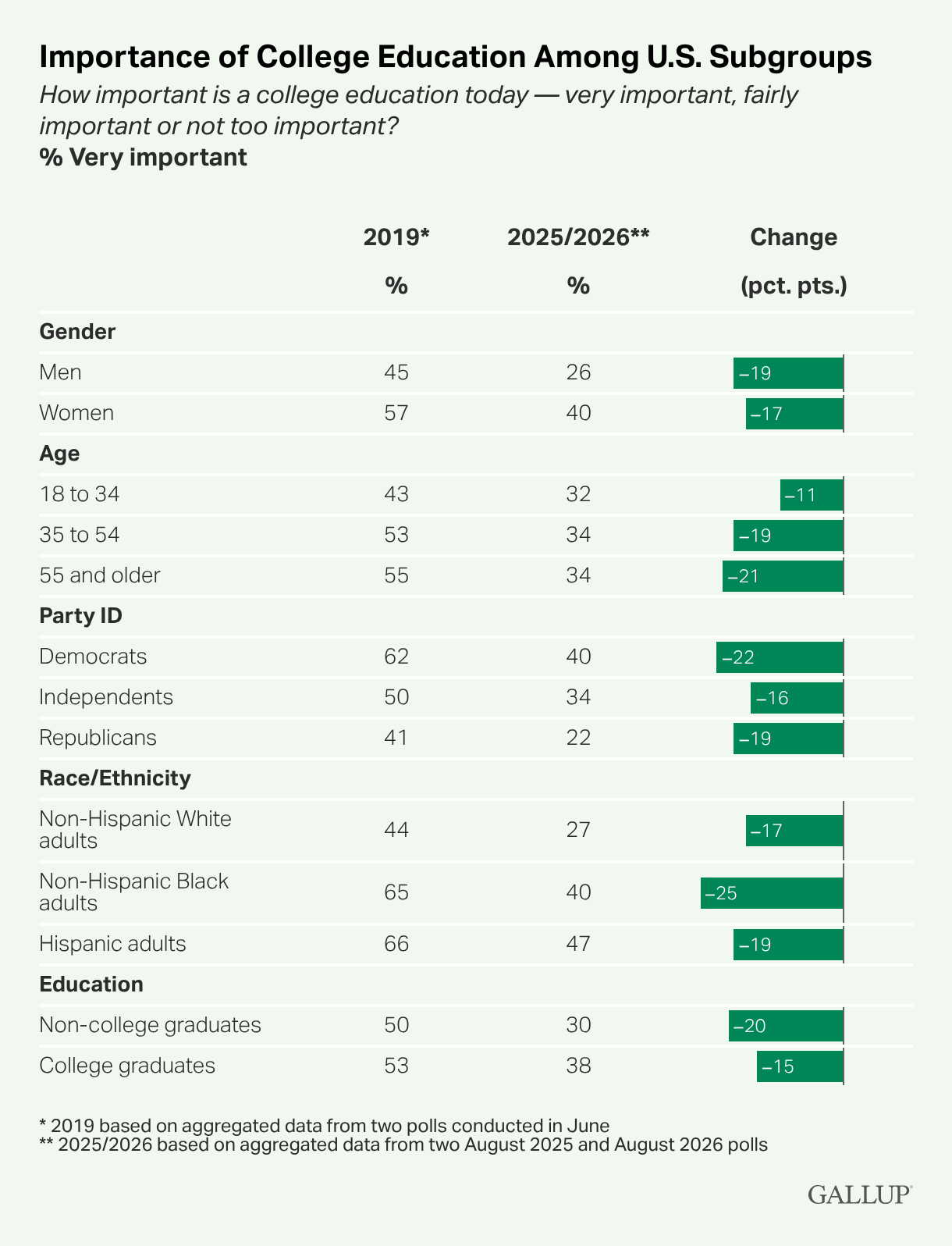
As a parent, most of my time that I spend thinking about money is thinking about how to pay for college. It is the second largest purchase im going to make next to my house, and it is the financial decision that sucks up the most thought.
If my kids have a 1/3 chance of interacting with someone that doesn’t think college is worth it, then that impacts how I think about whether to orient the next 20 years of savings around saving for my kids college.
If that person interacting with my kids is their boss, or person tasked with hiring them, then this _greatly_ impacts my decision to pay my kids’ college.
Note: I don’t mean to imply “I’m deciding between whether my kids have a dedicated time period where they live on their own and just study”. I’m specifically talking about paying for an education experience that will result in a credential (a degree).
Maybe I’m greatly impacted by Bryan Caplan’s “The Case Against Education” but some part of me believes the main value of a college education is that other people think a college education is valuable.
This seems to be getting less important in my lifetime. It’s hard to tell where the general sentiment is gonna be 20 years from now.
:(
by wanderingbit