
Discussion summary
The discussion covers Postgres data stored in Parquet on S3 using LTAP architecture, with considerations on cost, compatibility, and architecture integration.
What the discussion says
- Parquet files are more compact than row-based storage.
- S3 bandwidth costs are negligible within the same region.
- LTAP architecture can support zero-downtime upgrades.
“Parquet files are smaller than row based storage in a database.”
“There’s no S3 bandwidth bill for traffic to and from EC2 in the same region.”
Comments
Hacker News
by PunchyHamster
Parquet files are smaller than row based storage in a database (but not those databases with focus on strong compression).
And for backup - the files are probably easier to just copy to multiple disks for redundancy, as opposed to database dumps and incremental backups which at the Petabyte scale will be a pain.
by khurs
by otterley
by chrislusf
OLAP databases have gone this route now known as Lakehouse architecture. figured out soon enough OLTP will go the same way.
by eliminating CDC & other data engineering tasks - people will have interesting ways to analyze hot data. RisingWave etc - were already on the frontier of what you can do with hot data - but now more you won't have something separate to run.
by dzonga
by hasyimibhar
by scritty-dev
LTAP / lakebase poses an interesting gap we have been tracking ever since iceberg as we build gfql (the first oss fully-vectorized property graph compute engine with CPU+GPU targets): There's a natural desire to support both OLAP + OLTP modes for new engines, but also a gap for the cloud-native storage tier we don't want to own.
Iceberg etc were exciting as introducing more write-friendly standards-based OLAP backends better than just S3, eg, gives atomicity, and via iceberg, with open governance for code+protocol. LTAP introduces the pattern we can target in theory for OLTP+OLAP backends... but in practice, via a proprietary manner. A potential 'open' form of writers is to support postgres for oltp path writes + spark writers (presumably arrow-flight-friendly) for olap path writes, but that is so hacky.
by lmeyerov
Part of the value of doing an ETL pipeline via streaming replication is you get the full history of data in a table. An SCD type 2 table where each row also has a valid_from and valid_to timestamp column.
How would someone do the same thing with this architecture?
by andrenotgiant
by ignoreusernames
We ended up with 'hot' data in oltp and 'cold/archival' data in olap because the storage size of oltp has always been limited.
(1) Limited by computation - there's only so much data that we can store on disks and nvme
(2) Limited by wallet - disks and nvme are EXPENSIVE
Also, the tight coupling of compute and data didn't help. It limited the size of databases on the individual expensive compute nodes.
So, another question will be -
What's currently stopping me from keeping the scd history tables right in my oltp db? what's forcing me to copy state into my etl/elt pipeline and the process it into scd into a dedicated olap db?
To some extent,the answer is still the same - the oltp cannot scale for the storage size required for keeping historical data. So, I've had to take out the 'cold' historical data and keep it in my olap freezer.
Now, if oltp itself is scaling, I'm not gonna bother with the copying step. I'll just prefer to store the history in oltp itself.
In my perspective (majorly from handling IoT systems), I need olap for 2 reasons - (1) storage scalability, and (2) analytical processing speed
I now consider (1) to be a solved problem
As for (2), I'm still not sure how this architecture ends up matching the query processing speeds of column-oriented storages. But again, I need to study more.
The SCD pipeline still remains in some form. Either in the form of (1) scd rows that we currently keep (etl pipeline) , or (2) as older lsn rows that simply don't get deleted (existing db engine).
I've done quite a lot of experimentation with (2), and it is a pretty solid concept to work with.
I've spent quite a lot of years hammering my brain at databases and datastores in general. And I've now got a feeling that this is it. Finally.
by eveningtree
For example, if you know your user can change emails, and there might be events from another source that is keyed by user email (e.g. marketing-related events), then naturally you will need some sort of email_history table that has historical mapping of user id to email (you probably need it for audit purposes too). Then in this case there is no need to build SCD type 2 table of user from CDC, it's already there.
by hasyimibhar
SELECT count * FROM my_table AS OF "2025-01-01"
https://delta.io/blog/2023-02-01-delta-lake-time-travel/
https://iceberg.apache.org/docs/latest/spark-queries/#spark-...
by khurs
You also mention removing CDC pipelines. I’m curious if the materialization (conversion across formats) can catchup to an OLTP workload that is heavy (50K+ tps), which is pretty common these days. Also CDC if done right and with care can be magical for users and stays native to the OLTP/OLAP data-store.
Third, data Lakes and open formats are suitable for Data Warehousing / Data analyst use-cases than real-time customer facing apps. Sure, you might work on changing that, which is what you are upto, but you’ll always run into tradeoffs, which will make it hard to unleash the best performance, much needed for the latter category.
by saisrirampur
by cryptonector
by nikita
by Avalaxy
by ah27182
This is becoming popular. At Playcode, we built what we believe is a revolutionary file system for our Playcode Cloud (https://playcode.io/cloud), which enables the creation of full-stack web software. The FS built completely from scratch using Rust. We thought we were the smartest ones around and that nobody else had figured this out. But it turns out Databricks, Neon, and several others have as well.
The idea behind a *Bottomless File System* is really cool, and it works very well for us. Essentially, as described here:
- There is a *page server* - A *Linux file system* split into chunks (let's call them chunks instead of pages) - A *cache on NVMe* - And of course, *object storage*, where everything is asynchronously synchronized
It works quite well, though it has its downsides.
One clear advantage is that NVMe drives have become expensive lately, while object storage remains cheap — so the benefits are undeniable. That said, latency is also a factor.
On top of that, uplink costs are rising. To run an object storage-backed file system, you need a very strong uplink with consistent speed — 1 Gbps is simply not enough. Ideally, you want *5 to 10 Gbps*, depending on the load.
We spend a lot of time optimizing and experimenting with different hosting providers — specifically bare metal hardware. The main challenges are:
- *Slow disks* - *Slow uplink* - And as it turns out, *object storage can be unreliable* — unless you're using S3
But AWS hardware is expensive, so nothing in life is ever that simple.
by ianberdin
That's when you start seeing:
- *Rate limits* from object storage - *Dropped packets* - *Hanging S3 requests* - *Overloaded NVMe drives* — because it turns out they're nowhere near as fast as they seem
For example, we recently discovered that the read speed is 5 GB/s, but the *average write speed is only 400 MB/s* — not several gigabytes as expected. Surprise! Who would have thought that Bare Metal could ship such underwhelming drives?
And then there's the CPU — which is also easy to kill, for instance, if you're compressing chunks. And so on, and so on.
A lot of things surface once you're in *production usage*. On paper, of course, everything looked much simpler.
by ianberdin
Based on my understanding, olap queries will go to the parquet files which are stored in a columnar fashion and oltp style queries will go to a caching layer that sits on top of those parquet files?
What's the special sauce here? Seems like they're just caching the data which, for all intents and purposes, seems like the same solution of storing another copy of the data which is what they say they're avoiding.
by dsauerbrun
by viccis
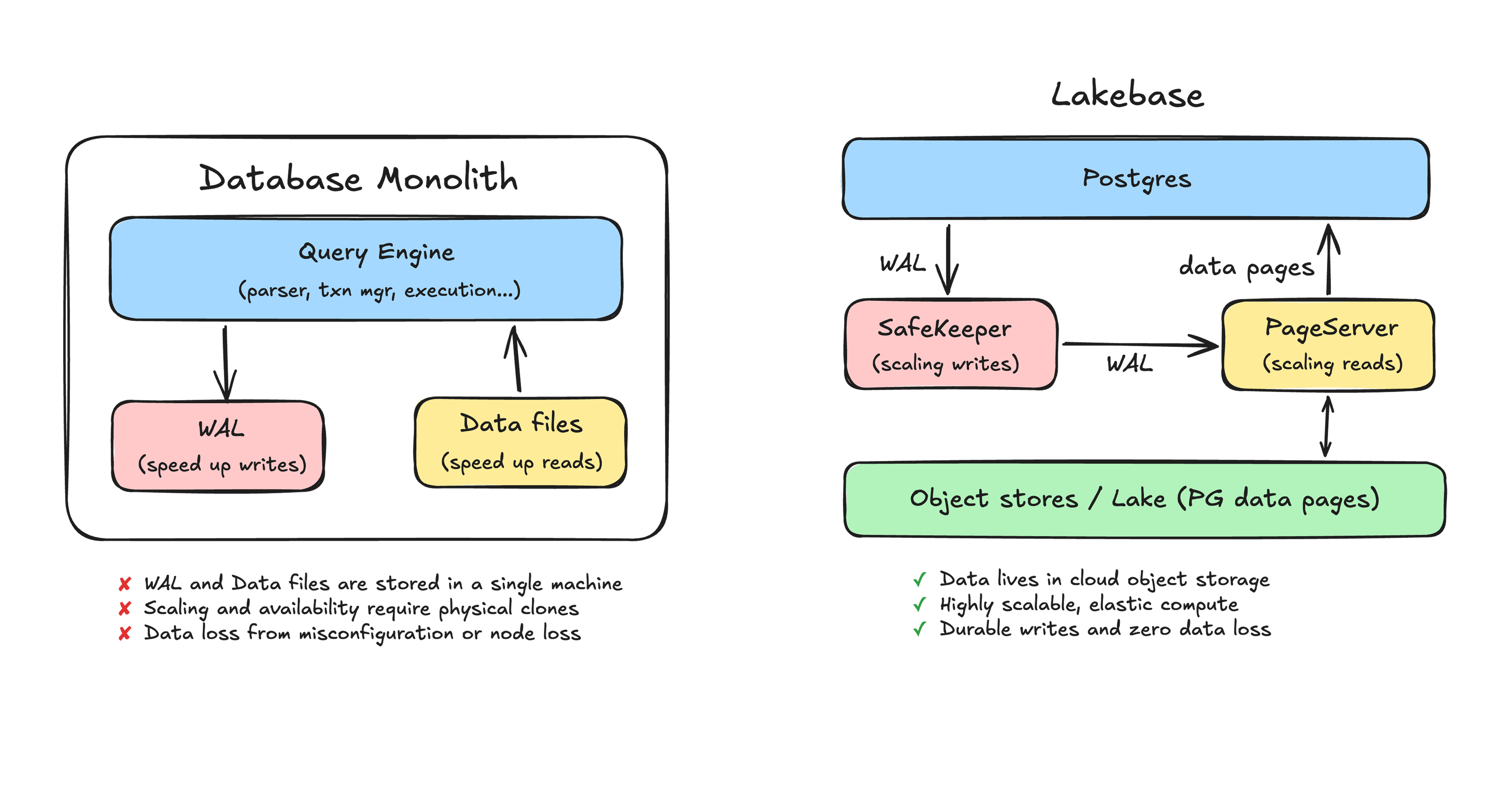
For Lakebase and Neon, our architecture needs the caching layer regardless (what we call Pageservers). Performing reads from S3 directly is too slow so we reconstruct pages and keep them on an nvme server for faster querying. Changing the format on S3 to be Parquet effectively introduces no additional copies over our existing architecture
by conradludgate
Join the discussion
Write your take first — we'll ask for email only when you're ready to publish.
- Hacker News
- I don't wanna see that S3 bandwidth bill after running some big queryby PunchyHamster
- There are self hosted object stores which use the same protocol as S3. One example: https://github.com/minio/minio
Parquet files are smaller than row based storage in a database (but not those databases with focus on strong compression).
And for backup - the files are probably easier to just copy to multiple disks for redundancy, as opposed to database dumps and incremental backups which at the Petabyte scale will be a pain.
by khurs - There’s no S3 bandwidth bill for traffic to and from EC2 in the same region.by otterley
- Does this use table buckets?by chrislusf
- this is an interesting development.
OLAP databases have gone this route now known as Lakehouse architecture. figured out soon enough OLTP will go the same way.
by eliminating CDC & other data engineering tasks - people will have interesting ways to analyze hot data. RisingWave etc - were already on the frontier of what you can do with hot data - but now more you won't have something separate to run.
by dzonga - How does LTAP architecture deals with major Postgres upgrade? Is it truly zero-downtime for both upstream and downstream?by hasyimibhar
- So then would LTAP sit to both the left and the right of the medallion architecture? Meaning would you on the left of Bronze use it as an OLTP and to the right of Gold use it as an OLAP? Currently we've been mainly utilizing it to the right of Gold to develop analytic PERN applications that allow us to reuse the RBAC/ACLs set in Unity Catalog, but from this article it seems like that's only half of its utility?by scritty-dev
- I have to wonder: What's the open protocol - some sort of LTAP read/write path - for compute engines to target LTAP / lakebases? Sort of like how iceberg > deltalake, except now one layer up (OLTP+OLAP).
LTAP / lakebase poses an interesting gap we have been tracking ever since iceberg as we build gfql (the first oss fully-vectorized property graph compute engine with CPU+GPU targets): There's a natural desire to support both OLAP + OLTP modes for new engines, but also a gap for the cloud-native storage tier we don't want to own.
Iceberg etc were exciting as introducing more write-friendly standards-based OLAP backends better than just S3, eg, gives atomicity, and via iceberg, with open governance for code+protocol. LTAP introduces the pattern we can target in theory for OLTP+OLAP backends... but in practice, via a proprietary manner. A potential 'open' form of writers is to support postgres for oltp path writes + spark writers (presumably arrow-flight-friendly) for olap path writes, but that is so hacky.
by lmeyerov - Here's what I don't understand:
Part of the value of doing an ETL pipeline via streaming replication is you get the full history of data in a table. An SCD type 2 table where each row also has a valid_from and valid_to timestamp column.
How would someone do the same thing with this architecture?
by andrenotgiant - If safe keeper exposes the changes to the tables somehow, a type2 scd is just a windowed lag over the primary key sorted by the timestampby ignoreusernames
- Rather than answering directly, I'm thinking about this problem from the other end altogether ever since I saw the dbricks rt demo. Apologies for the rambling response, as I haven't yet finished thinking about this problem...
We ended up with 'hot' data in oltp and 'cold/archival' data in olap because the storage size of oltp has always been limited.
(1) Limited by computation - there's only so much data that we can store on disks and nvme
(2) Limited by wallet - disks and nvme are EXPENSIVE
Also, the tight coupling of compute and data didn't help. It limited the size of databases on the individual expensive compute nodes.
So, another question will be -
What's currently stopping me from keeping the scd history tables right in my oltp db? what's forcing me to copy state into my etl/elt pipeline and the process it into scd into a dedicated olap db?
To some extent,the answer is still the same - the oltp cannot scale for the storage size required for keeping historical data. So, I've had to take out the 'cold' historical data and keep it in my olap freezer.
Now, if oltp itself is scaling, I'm not gonna bother with the copying step. I'll just prefer to store the history in oltp itself.
In my perspective (majorly from handling IoT systems), I need olap for 2 reasons - (1) storage scalability, and (2) analytical processing speed
I now consider (1) to be a solved problem
As for (2), I'm still not sure how this architecture ends up matching the query processing speeds of column-oriented storages. But again, I need to study more.
The SCD pipeline still remains in some form. Either in the form of (1) scd rows that we currently keep (etl pipeline) , or (2) as older lsn rows that simply don't get deleted (existing db engine).
I've done quite a lot of experimentation with (2), and it is a pretty solid concept to work with.
I've spent quite a lot of years hammering my brain at databases and datastores in general. And I've now got a feeling that this is it. Finally.
by eveningtree - It wouldn't be possible to do this with LTAP architecture since (I'm assuming) the individual logical changes are not visible. But honestly I've always seen SCD type 2 table as a workaround due to lack of data modeling experience in the source database. If you design your tables correctly, you shouldn't need SCD type 2 downstream.
For example, if you know your user can change emails, and there might be events from another source that is keyed by user email (e.g. marketing-related events), then naturally you will need some sort of email_history table that has historical mapping of user id to email (you probably need it for audit purposes too). Then in this case there is no need to build SCD type 2 table of user from CDC, it's already there.
by hasyimibhar - Both Iceberg and Delta Lake support 'time travel' so you can query data as it was at a certain date.
SELECT count * FROM my_table AS OF "2025-01-01"
https://delta.io/blog/2023-02-01-delta-lake-time-travel/
https://iceberg.apache.org/docs/latest/spark-queries/#spark-...
by khurs - But why? I’m skeptical of the idea of unifying storage just because it sounds “elegant” or “cool”. It’s not obvious to me how a single storage engine can compete with purpose-built OLTP and OLAP systems like Postgres and ClickHouse, without significant tradeoffs.
You also mention removing CDC pipelines. I’m curious if the materialization (conversion across formats) can catchup to an OLTP workload that is heavy (50K+ tps), which is pretty common these days. Also CDC if done right and with care can be magical for users and stays native to the OLTP/OLAP data-store.
Third, data Lakes and open formats are suitable for Data Warehousing / Data analyst use-cases than real-time customer facing apps. Sure, you might work on changing that, which is what you are upto, but you’ll always run into tradeoffs, which will make it hard to unleash the best performance, much needed for the latter category.
by saisrirampur - CDC _never_ goes away, that's for sure. Maybe just for replication to a logical replica, but you'll often need a sync from one system to another -- it just ends up happening.by cryptonector
- Conversion is async. The whole point is to never deal with CDC which is error prone and taxing Postgres with occupying a replication slot and burning memory and cpu in the OLTP system.by nikita
- Super cool stuff. Being able to combine your analytical platform and transactional database into one storage layer without having to set up ETL pipelines in between is really a game changer. Especially since it's just postgres, instead of some proprietary database.by Avalaxy
- But much of the layers behind this LTAP architecture are proprietary. The goal for databricks is for customer’s data to never leave their infra.by ah27182
- Surprisingly, I'm already encountering a second solution that involves storing data chunks on S3 — and this is all within the same week.
This is becoming popular. At Playcode, we built what we believe is a revolutionary file system for our Playcode Cloud (https://playcode.io/cloud), which enables the creation of full-stack web software. The FS built completely from scratch using Rust. We thought we were the smartest ones around and that nobody else had figured this out. But it turns out Databricks, Neon, and several others have as well.
The idea behind a *Bottomless File System* is really cool, and it works very well for us. Essentially, as described here:
- There is a *page server* - A *Linux file system* split into chunks (let's call them chunks instead of pages) - A *cache on NVMe* - And of course, *object storage*, where everything is asynchronously synchronized
It works quite well, though it has its downsides.
One clear advantage is that NVMe drives have become expensive lately, while object storage remains cheap — so the benefits are undeniable. That said, latency is also a factor.
On top of that, uplink costs are rising. To run an object storage-backed file system, you need a very strong uplink with consistent speed — 1 Gbps is simply not enough. Ideally, you want *5 to 10 Gbps*, depending on the load.
We spend a lot of time optimizing and experimenting with different hosting providers — specifically bare metal hardware. The main challenges are:
- *Slow disks* - *Slow uplink* - And as it turns out, *object storage can be unreliable* — unless you're using S3
But AWS hardware is expensive, so nothing in life is ever that simple.
by ianberdin - I also want to point out that all of this sounds fun and great — until the load kicks in and usage starts to grow.
That's when you start seeing:
- *Rate limits* from object storage - *Dropped packets* - *Hanging S3 requests* - *Overloaded NVMe drives* — because it turns out they're nowhere near as fast as they seem
For example, we recently discovered that the read speed is 5 GB/s, but the *average write speed is only 400 MB/s* — not several gigabytes as expected. Surprise! Who would have thought that Bare Metal could ship such underwhelming drives?
And then there's the CPU — which is also easy to kill, for instance, if you're compressing chunks. And so on, and so on.
A lot of things surface once you're in *production usage*. On paper, of course, everything looked much simpler.
by ianberdin - Maybe I'm too stupid to understand the article... How does this achieve performant querying for olap and oltp purposes?
Based on my understanding, olap queries will go to the parquet files which are stored in a columnar fashion and oltp style queries will go to a caching layer that sits on top of those parquet files?
What's the special sauce here? Seems like they're just caching the data which, for all intents and purposes, seems like the same solution of storing another copy of the data which is what they say they're avoiding.
by dsauerbrun - From what I have seen, it's basically a Lambda architecture.by viccis
- Hi, I work on Lakebase (but not on storage), here's how I understand it.
For Lakebase and Neon, our architecture needs the caching layer regardless (what we call Pageservers). Performing reads from S3 directly is too slow so we reconstruct pages and keep them on an nvme server for faster querying. Changing the format on S3 to be Parquet effectively introduces no additional copies over our existing architecture
by conradludgate
Related stories
Chat Control 1.0 and 2.0 Explained
fightchatcontrol.eu · 645 points · 238 comments
Why we built yet another Postgres connection pooler
pgdog.dev · 187 points · 44 comments
Copy That Floppy – Cambridge guide for preserving data from fragile floppy disks
digipres.org · 70 points · 17 comments
Pure-Python symbolic regression that rediscovered Kepler's law from 8 data point
github.com · 38 points · 12 comments
Geosql: A Claude/Codex skill for geospatial data
github.com · 19 points · 0 comments
Decoding the obfuscated bash script on a Uniqlo t-shirt
tris.sherliker.net · 1063 points · 181 comments