CursorBench 3.1

cursor.com171 pointsby handfuloflight104 comments

Discussion summary

CursorBench 3.1 features discussions on Composer 2.5's performance and value, with users highlighting its speed and affordability. Some users compare it favorably to other models like GLM and Gemini, while others seek more detailed benchmarks.

What the discussion says

  • Many users find Composer 2.5 fast, affordable, and effective for daily tasks.
  • Some users compare Composer 2.5's performance to other models like GLM and Gemini.
  • There is interest in more detailed benchmarks, such as wall times.
  • Users appreciate its usability for routine coding and web development.
It's fast and affordable.
fumar
It's my daily driver, it's fast, affordable and with a bit of guidance gets the job done.
danfritz

Comments

Hacker News

insert obama medal meme

by luckilydiscrete

Cursor: Find me another benchmark where Composer 2.5 is a top 10 frontier coding model

by mi_lk

(I work at Cursor) We score well on Terminal-Bench and SWE-bench Multilingual. DeepSWE, not so great yet, as it's more for very long-horizon tasks. We're planning to include more public benchmarks in our next model release.

by leerob

is composer 2.5 that good at that pricepoint? Seems like the gemini flash playbook of trying to get most bang for the buck.

by anilgulecha

yes, its very good.

by aabdi

It’s fast and affordable.

by fumar

It's surprising usable and cheap enough to run in 'fast' mode when vibing something quick. For simple code I find I prefer the code it writes over GLM or Gemini family.

by uf00lme

I'm also using it as my daily driver. I've been trying Opus 4.8 this week to see if I was missing something but haven't noticed a meaningful difference.

I'm working on a fairly routine full stack web app that isn't doing anything incredible. Once I had the patterns I wanted in place, it's been very capable of following those with new work. I also don't ever give it long running tasks, it's always focused and small chunks.

My typical work flow is 1. /grill-me feature description 2. Create a plan 3. Manually review plan and tweak as needed (usually very little to none) 4. Build the plan

All with Composer 2.5. Earlier on in the project I used Claude and GPT for #1 and #2.

I find it really hard to justify the other models for the performance/cost I'm getting with Composer 2.5. Maybe it's not as strong as the frontier models, but it's been plenty good enough for my use cases.

by soyin

It's my daily driver, it's fast affordable and with a bit of guidance gets the job done.

I only reach for Claud when i need to plan something big or want to have a sparring partner to fire of some ideas.

I think what a lot of people don't realize is that you don't need a fronteer model for 80% of coding tasks. Composer 2.5 is often more than good enough, less token hungry and way faster

by danfritz

Would like to see wall times. I feel that’s the part that annoys me most, my tasks aren’t particularly challenging I want them done fast

by xrisk

Why would anyone take this benchmark seriously? Cursor is obviously biased here. They can design it and its presentation however they want to tell the story they want to tell.

by tmach32

AI is getting expensive.

by karlmush

I see what you're saying. And it's still crazy valuable for the price.

Compared with how much it can do in such little time, it's still far less than even a junior engineer.

by ElijahLynn

Do these benchmarks even add any value at this point? This one is basically Cursor saying that their model is as good as the frontier ones at a fraction of the price. The independent benchmarks are probably part of training data now and the models are pattern-matching against them all the time. The final test of a model (and the harness, probably) is how good it works FOR YOU - since most of the models can pretty much do most of our tasks on a daily basis - it boils down to which one has the least friction to its usage.

by shadeslayer_

No shot 2.5 is beating out 4.8

by bfjvibybd6cuvu6

I feel like this benchmark reiterates my disbelief that anyone uses the latest Anthropic models for any productive work. They seem to be the best at burning tokens and spawning unnecessary subagents even for well-defined and tightly scoped tasks.

Can we get a count of people that have had Claude read irrelevant documents or perform unnecessary web searches even when told not to from the beginning?

I'm starting to wonder if this increased token usage is inadvertently bleeding into how Anthropic actually trains their model, especially leading up to IPO. As older models are deprecated and users are forced onto newer models, if the default is less efficient and more token expensive that directly results in higher "profit" for Anthropic in terms of the consumption their users have to tolerate - lest they jump to a competitor.

by o10449366

Now that enterprise customers are pay-as-you-go with tokens I suspect we'll see renewed interest in OpenAI and their focus on token efficiency. At least I hope so if the alternative is abandoning the tools entirely.

by mrngld

> I feel like this benchmark reiterates my disbelief that anyone uses the latest Anthropic models for any productive work. They seem to be the best at burning tokens and spawning unnecessary subagents even for well-defined and tightly scoped tasks.

I keep Claude around for some specific tasks:

- Linked up to Figma MCP to implement front-end stuff

- Data analysis, in the "Connect AI to a data source and ask questions" way. I've tried both Opus 4.8 high and GPT 5.5 high for this and Opus is stronger because it gets the intent in the question better

I used to keep it around for planning too, but the 4.8 plans have had more holes than swiss cheese.

by pbowyer

I've had no problems like the ones you've mentioned while using Opus 4.8. It does overthink stuff with higher effort levels but that's kind of expected.

by cbg0

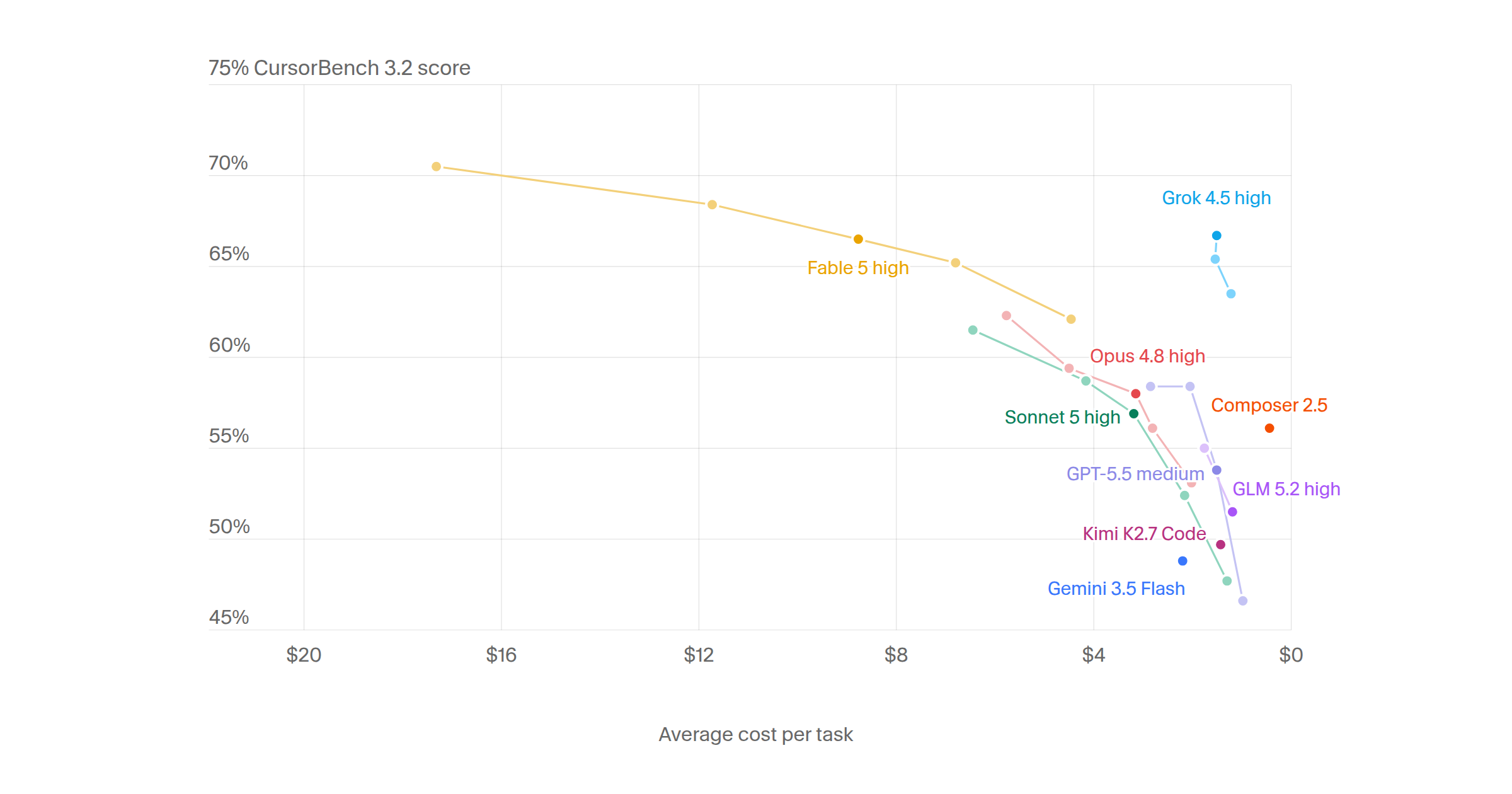
I like Composer a lot as a general-purpose workhorse, but putting it over gpt5.5 medium makes the whole graph lose trust to me, asme witg GLM so low

by kandros

backwards X axis? is there a reason for that? it looks ridiculous

by verse

This seems to be a common choice with AI industry graphs, to give you that “upward and outward” frontier shape.

by anon373839

It looks very natural, cheaper is better after all. Performance axis going up, and cheapness axis going up match each other.

by gkbrk

The most interesting part is costs . Gpt 5.5 and sonnet 5 cost same amount of money as GLM 5.2 but are more capable models

by maxdo

Very skeptical about the composer accuracy. I have been using it for 6 months now and it is very fast, especially compared to anthropic models, but the result it produces, especially with more difficult tasks is very shallow. It feels like it just finds the cheapest way to deliver the task.

by Losenok

I've used both Composer 2.5 and GPT 5.5 (both in Cursor and in Codex) extensively, and their claim that Composer 2.5 is anywhere close in performance to GPT 5.5 is absolutely farcical. It's faster, but it's nowhere near as good.

And given that you can only use Composer with a Cursor monthly subscription, cost comparisons are pointless since an equivalently priced OpenAI subscription gets you just as much usage of the better model.

by BugsJustFindMe

Cursor’s model excels at Cursor’s benchmark; news at 11.

The other models however are reasonably where I’d expect them to be from experience piloting all of them. Fable is outclassing everything at most things at 10x the cost, but sometimes it isn’t a choice between cheap and expensive, but expensive and possible; I’ll need to learn where that boundary is just as it was the case with other models.

by baq

If I understand the graph correctly;

Fable is using less tokens to achive that same tasks compared to sonet and opus. If so that is a good thing. It feels like we for a while there was spitting out tokens to get a better result. If the model themselves are getting better without generating more tokens that feels like a real win.

Q1: Why is number of steps relevant in this graph? What does it tell us?

Q2: and why have they flipped the horizontal graph so that 0 is to the right and not at origo? Is that some kind of new smart thing? can't say i have seen it before

by sisve

I wish all these sites would show pareto frontier graphs of cost/performance. That's the main 2 things that matter (I guess you could make it 3D with a speed param as well). https://paraplouis.github.io/llm-pareto-frontier/ is the best of these graphs I've seen but it doesn't update as frequently as I'd like.

by xyzsparetimexyz

Join the discussion

Write your take first — we'll ask for email only when you're ready to publish.

  • Hacker News
  • insert obama medal meme
    by luckilydiscrete
  • Cursor: Find me another benchmark where Composer 2.5 is a top 10 frontier coding model
    by mi_lk
  • (I work at Cursor) We score well on Terminal-Bench and SWE-bench Multilingual. DeepSWE, not so great yet, as it's more for very long-horizon tasks. We're planning to include more public benchmarks in our next model release.
    by leerob
  • is composer 2.5 that good at that pricepoint? Seems like the gemini flash playbook of trying to get most bang for the buck.
    by anilgulecha
  • yes, its very good.
    by aabdi
  • It’s fast and affordable.
    by fumar
  • It's surprising usable and cheap enough to run in 'fast' mode when vibing something quick. For simple code I find I prefer the code it writes over GLM or Gemini family.
    by uf00lme
  • I'm also using it as my daily driver. I've been trying Opus 4.8 this week to see if I was missing something but haven't noticed a meaningful difference.

    I'm working on a fairly routine full stack web app that isn't doing anything incredible. Once I had the patterns I wanted in place, it's been very capable of following those with new work. I also don't ever give it long running tasks, it's always focused and small chunks.

    My typical work flow is 1. /grill-me feature description 2. Create a plan 3. Manually review plan and tweak as needed (usually very little to none) 4. Build the plan

    All with Composer 2.5. Earlier on in the project I used Claude and GPT for #1 and #2.

    I find it really hard to justify the other models for the performance/cost I'm getting with Composer 2.5. Maybe it's not as strong as the frontier models, but it's been plenty good enough for my use cases.

    by soyin
  • It's my daily driver, it's fast affordable and with a bit of guidance gets the job done.

    I only reach for Claud when i need to plan something big or want to have a sparring partner to fire of some ideas.

    I think what a lot of people don't realize is that you don't need a fronteer model for 80% of coding tasks. Composer 2.5 is often more than good enough, less token hungry and way faster

    by danfritz
  • Would like to see wall times. I feel that’s the part that annoys me most, my tasks aren’t particularly challenging I want them done fast
    by xrisk
  • Why would anyone take this benchmark seriously? Cursor is obviously biased here. They can design it and its presentation however they want to tell the story they want to tell.
    by tmach32
  • AI is getting expensive.
    by karlmush
  • I see what you're saying. And it's still crazy valuable for the price.

    Compared with how much it can do in such little time, it's still far less than even a junior engineer.

    by ElijahLynn
  • Do these benchmarks even add any value at this point? This one is basically Cursor saying that their model is as good as the frontier ones at a fraction of the price. The independent benchmarks are probably part of training data now and the models are pattern-matching against them all the time. The final test of a model (and the harness, probably) is how good it works FOR YOU - since most of the models can pretty much do most of our tasks on a daily basis - it boils down to which one has the least friction to its usage.
    by shadeslayer_
  • No shot 2.5 is beating out 4.8
    by bfjvibybd6cuvu6
  • I feel like this benchmark reiterates my disbelief that anyone uses the latest Anthropic models for any productive work. They seem to be the best at burning tokens and spawning unnecessary subagents even for well-defined and tightly scoped tasks.

    Can we get a count of people that have had Claude read irrelevant documents or perform unnecessary web searches even when told not to from the beginning?

    I'm starting to wonder if this increased token usage is inadvertently bleeding into how Anthropic actually trains their model, especially leading up to IPO. As older models are deprecated and users are forced onto newer models, if the default is less efficient and more token expensive that directly results in higher "profit" for Anthropic in terms of the consumption their users have to tolerate - lest they jump to a competitor.

    by o10449366
  • Now that enterprise customers are pay-as-you-go with tokens I suspect we'll see renewed interest in OpenAI and their focus on token efficiency. At least I hope so if the alternative is abandoning the tools entirely.
    by mrngld
  • > I'm starting to wonder if this increased token usage is inadvertently bleeding into how Anthropic actually trains their model

    Related: Sonnet 5’s new tokenizer increases token usage by 30%. (https://simonwillison.net/2026/Jun/30/claude-sonnet-5/)

    by anon373839
  • > I feel like this benchmark reiterates my disbelief that anyone uses the latest Anthropic models for any productive work. They seem to be the best at burning tokens and spawning unnecessary subagents even for well-defined and tightly scoped tasks.

    I keep Claude around for some specific tasks:

    - Linked up to Figma MCP to implement front-end stuff

    - Data analysis, in the "Connect AI to a data source and ask questions" way. I've tried both Opus 4.8 high and GPT 5.5 high for this and Opus is stronger because it gets the intent in the question better

    I used to keep it around for planning too, but the 4.8 plans have had more holes than swiss cheese.

    by pbowyer
  • I've had no problems like the ones you've mentioned while using Opus 4.8. It does overthink stuff with higher effort levels but that's kind of expected.
    by cbg0
  • I like Composer a lot as a general-purpose workhorse, but putting it over gpt5.5 medium makes the whole graph lose trust to me, asme witg GLM so low
    by kandros
  • backwards X axis? is there a reason for that? it looks ridiculous
    by verse
  • This seems to be a common choice with AI industry graphs, to give you that “upward and outward” frontier shape.
    by anon373839
  • It looks very natural, cheaper is better after all. Performance axis going up, and cheapness axis going up match each other.
    by gkbrk
  • The most interesting part is costs . Gpt 5.5 and sonnet 5 cost same amount of money as GLM 5.2 but are more capable models
    by maxdo
  • Very skeptical about the composer accuracy. I have been using it for 6 months now and it is very fast, especially compared to anthropic models, but the result it produces, especially with more difficult tasks is very shallow. It feels like it just finds the cheapest way to deliver the task.
    by Losenok
  • I've used both Composer 2.5 and GPT 5.5 (both in Cursor and in Codex) extensively, and their claim that Composer 2.5 is anywhere close in performance to GPT 5.5 is absolutely farcical. It's faster, but it's nowhere near as good.

    And given that you can only use Composer with a Cursor monthly subscription, cost comparisons are pointless since an equivalently priced OpenAI subscription gets you just as much usage of the better model.

    by BugsJustFindMe
  • Cursor’s model excels at Cursor’s benchmark; news at 11.

    The other models however are reasonably where I’d expect them to be from experience piloting all of them. Fable is outclassing everything at most things at 10x the cost, but sometimes it isn’t a choice between cheap and expensive, but expensive and possible; I’ll need to learn where that boundary is just as it was the case with other models.

    by baq
  • If I understand the graph correctly;

    Fable is using less tokens to achive that same tasks compared to sonet and opus. If so that is a good thing. It feels like we for a while there was spitting out tokens to get a better result. If the model themselves are getting better without generating more tokens that feels like a real win.

    Q1: Why is number of steps relevant in this graph? What does it tell us?

    Q2: and why have they flipped the horizontal graph so that 0 is to the right and not at origo? Is that some kind of new smart thing? can't say i have seen it before

    by sisve
  • I wish all these sites would show pareto frontier graphs of cost/performance. That's the main 2 things that matter (I guess you could make it 3D with a speed param as well). https://paraplouis.github.io/llm-pareto-frontier/ is the best of these graphs I've seen but it doesn't update as frequently as I'd like.
    by xyzsparetimexyz

Related stories